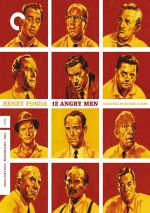
12 Angry Men appears in an aspect ratio of approximately 1.66:1 on this 4K UHD Disc. Though not flawless, the Dolby Vision image looked pretty solid.
The biggest distraction stemmed from grain. Hoo boy, did the movie display a lot of graininess!
That was a consistent presence throughout the film, and it tended to make the image a little murkier than I’d like. However, this was almost certainly a vestige of the original photography. Heavy grain impacted both the DVDs and the prior Criterion Blu-ray, so I suspect that it’s just inherent to the original photography.
The 4K UHD demonstrated consistently good definition. Virtually no problematic soft shots emerged, as the flick appeared accurate and distinctive despite all the grain.
I noticed no issues with shimmering or jaggies, and edge haloes remained absent. Print flaws never marred the presentation.
Blacks were deep and tight, and shadows showed good definition. HDR gave whites and contrast nice punch, even if all that grain restricted them. Overall the presentation impressed.
I also felt reasonably satisfied with the LPCM monaural soundtrack of 12 Angry Men. To call this an unambitious mix would be an understatement.
The track offered very little score, and effects were essentially restricted to the creaks of chairs and the bumps of closed doors. Both sounded acceptable, though they generally were rather thin and without much range.
Speech accounted for every important aspect of the mix. At all times, the dialogue was intelligible and fairly natural.
Some lines could be a bit brittle, but that wasn’t a major concern so speech remained acceptably concise given the track’s age. Nothing here excelled, but the audio was perfectly solid for something as old and low-key as this production.
How did the 4K UHD compare to the Criterion Blu-ray from 2011? Both came with identical audio.
As for the Dolby Vision UHD, it lost some light edge haloes and print flaws from the Blu-ray and also boasted stronger blacks and definition. Though the grainy source meant this never became a visual showcase, it represented the movie well.
The 4K UHD repeats the 2011 BD's extras on a separate Blu-ray disc, and we open with the television version of 12 Angry Men. Directed by Franklin Schaffner, this one runs 50 minutes, 42 seconds. Obviously it’s a quicker, rougher take on the story, and it’s significantly less satisfying.
I’d love to have seen the TV version first, as I imagine it’d be more enjoyable when seen without comparison to the more polished movie. The TV edition certainly isn’t bad, and both clearly share many similarities.
The feature film simply feels more complete, like it’s a final product and the TV version’s a rough draft. It’s great to see the TV movie and it’s certainly interesting, but it’s not nearly as good as the theatrical version.
(Note that most of the cast is unique to the TV version, but two actors would reprise their roles in the feature film. The 1957 edition brings back Joseph Sweeney and George Voskovec.)
We can watch an introduction from Paley Center for Media curator Ron Simon. He chats for 14 minutes, four seconds as he discusses TV in the mid-1950s as well as aspects of the era’s live drama and this version of 12 Angry Men. Simon delivers a nice overview of details related to the TV production and its participants.
A few featurettes follow. From TV to the Big Screen goes for 25 minutes, 33 seconds and provides notes from film scholar Vance Kepley as he looks at the TV version, the development of the big-screen adaptation, cast, crew and the shoot, the film’s reception, influence and legacy.
At the start, Kepley tends to repeat info we heard from Simon’s piece, but once he heads toward the feature film, he gets into unique material. Kepley covers all the bases well and creates an informative piece; it’s too bad he didn’t sit for a full commentary.
A collection of Interviews with Director Sidney Lumet fill 22 minutes, 58 seconds. In these, Lumet talks about his early involvement in theater and movies, getting into TV directing and then films, and making and releasing 12 Angry Men. The different interview sessions combine well to create a coherent piece in which Lumet delivers a lot of good notes about his life and career.
For more about the director, we get the nine-minute, 28-second Reflections on Sidney. Here Fail-Safe screenwriter Walter Bernstein chats about his own career and aspects of working with Lumet. We get a nice first-person perspective in this interesting chat.
We hear about a couple of other film participants next. On Reginald Rose goes for 14 minutes, 59 seconds as Paley Center for Media curator Ron Simon discusses the 12 Angry Men story/screenwriter. Simon tells us about Rose’s life and career, with an emphasis on the latter. This turns into another useful, informative piece.
Next we find On Boris Kaufman. It lasts 38 minutes, 21 seconds as cinematographer John Bailey talks about Men director of photography Kaufman. We learn a bit about Kaufman’s life and a lot about his work, with plenty of examples. Bailey provides a good perspective on his predecessor and helps make this a rich examination of Kaufman’s photography.
Another teleplay shows up via 1956’s Tragedy in a Temporary Town. Written by Reginald Rose and directed by Sidney Lumet, this episode of The Alcoa Hour goes for 55 minutes, 11 seconds and stars Lloyd Bridges and Jack Warden.
At a makeshift construction camp, a girl gets assaulted. The inhabitants accuse a Puerto Rican worker and a vigilante mob plans to take justice into their own hands before one man (Bridges) stands up against them.
One can clearly see a connection between Town and 12 Angry Men, as both offer tales in which one man bucks the masses and their emotional/racist reactions. Perhaps because I don’t have a (superior) movie against which to compare it, I like Town more than the TV version of Men. It sags a bit at times, mainly when it leaves the action for some personal/family moments among the characters, but it’s still an interesting take on the climate of the era.
In addition to the film’s Trailer, the set includes a 24-page Booklet. Along with credits and movie-related art, it provides an article from novelist/essayist/law professor Thane Rosenbaum. This isn’t one of Criterion’s most extensive booklets, but it’s a nice addition to the package.
After almost 70 years, 12 Angry Men occasionally shows its age. However, it succeeds much more than it falters, and it remains a gripping piece of drama. The 4K UHD boasts very good picture, perfectly positive audio and a nice roster of supplements. The Criterion 4K UHD becomes the best release of this excellent film and earns a high recommendation from me.