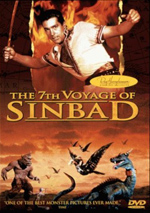
The 7th Voyage of Sinbad appears in an aspect ratio of approximately 1.85:1 on this single-sided, double-layered DVD; the image has been enhanced for 16X9 televisions. This erratic transfer came with a number of problems.
My main complaint came from the excessive grain that affected much of Voyage. This was a virtually constant presence that made the entire image rather messy. I didn’t mind the grain so much during interiors or effects shots; I expected them there. However, even daytime exteriors suffered from an awful lot of grain, and that left us with cloudy visuals that tended to mar every other aspect of the image.
Other source flaws caused distractions, though not to the same level of severity. I noticed specks, marks, hairs and nicks on occasion. Black levels seemed okay, though they tended to be a little too dense. Shadows were fairly smooth and well-developed much of the time, though some ugly “day for night” shots looked rather opaque.
Because of all the grain, colors varied. At times they could be pretty dynamic, but since the grain often made it look like we watched the film through gauze, the hues usually suffered. Much of the time they were flat and runny.
Sharpness was erratic. The messiness caused by the grain could make things seem tentative, and since that was such a big factor, much of the movie looked moderately ill-defined. Some shots featured nice delineation, but the transfer lacked consistency. No issues with jagged edges or shimmering occurred, and edge enhancement remained minor. Honestly, without the excessive grain, this probably would have been a decent transfer, but as is, it looked pretty bad.
7th offered a passable monaural sound mix that did some things right but nonetheless had a fair number of flaws. Actually, only one major problem affected the audio: the fact that all dialogue was so obviously and poorly dubbed. I can't recall the last time I heard such artificial-sounding speech; it seemed so fake that it sometimes resembled the stereotypically bad dubbing of foreign martial arts films. While the dialogue was always intelligible and lacked other problems, I couldn't help but feel extremely distracted by how poorly it got integrated into the action.
Otherwise, overall audio quality was relatively decent for the film's age. Dialogue, effects and music seemed thin and shallow, and the mix lacked balance - speech really dominated - but the track to display any prominent examples of distortion or any other source flaws. This ended up as an average track for its age.
The one saving grace of this DVD comes from its fine assortment of supplements. The prime attraction is a terrific 58-minute documentary called the Ray Harryhausen Chronicles. The program features narration from Leonard Nimoy and also presents interviews with Harryhausen, producer Charles Schneer, Ray Bradbury, George Lucas, special effects master Dennis Muren, and stop motion filmmaker Henry Selick (James and the Giant Peach and Nightmare Before Christmas).
We also see a lot of great archival footage from literally every stage of Harryhausen's career, including some wonderful material he created as a teen. This program offers an excellent chronological history of Harryhausen's career (and essentially the evolution of movie effects, as well). It's very nicely paced and quite charming; overall, it's an absolutely fascinating feature.
The 7th Voyage of Sinbad DVD provides a few other shorter programs also. We get Interviews: A Look Behind the Voyage, an 11-minute and 40-second piece that features comments from Harryhausen, Schneer, and actor Kerwin Mathews. This is a pleasant and entertaining feature that offers some interesting details about the creation of the film.
This Is Dynamation! is a three and a half minute featurette that comes from the era in which the movie was released. It's short and frothy fun, in a campy way.
Jason and the Argonauts is another documentary, but this one focuses on the film of that name. Director John Landis interviews Harryhausen and has him demonstrate some aspects of his effects work. The piece lasts for almost 12 minutes and essentially provides an abridged history of Harryhausen's career. It shows nothing particularly crucial that we don't hear elsewhere, but Landis' obvious affection and semi-awe help make it entertaining; ultimately, it helps give us a better appreciation for Harryhausen because we can see him through the eyes of those who really learned from him.
In addition to all these features, we receive an abundance of trailers. We get promos for 7th Voyage of Sinbad, 20 Million Miles to Earth; Earth Vs. the Flying Saucers, The 3 Worlds of Gulliver, Jason and the Argonauts, It Came from Beneath the Sea, and The Golden Voyage of Sinbad (not to be confused with the porno film, The Golden Showers of Sinbad). Talent Files for Harryhausen, director Nathan Juran, and actors Mathews, Grant and Thatcher appear; as is typical of CTS DVDs, these offer very little information and are nearly useless. The DVD also shows a reproduction of the theatrical poster and contains a booklet with basic but interesting information.
While I really respect the pioneering visual effects work of Ray Harryhausen, many of the flicks on which he worked weren’t good. The 7th Voyage of Sinbad boasts some cool visuals but otherwise stinks. Packed with poor acting, bad dialogue and a host of other problems, it’s a pretty bad movie. The DVD offers flawed visuals, pretty good audio, and a very nice roster of supplements. This is a passable release for a silly movie.
To rate this film, visit the 50th Anniversary Edition review of THE 7TH VOYAGE OF SINBAD