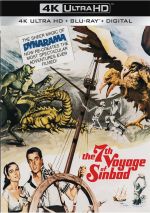
The 7th Voyage of Sinbad appears in an aspect ratio of approximately 1.66:1 on this 4K UHD Disc. Despite the challenges brought from the source, this became a pretty terrific Dolby Vision presentation.
Inevitably, the film’s heavy use of various effects impacted visuals. These shots turned soft and brought heavy grain.
However, those “issues” became unavoidable and didn’t create much of a distraction anyway. The rest of the movie boasted good to great definition.
No issues with jagged edges or shimmering manifested, and I saw no edge haloes. Grain felt natural – though occasionally heavy, as noted – and print flaws remained absent.
The movie’s bright palette excelled, with colors that appeared vivid and full. HDR gave the hues a nice boost.
Blacks seemed deep and dense, and outside of some predictably thick day for night shots, shadows looked positive. Whites and contrast benefited from HDR. This almost certainly represented the best the film will ever look.
Much of the time, I don’t care for remixes made from single-channel sources. However, the DTS-HD MA 5.1 reworking of Voyage offered a surprisingly natural piece of audio.
Taken from that original monaural version – which also appeared here via a DTS-HD MA option – the soundfield created a pretty broad and involving setting. Shots on the water opened things up well, and scenes with action also gave us some good localized audio.
These elements meshed smoothly. The mix also used the surrounds in a moderately useful manner.
Bernard Herrmann’s score fared best of all, as the flick featured very good stereo imaging that allowed the music to come to life. In fact, the musical presentation seemed so solid that it tended to make the rest of the track a little less effective. The score barely showed its age, as the music felt lively and robust.
Other aspects of the audio seemed more dated but remained acceptable. Speech suffered from a lot of awkward dubbing, but the lines remained intelligible and lacked edginess.
Effects elements could be a bit rough, but they appeared decent at worst and boasted some nice low-end response. Overall, this was a good little track.
How did the 4K UHD compare to the Blu-ray version? The audio was a wash, for though the 4K UHD featured DTS-HD MA versus the BD’s Dolby TrueHD, both flicks boasted virtually identical sound.
As for the visuals, the Dolby Vision UHD absolutely blew away the spotty BD. It came with superior colors, definition and blacks and also lost the print flaws from its predecessor.
The UHD gave us a 1.66:1 aspect ratio instead of the BD’s 1.85:1, which apparently better represented the filmmakers’ original intentions. All of this added up to a UHD release that made the BD obsolete.
On the UHD disc, the only extras consist of a trailer and a documentary called The Harryhausen Chronicles. Found on the original 1999 DVD but AWOL since then it spans 57 minutes, 56 seconds.
Along with narration from Leonard Nimoy, “Chronicles” brings interviews with special effects creator Ray Harryhausen, producer Charles Schneer, author Ray Bradbury, filmmaker George Lucas, special effects master Dennis Muren, and stop motion filmmaker Henry Selick. We also see a lot of great archival footage from literally every stage of Harryhausen's career, including some material he created as a teen.
This program offers an excellent chronological history of Harryhausen's career and it essentially follows the evolution of movie effects, as well. “Chronicles” moves at a nicely pace and delivers a terrific look at Harryhausen and his career.
The set includes the same Blu-ray from 2008, where the extras open with an audio commentary from Harryhausen, producer Arnold Kunert, visual effects experts Phil Tippett and Randall William Cook and Bernard Herrmann biographer Steven Smith. All sit together for this running, screen-specific look at cast and crew, the score and its composer, the project’s origins and development, the film’s impact and influence, sets and locations, and its visual effects.
Expect a lively little chat here. This became the fourth Harryhausen commentary I screened, and it turned into the best, largely due to the presence of Smith.
The biographer adds a non-effects perspective that provides useful, while the others give us a good take on the flick’s technical elements. This turns into a solid commentary.
Next comes a featurette called Remembering The 7th Voyage of Sinbad. In this 23-minute, 30-second program, we hear from Harryhausen.
We get notes about the film’s roots and development as well as facts about Harryhausen’s effects and some other production issues. If you listened to the commentary, you already learned virtually everything presented here.
We see some interesting archival elements, and Harryhausen even trots out one of the old skeletons he animated. Nonetheless, if you took in the commentary, you might want to skip this fairly redundant piece.
The Harryhausen Legacy goes for 25 minutes, 30 seconds and includes remarks from Tippett, archivist/film historian Bob Burns, writer/agent/editor Forrest J. Ackerman, and filmmakers John Landis, Hoyt Yeatman, Ken Ralston, Joe Dante, John Dykstra, the Chiodo Brothers, Dennis Muren, Doug Beswick, Jon Berg, Rick Baker, Kevin Kutchaver, Frank Darabont, and Stan Winston.
The participants reflect on how Harryhausen’s work influenced them as well as aspects of his effects. Expect a lot of fawning praise here.
Yes, it’s nice to get the perspectives of those so heavily impressed by Harryhausen, but the comments lack the critical assessment I’d like. If the show had focused more on an appreciation of specifics and less on general praise, it would’ve been more satisfying.
In the 26-minute, 50-second The Music of Bernard Herrmann, we hear from Smith. He gives us an overview of Herrmann’s career and also an appreciation for those scores.
I like the parts that emphasize Herrmann’s work on the Harryhausen flicks, but we don’t get a great general look at Herrmann. Smith barely mentions Hitchcock, so this doesn’t become a strong biography. Nonetheless, it allows us some good info about Herrmann’s fantasy film efforts, so it’s worth a look.
A running Photo Gallery fills nine minutes, 34 seconds. Movie score accompanies the shots as we see a mix of shots from the flick. I’d have liked some behind the scenes images, but this remains a decent collection.
For something unusual, we head to ”Sinbad May Have Been Bad, But He’s Been Good to Me”. This offers a song created to promote the film, and it comes accompanied by movie ads. It’s a goofy little tune, but it’s fun to hear.
A Look Behind the Voyage provides an 11-minute and 46-second piece that features comments from Harryhausen, Schneer, and actor Kerwin Mathews. This is a pleasant and entertaining feature that offers some interesting details about the creation of the film.
This Is Dynamation! is three-minute and 25-second featurette that comes from the era in which the movie was released. The piece gives us a hint of what to expect from the flick’s effects. It's short and frothy fun in a campy way, and it includes a few decent notes about the creation of the effects.
For the final featurette, Ray Harryhausen Interviewed by John Landis fills 11 minutes, 52 seconds. Despite its placement on this disc, the program concentrates on Jason and the Argonauts.
Landis chats with Harryhausen about the flick and has him demonstrate some aspects of his effects work. While it does focus on Argonauts, it also provides an abridged history of Harryhausen's career.
It shows nothing particularly crucial that we don't hear elsewhere, but Landis' obvious affection and semi-awe help make it entertaining. Ultimately, it helps give us a better appreciation for Harryhausen because we can see him through the eyes of those who really learned from him.
The Blu-ray includes Previews for a few films. We get ads for Men in Black, Casino Royale (2006), CJ7 and Water Horse: Legend of the Deep.
While I really respect the pioneering visual effects creations of Ray Harryhausen, many of the flicks on which he worked weren’t good. The 7th Voyage of Sinbad boasts some cool visuals but otherwise stinks. The 4K UHD offers good picture and audio as well as a very nice roster of supplements. This 4K UHD blows away all prior home video releases of the film.