Reviewed by Colin Jacobson

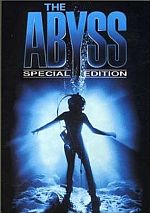
Title: The Abyss: 2-Disc Special Edition (1989)
Studio Line: 20th Century Fox - A place on earth more awesome than anywhere in space.

In this thrilling, underwater action adventure from writer-director James Cameron, a civilian oil rig crew is recruited to conduct a search-and-rescue effort when a nuclear submarine mysteriously sinks. One diver (Ed Harris) soon finds himself on a spectacular odyssey over 25,000 feet below the ocean's surface, where he confronts a mysterious force that has the power to change the world or destroy it.

Director: James Cameron
Cast: Ed Harris, Mary Elizabeth Mastrantonio, Michael Biehn, Leo Burmester, Todd Graff, John Bedford Lloyd, J.C. Quinn, Kimberly Scott
Academy Awards: Nominated for Best Cinematography; Best Art Direction-Set Decoration; Best Sound. 1990.
DVD: 2-Disc set; Widescreen 2.35:1; audio English DD 5.1 & Dolby Surround; THX; subtitles English, Spanish; closed-captioned; single sided - dual layered; 54 chapters; rated PG-13; 171 min.; $34.98; street date 3/21/00.
Supplements: Disc One: Includes both the Special Edition, with 28 minutes of additional footage PLUS the original theatrical version; Text only commentary option for both versions; Collector's Edition 12-page booklet.
Disc Two: 60-minute documentary - "Under Pressure: Making The Abyss"; James Cameron's complete screenplay; Multi-angles of pseudopod sequence; 3 DVD-ROM games; Extensive storyboards and original concept art and more!
Purchase: DVD | Score soundtrack - Alan Silvestri


Picture/Sound/Extras: A/A-/A+

In my ever-so-humble opinion, The Abyss stands as James Cameron's "median" film. That is, there are equal numbers of his movies that I think are better than it as there are Cameron flicks I find to be worse. For the record, above The Abyss I place Aliens (the perfect movie), Terminator 2, and Titanic, while I rank True Lies, the original Terminator, and Piranha II: The Spawning below it. (Okay, I must acknowledge I've never seen PII, but I think it's a pretty good bet that it's the worst of the bunch.)

I relate this ranking to indicate what a remarkable directorial career Cameron has had so far. Granted, he's only cranked out seven movies, but only one of those seems to be an outright clunker (PII, natch), and many would rank my next-to-last-place entry - Terminator - at the head of the list.

The point being made is that while I may classify The Abyss as a middling film by Cameron standards, it's nonetheless actually a rather terrific film, one that would easily top the list of many - if not most - other directors with similar or greater track records. You think Joel Schumacher or Brian De Palma wouldn't kill to have such a solid piece of work in the middle of their respective packs? (Actually, you think those two wouldn't like to have something as good as The Abyss at the top of their lists?)

Of course, the rating of The Abyss may change depending on which version you watch. The 1989 film initially appeared in a roughly 140-minute edition but it was expanded to about 170 minutes when a "special edition" laserdisc came out in March 1993. This version added back some small character moments but most importantly reinserted a major subplot that concerned the Non-terrestrial Intelligent beings (NTIs).

That latter addition was crucial. I liked The Abyss in its theatrical cut but found the ending to just kind of collapse; the last act falls flat. With the restoration of the subplot, the conclusion actually makes sense and doesn't make you wonder what went wrong. Don't get me wrong; The Abyss was a good movie in its original incarnation; however, the extended cut made it more totally satisfying.

Three of Cameron's movies have received the extended treatment, but The Abyss is the only one that really benefits from it. I enjoy the elongated versions of both Aliens and T2, but the films work equally well in their theatrical cuts. The same cannot be said for The Abyss; while the added footage doesn't make it seem like a whole new film, it certainly creates a much more fulfilling vision.

The heart of the film remains the same in either cut: a believable relationship story between estranged leads Bud (Ed Harris) and Lindsey (Mary Elizabeth Mastrantonio) Brigman. In Cameron films, the action may knock you out, but his films reach a higher level because of the realistic and compelling human stories behind them; the characters can be somewhat cartoony at times, but they still display qualities that usually don't appear in action films. I think the biggest failure of True Lies comes from this factor; the leads were much less sympathetic and interesting than usual. (It didn't help that the actors weren't as good as folks like Harris, Mastrantonio, or Sigourney Weaver either - Schwarzenegger can do the terminator but that's the extent of his range.)

The Abyss lives and dies with Bud and Lindsey, and we accept and embrace their escalating reinterest in and recommitment to each other. Again, it helps that in Harris and Mastrantonio Cameron captured two terrific actors; in lesser hands, the relationship may not have worked.

As also is typical of Cameron films, the supporting cast tends toward broad characterizations. The crew doesn't come close to matching the heights of the folks found in Aliens - possibly the greatest example ever of a strong cast overcoming cartoony characters - but all of the actors are decent, and they help the film whereas they could easily have hurt it. Michael Biehn tries a little too hard to overcome his "good guy" image and be creepy in his role as Lieutenant Coffey, but he's still very good and he makes the part work.

I've watched The Abyss maybe ten times over the last decade, and I must admit that I tire of it sometimes. The film starts off slowly and really takes a long time to get into the heart of things, which concerns Bud and Lindsey's relationship and the deepening threat. Ultimately, all of those parts make the experience worthwhile. I can get a little restless in the early going, but it comes together well and makes for a very compelling and rewatchable film.

The DVD:

The Abyss appears in its original theatrical aspect ratio of 2.35:1 on this single-sided, dual-layered DVD; much to the chagrin of many, the image has not been enhanced for 16X9 televisions. Technically, this transfer comes from that used for the "old" laserdisc set in 1993; many naysayers have glommed onto that issue to "prove" that the DVD would offer an inferior image.

Bollocks, say I. For one, as detailed in the excellent "Production Diary" on DVD Review, while the transfer indeed does come essentially from 1993, the one on the LD is from a D2 source whereas the DVD is D1. As such, many of the flaws (like chroma noise) that may have accompanied the LD transfer should not show up on the DVD. Also, as is pointed out on DVD Review, the creators of the DVD thoroughly assessed the quality of the transfer to ensure it would look good; it's not like some dude just fired up his LD player and copied the movie straight to a DVD.

All the debate about transfer sources and whatnot now stands as moot, because the DVD has arrived and we can actually look at the stupid things and decide for ourselves. While it would have been nice to get The Abyss mastered as an anamorphically-enhanced DVD, the current incarnation offers a very good picture as it stands, "ancient" LD transfer or not.

I own that LD box set, so I feel confident when I say that The Abyss has never looked better. Actually, that's especially true for the theatrical cut of the film, for this is the first time it's appeared in its correct aspect ratio; the 1990 LD used a compromise ratio of about 1.85:1 (which noticeably cropped the picture). That LD looked okay in its day but paled in comparison with the SE LD, which doesn't live up to the DVD, so since if "A">"B" and "B">"C" then "A" must be greater than "C", this has to be the best-looking version of the theatrical cut. (I came for a DVD review and got a math lesson!)

As noted earlier, the DVD contains both the 140 minute theatrical release of The Abyss plus the 170 minute special edition cut. For the purposes of this review, I only watched the SE, but that doesn't mean the theatrical cut will look different; because of the use of branching, they come from the same materials. Although I didn't watch the entire film, I did browse through the theatrical cut to see if I'd notice any pauses when the disc needed to skip SE content. Happily (for those who want to watch the original version), I noticed not a hint of a problem in that area; if you didn't know that the DVD needed to jump ahead, you wouldn't have any idea something unusual occurs.

Sharpness looks terrific throughout the film. Some underwater scenes appear a bit murky but that's simply due to the nature of that sort of shot; underwater scenes will always display that kind of haziness. I noticed virtually no signs of moiré effects or jagged edges; I thought I detected the slightest amount of edginess in the first shot of One Night's hat, it was exceedingly minor, and despite a number of surfaces conducive to shimmering and other problems - such as metal grates - none of the issues arose.

The print used for the transfer appeared immaculate. I noticed no signs of any scratches, speckles, hairs, spots, or streaks, and I also couldn't detect any grain; it's a clean image. Colors looked thoroughly lovely and true. Because of the setting, blue and gray tones dominate, and they display no blotchiness or other problems. When brighter tones appear, they also seem nicely rendered and look realistic and accurate. Even when characters are bathed in red light - frequently a problem on home video - I saw no signs of smearing or distortion; inspect the scene that shows the submarine sinking to find out what I mean.

Black levels are thoroughly deep and solid, and shadow detail consistently seemed appropriately opaque but not overly thick or muddy; this film offers a lot of low-light scenes, and I never had to strain to see images that should have been clear. While this transfer may have been mastered seven years ago, that matters not one iota; it was a fantastic image then, and it still looks terrific today.

One interesting "correction" occurs in the DVD's transfer. As noted in the set's booklet, the LD of the SE contained some awkward "jumpcuts" many times when the new footage appeared. According to the booklet, "this is due to the nature of film negative cutting. When film negative is first cut and reassembled into the final film order, half of one frame is destroyed on each side of the cut in order to hot-splice the frames of the film together. Thus, half a frame - and therefore the whole frame - will be missing when scene extensions are made to an existing cut negative; these jumps are only occasionally noticeable, usually in scene extensions of continuous shots containing a lot of movement."

I knew those jumpcuts well, since I'd lived with them for seven years, but strangely, they don't appear in the DVD version. Well, that's not totally true; I noticed a slightly awkward blip during chapter 50. Other than that, though... nothing. I even went back to the LD and compared a number of these scenes side by side and still saw none of the issues that previously occurred. For instance, chapter 22 offers an extension of the scene in which Sonny futilely tries to radio the surface. On the LD, the added footage is very noticeable because you can see the jump and a small mark when it starts. That problem is completely gone on the DVD; as such, while the SE LD integrated the extra material well, the DVD does it even better. In and of itself, that's not a reason to ditch the LD and buy the DVD, but it doesn't hurt.

One area in which the DVD of The Abyss clearly surpasses the LD set stems from its sound; there were no Dolby Digital 5.1 laserdiscs in March 1993, so that issue had to settle for Dolby Surround. It was a good mix, but lacked the depth that DD's full-range surrounds can add. A subsequent movie-only release featured the 5.1 soundtrack, but its lack of supplemental content made it less than appealing to many.

Now we can have our cake and eat it, too, since the DVD offers all of those things. It's also the first time that the theatrical cut appears with a 5.1 soundtrack. Some controversy has arisen over the nature of the surrounds for this mix; some reviews claim that there's serious split-surround activity, but others state that the rears offer monaural audio. For the record, all reports of the LD's 5.1 mix stated that it appeared to provide mono surrounds.

To these ears, it does indeed sound as though the surrounds are monaural. However, it was hard to tell and I think the filmmakers crafted such a broad mix in the front that it deceives the ears into hearing more localized sound from the rears. The forward channels indeed provide an image that spreads extremely well across the speakers; it creates a tremendously effective and lively forward soundstage. The activity in the rears is not as hot and heavy, but it keeps up and adds a lot to the action.

Because of the breadth of the front channels, it often really sounded like I heard discrete activity from the rears, and I can't state 100% that none of this exists; it's really hard to tell. However, I'm pretty sure that this is simply an aural illusion created by the fantastic separation up front; sounds are so well placed in the forward soundstage that the rears reflect that quality and offer this "phantom" audio. The surrounds do appear to be full-range, which helps as well, since the sound lacks the thin tone that often accompanies limited-range Dolby Surround mixes; since the quality of the sound from the front and the rears seems equal, the aural illusion becomes more convincing.

Overall quality does seem very good. Dialogue was heavily dubbed and it occasionally seems a bit rough or flat, but for the most part, speech appeared clear and fairly natural; I had no problems understanding it, even in the most hectic of circumstances. Effects sounded terrific, with an absolute lack of distortion; the realistic nature of these pieces strongly adds to the impact of the film, as the highly-detailed environment shines. Alan Silvestri's score also seems well-reproduced, with clear highs and deep lows; it comes across very nicely. While my "A-" rating reflects a slight age bias - I expect less from a 1989 soundtrack than I do from a 1999 mix - that shouldn't negatively impact upon this track; despite its vintage, it still sounds very good and outdoes many new mixes as well as virtually anything from the late Eighties.

Longtime readers of the DVD MovieGuide may have noted my extreme aversion to awarding DVDs "A+" rankings. Some sites thrive on such plaudits, but I hate them because they leave me nowhere to go; I mean, I'm won't engage in silliness like "A++" so if I grant an "A+", that sucker better really deserve it.

I'm even tougher on supplements than I am on picture or sound, because extras are one area in which DVD has yet to truly surpass laserdisc. Oh, it's true that DVDs provide supplemental features as much more of a standard than did LDs, and there's no question DVDs have made special editions much more available and affordable, so on a general level, DVD beats LD in that area.

However, DVD has yet to live up to the best LD special editions. The classics of that genre - Toy Story, Terminator 2, Amadeus - have not appeared in similar DVD editions, and only A Bug's Life has offered similar depth in a program that's original for DVD. Not coincidentally, ABL earned my first - and previously only - "A+" for supplements.

That "only" evaporated when I got The Abyss. To call this set extremely detailed is an understatement. It's essentially a port of the $100 1993 boxed set, but it actually expands on that terrific offering and easily earned its "A+".

So grab a sandwich and get comfortable: it's going to take a while for me to sort this the spectacular complement of supplements available of The Abyss. By the way, I'd like to note what sections do not appear on the LD, so whenever a supplement is italicized, that means it's new to the DVD; if it's in quotes, it's a repeat of an LD feature. (This doesn't apply to the names of the various sections - they'll always be in quotes; it just regards each specific supplement.) Please note that some of the supplements from the original LD may have been listed under different names there or appeared in more inclusive sections; as such, sometimes a feature may appear to be new but it's not.

While most of the supplements appear on the second disc, DVD 1 of The Abyss offers a few tidbits. The "Personnel Lockers" section includes biographies for 12 of the actors and six crew members. These are pretty good overall, though the depth of the entries depends on the fame of the person; the text is fairly detailed for folks like Ed Harris or Cameron, but not nearly as complete for the less-known actors.

The "Personnel Lockers" also presents six text pieces that offer production notes: About the Story, Filming Underwater, Recording Dialogue Underwater, Building "Deepcore", The Diving Gear, and The Submersibles. The "Personnel Lockers" appear on both DVD 1 and DVD 2.

While the "Personnel Lockers" are nice, the real treat on DVD 1 - aside from the neat branching for either the theatrical or special edition versions - is a running text commentary written by Van Ling, the producer of this package. It's a lot of fun and very interesting, even if Ling tends toward technical details such as often noting how an effects shot was generated. Those parts get a little dry, but he offers so much other strong content that they're easily forgivable. Reams of information appears, and Ling even displays a little "Pop-Up Video" style irreverence from time to time. It's a compelling piece.

That finishes out the first disc; onto the smorgasbord on DVD 2! This disc offers six different sections; since they don't appear in any specific order, I'll list them in order of fan-related intensity, from most easily accessible to new viewers to most demanding and "hard-core."

The "Trailers" section seems least intimidating, really. This provides three clips for The Abyss itself; we get the "teaser", the full "theatrical" trailer, and a "reviews" piece that emphasizes the film's critical accolades. Also, please note that with a little futzing around with your player's remote, you can find trailers for fellow Cameron directed and/or produced films True Lies, Aliens, and Strange Days. Even more hidden are additional trailers for Aliens and Strange Days; those two different clips can be found in the "Imaging Station". I couldn't find a second True Lies trailer, so I'm not sure if one appears on the DVD; I also speculate that other clips may be around the DVD, but that's all I could locate. (The Abyss LD features all three Abyss trailers and both Aliens clips but doesn't offer the others, since those two films didn't exist in 1993.)

Next stop is the "Documentaries" area. The prime attraction here is "Under Pressure: Making The Abyss", a terrific 59-minute program that details the travails of the creation of the film. The piece comes from 1992 and includes then-current interviews with most of the prominent cast and crew members; only still-peeved-at-Cameron Mary Elizabeth Mastrantonio fails to appear. As much as I like this program - it really does tell a compelling "warts and all" tale - it's too bad a new documentary was not attempted as well, if just because Mastrantonio might have been more open to participation now than then, when memories of the aggravation were much more fresh. Maybe not, but an additional "updating" would have been nice. Still, even without that, it's a very good piece.

Also included is a 10-minute documentary called Making The Abyss. Despite its brevity, this is still a good piece, and it lacks the annoyingly promotional quality of most of these programs. No, it doesn't compare to the longer show, but it's worth a watch, if just to laugh a little more at the spectacle of Cameron doing his underwater interviews.

Next we move to the "Imaging Station" which provides a wealth of both text and video information. Here you can read the "shooting script" or the "original story treatment"; in regard to the latter, it's pretty startling how close the finished project hews to the initial draft. (It's not perfect but it matches better than I'd expect.) The "storyboards" area shows all 773 of those, presented in sequence. I didn't count the storyboards - the title card indicates the total - but I did (insanely) total the shots in the "Image Gallery"; it includes 16 sections of pictures, with between 29 and 273 per section, for a total of roughly 1450 shots! You can check these out through the individual sections or - if you're completely nuts - watch them all in order in the "all images" area. (For the record, although I think most of these images appear on the LD, I'm not totally sure - they aren't presented in this manner on that set, so it's very hard to confirm. Some were definitely new, but I believe the majority are not.)

Still in the "Imaging Station" we discover a variety of video clips as well. The Visual Effects Reel provides a 20-minute compilation of visual effects (duh!) shots from the film. This piece was created for Academy Award consideration and also provides annotations that indicate what kind of effects appear. It's a little dull to watch, but it's a neat program to have.

Deepcore Timelapse takes seven minutes and 15 seconds to build the large exterior Deepcore set; all that time passes in minutes through the timelapse photography and the edifice grows right before your eyes! A similar program shows the "Motion Control Timelapse Montage"; it takes 60 seconds to focus on the shooting of some miniatures.

Still in the "Imaging Station", we get the Pseudopod Multiangle section. This lets you watch the shots of the pseudopod in any of four different ways: 1) the final, finished shots; 2) the storyboards; 3) the rough shots from the dailies; 4) the workcut with temporary special effects. For my money, the last two are the most compelling, and I especially like the dailies; it's fun to watch the actors interact with nothing.

A variety of brief video clips appear. The "Crane Crash Shot" (25 seconds) offers a look at that scene, but in real-time, unlike the greatly slowed down result in the film, while the "Surface Unit Shoot" displays a couple of "behind the scenes" shots on the ocean. Two parts involve effects on the Montana sub: "Engine Room Flooding" (45 seconds) presents some shots of the miniature, while "Bridge Set Flooding" (45 seconds) shows the full-size set with actors being inundated with water.

A crude piece of work shows up in the "Videomatics Montage" (90 seconds). These are essentially video storyboards that offer basic mock-ups of effects, and they can be quite entertaining. One cool aspect of these is that you can watch them either fullframe or letterboxed in a 2.35:1 ratio. No, they don't appear twice; the producers of the DVD actually use the subtitle functions to let you letterbox the image manually! Flip that "subtitles" switch and black bars will appear at the top and bottom of the screen. This is a feature that could really be of use on DVDs of movies that were shot fullframe but projected 1.85:1 or so theatrically; this simple solution would let us have the option of fullframe or letterboxed titles without additional mastering or the use of more disc space. Granted, this method doesn't help a lot of movies that actually pan and scan, but it could be an easy way to offer a compromise for many titles, and I hope studios think to use it.

Finally, the "Demo of Miniature Rear Projection" shows how they made it appear that the actors were inside some of the underwater ships. None of these various pieces are scintillating, but overall they add up to a lot of fun stuff.

At this point, we leave the "Imaging Station" and enter the world of entirely text materials, with some photos tossed in for good measure. Prepare your thumb - you will do a lot of frame advancing!

"The Abyss In Depth" covers all of the text materials found on the LD. The "Mission Components" subsection discusses effects only; we get 15 different topics such as "NTI Beings" and "Little Geek". All of this information appeared on the LD, though sometimes under different names.

The other subsection is called "Operations" and its 16 areas more closely detail the creative side of the equation. We find areas like "The Production Team", "Character Development and Casting", and "Publicity, Advertising and Marketing", all of which discuss aspects of the film that generally don't specifically relate to the creation of special effects. Again, these pieces all can be found on the LD, though sometimes under different names.

If you'd like, you can access all of these materials in the same exact order as the LD in the "Drill Room" area. Unlike the LD, however, you have to proceed through everything; there's no chapter skip, so each and every page - all 30000 or so - has to be seen in sequence. This section repeats text found elsewhere, as do some of the other parts; the "Little Geek" and "Big Geek" topics in the "Mission Components" are exactly the same, and they are duplicated in the "Operations" area's "ROVs and Video In the Abyss". It seems a little silly to repeat the stuff, but there's no harm in it, I suppose.

These text materials are tremendously extensive and detailed; as such, they're of most interest to the serious Abyss fans. Face it: casual observers won't care to spend many, many hours wading through all this minutiae. However, if you love this sort of material - as I do - you'll be tremendously entertained.

While I've covered the documents found on the DVD but not the LD, what happens in the other direction? Nothing, really; the LD does not include any disc-based content that's not also on the DVD. The only difference stems from the two booklets; the LD's booklet offers some comments from Cameron that can't be found here. The DVD's paper text replicates the LD's "restoration notes" (which detail the additional footage) but not Cameron's statements. However, Cameron's comments can be found in the "Restoration" subtopic of the "Operations" area, so they do appear in this set - just not in the booklet.

One difference between the two formats that actually favors the LD has nothing to do with content; it concerns accessibility. I find it awkward and slow to skip through stillframes on DVDs, and that's a serious problem here, with a DVD that offers literally tens of thousands of frames. For that reason and that reason alone, I plan to keep my LD set; I simply find it much easier to read the text materials on it. That shouldn't shy anyone away from the DVD - it's still a viable way to access this information - but given a choice, I'll take the LD for that purpose; frame advancement remains much quicker and easier on LD.

As if all that stuff wasn't enough, this DVD chimes in with some DVD-ROM content. I still have no DVD-ROM drive, so I'll just have to relate the description from the DVD itself: the DVD-ROM content "will allow you to read the script and view storyboards while watching the special edition version of the film. Access the Abyss DVD website for more information and educational links to the Internet, or play custom games."

Could you ask for anything more? Yeah, I guess, but The Abyss on DVD stands as one of the very best DVDs on the market today. The film itself remains compelling over repeated viewings, and the DVD presents it with great picture and sound. Best of all, it packs in an audacious number of supplements; pretty much everything you could want to know about the film appear in this set. It's too early to pick the best DVD of 2000, but there's no doubt The Abyss will be one of the finalists - this is an absolute "must have" DVD and it gets my highest recommendation.

Menu:  DVD Movie Guide | Archive | Top