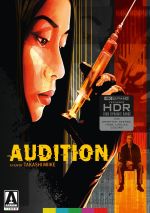
Audition appears in an aspect ratio of 1.85:1 on this 4K UHD Disc. This became a less than attractive Dolby Vision image, though I strongly suspect the issues stemmed from the original Super 16mm photography.
Definition seemed mediocre most of the time, as a lot of the film leaned soft. While we got decent to good delineation for close-ups, wider elements tended to seem less than precise.
No issues with jagged edges or moiré effects appeared, and I saw no edge haloes. Print flaws remained absent but grain became surprisingly heavy.
The palette of Audition usually emphasized dull blue-greens or ambers, with reds/oranges more apparent late in the story. These seemed appropriate for the movie’s visual design but they didn’t impress, and HDR failed to give them much added heft.
Blacks appeared a little inky, and shadows came across as reasonably clear. Whites and contrast enjoyed a modest boost from HDR. Objectively, this became a moderately ugly visual presentation, but I awarded it a “B-“ simply because of my belief all the “problems” emanated from the source.
Though not exactly a slam-bang mix, at least I found less equivocal pleasures from the DTS-HD MA 5.1 soundtrack of Audition. For the most part, the film opted for a soundscape heavy on ambience.
Music used the channels well, and we got a good sense of place. A few louder/more dynamic scenes opened up the soundfield in a pleasing manner, but the overall impact of the track remained low-key.
Audio quality worked fine, with speech that appeared concise and distinctive. Music seemed full and rich.
Effects offered positive accuracy and range as well. Nothing about the soundtrack particularly impressed but it became more than satisfactory for the story at hand.
The film can be viewed with or without an introduction (1:15) from director Takashi Miike in which he winks at the “audition” process. While mildly clever, the reel seems forgettable.
The set includes two separate audio commentaries, and the first comes from director Takashi Miike and writer Daisuke Tengan. Both sit together for a running, screen-specific view of the project’s origins and development, the source and its adaptation, story/characters, cast and performances, production elements, other aspects of their careers and reactions to the film.
At times we get some useful insights related to Audition. However, the discussion tends to feel fairly general and without a lot of real depth.
For the second commentary, we hear from film historian Tom Mes. During his running, screen-specific chat, Mes looks at story/characters, genre domains, cast and crew, some production notes, and themes and interpretation.
That latter area dominates Mes’s chat, as he spends a lot of time with his take on Audition. Some of this fares acceptably well but the track comes with spotty notes.
A few video features follow, and Callback spans eight minutes. We find an interview with actor Ryo Ishibashi.
He looks at his character, his performances and his experiences. While Ishibashi gives us a few good notes, too much of the chat just feels superficial.
Under Archive Interviews, we find four different segments. These involve Miike (30:05), Ishibashi (16:13), and actors Eihi Shiina (20:09), Renji Ishibashi (20:55) and Ren Osugi (16:25).
Across these, we get info about story/characters, themes, cast and performances, the participants' careers, aspects of the Audition shoot and their thoughts about the film. We get a generally good collection of memories and insights across these reels.
Damaged Romance (35:20) provides an "appreciation" from film historian Tony Rayns in which he discusses the life and career of Takashi Miike as well as aspects of the Audition production. Rayns covers these topics in a concise and engaging manner.
With Deeper Into Audition (11:18), we find an "audio essay" in which academic Alexandra Heller-Nicholas offers analysis of various aspects of the film. She presents a brief but insightful chat.
Along with two trailers, we get an Image Gallery with 30 elements that show movie shots and behind the scenes photos. It becomes a forgettable compilation.
Although it influenced American ‘torture porn’ films, Audition provides something much less overt and aggressive than those films. While it can feel like slow-going much of the time, I appreciate the gradual build and subtlety of the movie. The 4K UHD comes with generally positive picture, appealing audio and a compilation of supplements. While Audition didn’t completely click for me, I like what it wants to do.