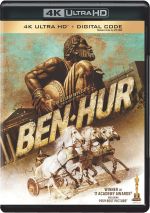
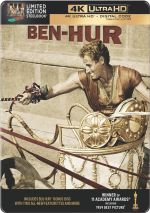
Ben-Hur appears in an aspect ratio of approximately 2.76:1 on these 4K UHD Discs. The package splits the film across two platters.
Disc One features the movie’s first two hours, 21 minutes and 51 seconds, while Disc Two runs one hour, 20 minutes, 32 seconds. From start to finish, the movie’s Dolby Vision presentation looked stunning.
Sharpness seemed amazing. Despite the many wide shots and the relatively-minuscule nature of lots of onscreen objects, the picture appeared very crisp and well-defined at all times.
Even the smallest items came across as clear and detailed. I also detected no signs of jagged edges or moiré effects, so this became a very stable picture.
Grain felt light but noticeable, and edge haloes failed to appear. Print flaws also never marred the presentation.
Colors looked consistently vivid and well-saturated, as the movie portrayed the hues in splendid fashion. Reds appeared especially bright and rich, and the tones enjoyed a nice bump from HDR.
Black levels came across as deep and dense, while shadow detail looked appropriately heavy but never excessively thick. This meant low-light situations became easily discernible at all times.
HDR added emphasis to whites and contrast. Across the board, this wound up as an absolutely magnificent visual presentation.
Downconverted to Dolby TrueHD 7.1, Ben-Hur also sounded good via the movie’s Dolby Atmos audio. The film featured a modestly involving soundfield that helped make the program more compelling.
The forward channels displayed a nicely broad mix during much of the movie. Music showed solid stereo separation, and quite a few directional effects came from the sides.
These also moved across the speakers and blended together fairly well. The imaging could be a little awkward at times, but given the vintage of the material, the transitions worked fine.
A modicum of dialogue also came from the side speakers, though this effect was limited. Very little speech emanated directly from one channel or the other, and most sounded as though it appeared in a mid-zone between speakers.
Surround usage was somewhat limited though it succeeded given the age of the film. The rear channels nicely bolstered the score, as they added a strong dimension of reinforcement to the music.
During some of the louder scenes, the back speakers also contributed fairly engulfing atmospheric effects. For example, thunder enveloped me, and the chariot race came across very well. Ultimately, the track sounded dated, but it provided a relatively positive soundfield nonetheless.
Audio quality seemed appealing, as dialogue usually appeared surprisingly natural and warm, and I never detected any problems related to intelligibility. Only a smidgen of edginess interfered.
Effects generally sounded clean and realistic, and they sometimes offered pretty solid dynamics. For example, the thunderclaps were nicely deep and rich, and most of the ambient audio seemed crisp.
Music appeared bright and vivid. Highs usually sounded clear and crisp, and the score boasted some surprisingly well-defined and deep bass at times.
For example, the drums appeared resonant. The soundtrack to Ben-Hur presented a positive auditory experience, especially given the film’s advanced age.
How did the 4K UHD compare to the Blu-ray from 2011? Though both remained fairly similar, the Atmos mix offered a bit more involvement than its 5.1 predecessor.
The UHD’s Dolby Vision presentation offered upgrades in terms of sharpness, colors, blacks and general stability. While the Blu-ray looked amazing for its format, the superior qualities of 4K UHD made it a clear step up in quality.
The set mixes old and new extras, and on 4K UHD Discs One and Two, we start with an audio commentary by film historian T. Gene Hatcher and actor Charlton Heston.
They don’t sit together, and Heston’s parts come from the original 2001 DVD. The actor fills roughly one-third of the movie, and Hatcher covers the rest.
At the start, Hatcher discusses Lew Wallace’s novel and its various stage and screen incarnations, MGM’s circumstances at the time and their need for a big hit, and factual/Biblical elements of the film. Much of the time he chats about cast and crew biographies, and he also digs into the nitty-gritty of making the flick.
We get lots of notes about shooting issues as well as the background for historical topics. We even receive a nice tutorial about leprosy over the years. Hatcher sags a little at times, but he mostly provides an informative and likable track.
Heston also covers a lot of ground. He goes from technical details of the production to anecdotes from the set to notes about coworkers.
Some of the same material gets repeated on occasion, but as a whole, Heston manages to keep most of the track fresh and compelling, especially when we get to the chariot race. Heston becomes most active at that time, and he adds a lot of solid remarks.
Heston spends a little too much time telling us how good different actors and scenes were, but I really like the commentary nonetheless, as it provides a strong look at the film. The two pieces mesh neatly and add up to a solid track.
Also spread across Discs One and Two, we find an Isolated Score that presents all of Miklos Rozsa’s music in stereo. I’m glad we get Rozsa’s work here, even if in lossy Dolby Digital form.
A documentary called Charlton Heston and Ben-Hur: A Personal Journey runs one hour, 18 minutes, four seconds. It includes notes from Charlton Heston’s son Fraser Heston, actors Stephanie Zimbalist, Julian Glover, Hildegard Neil and Tom Selleck, Heston’s daughter Holly Heston Rochell, Heston’s wife Lydia Clarke Heston, William Wyler’s daughters Catherine and Melanie Wyler, filmmaker Mike Newell, producer Peter Snell, author/film historian Jon Solomon, Heston’s grandson Jack Heston, and stuntman/double Jon Canutt.
“Journey” looks at Heston’s life and family, with an emphasis on the Ben-Hur period. Much of this offers an appreciation of Heston, as you’ll hear lots and lots of praise.
We still find some decent information about the movie and the actor, though, so there’s valuable content here. It’s just not the deepest documentary one will find.
Next comes a 1993 documentary called Ben-Hur: The Making of an Epic. Narrated by Christopher Plummer, this 58-minute, 14-second program provides a solid look at the history of the project.
It covers the story’s origins in the 19th century and follows it through earlier stage and screen presentations. We learn a surprisingly detailed account of the 1925 version's creation.
Of course, the show also discusses all the important elements related to the filming of the 1959 version well. It offers a lot of compelling information about cast, crew, story, script, locations, sets, stunts, music, effects and pretty much everything else you’d want covered all the way up to the flick’s release.
It does so through film clips, outtakes, behind the scenes material from the set, and interviews with film historian Rudy Behlmer, author Gore Vidal, MGM executive JJ Cohn, actor Ramon Navarro, director William Wyler, director’s daughter Catherine Wyler, editor Ralph Winters, art director’s son Edward Carfagno Jr., special effects director Richard Edlund, composer David Raksin, stunt man Joe Canutt, and second unit director Yakima Canutt.
"Making" delivers a frank, funny and informative piece. It kept me consistently involved and entertained.
For a collection of stills and a few other materials, we go to Ben-Hur: A Journey Through Pictures. This five-minute, eight-second piece shows production and publicity photos as we hear music and audio from the film.
We also see other bits like drawings, musical charts and ads along with a few movie clips and a behind the scenes snippet or two. I’m not wild about the format and don’t think this is a particularly effective program.
In Screen Tests (29:10), we see longer examples of some of the material found during the “Making of…” documentary. We get footage with Cesare Denova as Ben-Hur and Leslie Nielsen as Messala and then Nielsen shows up again in a silent piece that pairs him with Yale Wexler as Judah.
Next we get George Baker as Ben-Hur and William Russell as Messala. We also find a silent snippet from the make-up test for Haya Harareet, the actress who ultimately played Esther in the film. These clips offer a fun little historical element.
New to this release, Anatomy of an Epic lasts six minutes, 47 seconds and provides info from Deadline.com chief film critic/awards columnist Pete Hammond, Academy Museum of Motion Pictures Film Programs director KJ Relth-Miller, Sinners director of photography Autumn Durald Arkapaw, and author/film historian Tony Maietta.
"Anatomy" looks at Hollywood's attempts to combat the popularity of TV and the development of the era's epics as well as a few basics about Ben-Hur and its impact/legacy. The show largely praises the movie and doesn't provide many insights.
Another new program, The Cinema of Scale (8:23) also involves Maietta, Relth-Miller, Arkapaw, Hammond, and Panavision Image Technology Specialist Tommy Rose to look at Ben-Hur's aspect ratio and photography. Expect another mix of minor notes and lots of plaudits for the film.
Unfortunately, this release drops a lot of components from the original Blu-ray. Most painfully, it excises the 1925 silent Ben-Hur.
We also lose a documentary that looks at how Ben-Hur changed cinema. Sure, the two new featurettes examine some of that but because the older program ran almost an hour and also featured some Hollywood heavy hitters, it did so in a more satisfying manner.
This 2026 package omits trailers, vintage newsreels and excerpts from the 1960 Oscars ceremony. I don't know why all this material fails to reappear but the absence of so many elements disappoints.
More than 65 years after its initial release, Ben-Hur remains the definition of a screen epic. As a film, it still has a lot to offer - particularly in the excellent chariot race sequence - but some other elements didn’t age quite as well. The 4K UHD delivers stunning visuals, excellent audio and a mix of supplements that omits a lot from prior releases. The absence of so many existing bonus materials disappoints but this becomes the best home video rendition of the movie to date.