Reviewed by Colin Jacobson (February 3, 2026)
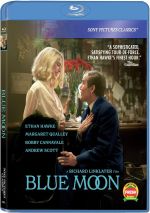
Back in 1948, Words and Music delivered a glossy look at successful musical lyricist Lorenz Hart. For a new look at Hart’s life, we go to 2025’s Blue Moon.
Lorenz Hart (Ethan Hawke) earned fame via the work he did with composer Richard Rodgers (Andrew Scott). This partnership falters due to the impact of Hart’s alcoholism and leads Rodgers to pair with Oscar Hammerstein (Simon Delaney), a new union that results in 1943’s Oklahoma!
After he attends opening night of that production, Hart slips away to commiserate with bartender Eddie (Bobby Cannavale) and deal with his jealousy since he knows the musical will become a smash. Though seemingly gay, Lorenz also finds himself fascinated by college student Elizabeth Weiland (Margaret Qualley).
As noted, 1948’s Words and Music looked at the Rodgers and Hart partnership, though it did so in an extremely sanitized manner. While Hart died five years earlier, Rodgers remained alive and active at that time, and the movie wouldn’t dare do anything to besmirch the living legend.
Even if Music wanted to paint Hart in a negative light, though, the mores of the era couldn’t do so with honesty. While the film showed him as lonely and needy – which we also see here – Music couldn’t explore either Hart’s sexuality or alcoholism.
Honestly, Music barely exists as a narrative, for it mainly feels like a bunch of musical performances punctuated with occasional character beats. This means Moon comes with ample opportunity to broach territory untouched in its 1948 predecessor.
For the most part, Moon succeeds in that regard, though it comes with unusual construction. Almost the entire film takes place in a bar where Hart retreats during that opening performance of Oklahoma!
As a result, Moon can feel more like a filmed stage play than an actual movie. Not that director Richard Linklater doesn’t imbue Moon with cinematic flourishes, but the limited setting ensures that it doesn’t stretch boundaries.
In truth, at times Moon feels like a vehicle to exist as a showcase for Hawke’s talents. He plays against type as Hart, an unusual mix of gregarious/charming and lonely/needy.
Hawke also plays against height. The five-foot-10 actor needs to squat a whole lot to resemble the five-foot-nothing Hart.
As I write this, the Oscar race for Best Actor seems to come down to Hawke against Timothée Chalamet’s work in Marty Supreme. Both offer excellent performances, though I admit I hope Hawke wins as a form of “career recognition”.
That shouldn’t diminish how impressive Hawke becomes as Hart, though. He manages to create a fully realized character, one who turns on a dime dependent on his audience.
When in the bar with just Eddie and a few others, Hart treats Oklahoma! and its authors with acerbic condescension. When Hart, Hammerstein and others there to celebrate the premiere arrive, he immediately attempts to ingratiate himself with them and lavish praise on the new musical.
Does Hart really hate Oklahoma! and only kiss up to Rodgers because he wants to renew their partnership, or does he truly admire the production but his jealousy prompts him to insult it? Good question, and Hawke’s deft performance ensures we can see Hart’s attitude either way.
When Moon sticks with the tensions related to Oklahoma! and Rodgers, it does very well. However, the subplot related to Elizabeth feels somewhat gratuitous.
I get that these scenes demonstrate Hart’s emotionally needy side and his desperation for love. Actually, that was one area of Words and Music the earlier film managed to pull off, as Mickey Rooney’s Hart came across as appropriately lonely.
However, I think Moon conveys Hart’s eagerness for approval and affirmation enough without Elizabeth. Granted, her presence adds an interpersonal air that the parts with Rodgers lack since those seem more oriented toward Hart’s career.
Nonetheless, the Elizabeth segments just don’t fit. They can feel like they come from an entirely different movie and they take the flick off-course whenever they arise.
But not badly astray, as Hawke’s stellar lead performance ensures that we remain invested in the tale. Ultimately Blue Moon presents a strong character piece.