Reviewed by Colin Jacobson (February 17, 2026)
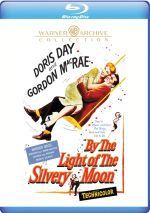
Originally successful as a pop singer, Doris Day made her film debut via 1948's Romance on the High Seas. Although Day wouldn't reach her peak fame as an actor until the late 1950s/early 1960s, many of her prior flicks did well, and 1953's By the Light of the Silvery Moon provides an early hit.
At the end of World War I, 20-year-old soldier Bill Sherman (Gordon MacRae) returns home to small-town Indiana. This thrills his 18-year-old girlfriend Marjorie Winfield (Day), as she feels this means the two can soon wed.
However, Bill now thinks that he needs to build some financial security before he and Marjorie marry. She seems less than excited to wait and this leads to complications, especially when Marjorie desires to join the workforce and Bill feels unhappy with that concpt.
Already in her early 30s during the film’s shoot, Moon wants us to buy Day as a teenager. This becomes a bridge too far, though the use of the also-early-30s MacRae as her only-slightly-older love interest means the movie at least avoids a contrast between the ages of the two leads.
Of course, films often use much too old actors to play barely adult roles, so I shouldn’t pick on Moon for this. Still, it feels like an awfully big stretch to present the 30-somethings as kids barely out of high school.
When I look at the movie beyond these awkward casting choices, does it succeed? Ehh, to some degree, as the movie provides occasional charms among a lot of fluff.
Unbeknownst to me as I entered my screening of Moon, it acts as a sequel to 1951’s On Moonlight Bay. That one introduced the Winfield family and launched the Marjorie/Bill relationship that heads toward fruition here.
Given I didn’t know Bay existed until I prepped this review, obviously I can’t compare the two. I strongly suspect that it offered the same format found here, though.
And what format would that be? Moon delivers a mix of light comedy, romance, music and melodrama.
Despite the implications of my synopsis, Moon exists as little more than a collection of scenes that revolve around the loose theme of Marjorie and Bill’s impending nuptials. Actually, the film loses track of that domain for fairly long stretches as it explores various side plots.
In particular, we get “controversy” when Marjorie’s banker dad George (Leon Ames) must consult with sexy stage performer Renee LaRue (Maria Palmer) and some family members suspect he conducts an illicit romance with her. We also see how younger brother Wesley (Billy Gray) tries to save his pet turkey from the Thanksgiving table as well as Wesley’s flights of fancy when he imagines himself as a private detective.
All of this leads to a fluffy concoction that seems episodic in nature. Again, while we find the through-line of the Marjorie/Bill relationship, Moon flits from one sub-story to another most of the time.
This makes the end product lighter than air but not an unpleasant screening. While I don’t think Day ever became a great actor, she did present a vivid screen presence, and that helps here.
Day’s charm goes a long way. While completely unconvincing as an 18-year-old, Day’s sweetness and spark allow us to overlook these issues.
MacRae proves less effective as Bill. Not only does he look closer to 40 than to 20, but also he just seems like a dud as a screen presence.
Day’s charisma helps elevate MacRae somewhat, but he simply can’t bring life to his role. In his hands, Bill becomes a flat male lead.
At least we find a capable supporting cast. Ames, Gray and Rosemary DeCamp prove more than serviceable as the other Winfields, and Mark Wickes offers her usual amusingly no-nonsense comedic presence as family housekeeper Stella.
All of this leaves Moon as a watchable confection and nothing more. It fills 102 minutes with moderate entertainment but it never threatens to become anything memorable.