|
EAGLE ROCK ENTERTAINMENT
|
| |
|
MOVIE INFO
|
|
Director:
George Scott
Cast:
Duran Duran
Writing Credits:
Various
Synopsis:
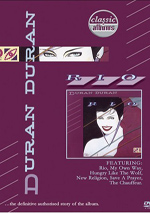
This latest addition to the acclaimed Classic Albums series takes us to the early eighties and the release of Duran Duran's second album "Rio". Released against a backdrop of riots, record unemployment and the Falklands War this optimistic and celebratory album would generate a string of hit singles and groundbreaking videos and catapult Duran Duran to global stardom. This DVD tells the story behind the writing, recording and subsequent success of the album through newly filmed interviews, musical demonstrations and both new and archive performances.
MPAA:
Rated NR
| |
|
DVD DETAILS
|
Presentation:
Widescreen 1.78:1/16X9
Audio:
English Dolby Stereo 2.0
Subtitles:
English
Spanish
French
Closed-captioned
Supplements Subtitles:
English
Spanish
French
Runtime: 52 min.
Price: $14.98
Release Date: 11/18/2008
Bonus:
• Added Interview Footage
• Five Songs “Live from Boston”
| |
|
PURCHASE @ AMAZON.COM
|

| |
|
EQUIPMENT
|
Panasonic 50" TH-50PZ77U 1080p Plasma Monitor; Harman/Kardon DPR 2005 7.1 Channel Receiver; Toshiba A-30 HD-DVD/1080p Upconverting DVD Player using HDMI outputs; Michael Green Revolution Cinema 6i Speakers (all five); Kenwood 1050SW 150-watt Subwoofer.
| |
[an error occurred while processing this directive]
|
Classic Albums: Duran Duran - Rio (2008)
|
|
Reviewed by Colin Jacobson (January 7, 2009)
Although most Classic Albums DVDs concentrate on the 1960s and 1970s, the series does show a willingness to view some newer albums as “classics”. For one of those, we learn about Duran Duran’s 1982 smash Rio.
The DVD follows the usual blueprint for the Classic Albums programs, as it presents band members and others connected with DD to detail the music and its creation. We hear from band members Simon LeBon, John Taylor, Roger Taylor, and Nick Rhodes as well as fashion designer Anthony Price, journalist Beverley Glick, photographer Denis O’Regan, musician Bob Geldof, co-manager (1980-1987) Paul Berrow, Capitol Records VP of A&R (1976-1982) Rupert Perry, video director Russell Mulcahy, EMI Video managing director (1980-1987) Geoff Kempin, US remix producer David Kershenbaum, and MTV co-founding executive John Sykes. (It comes as no surprise that estranged original guitarist Andy Taylor fails to appear here; he left the band a few years ago.)
In this program, we learn about aspects of the writing and recording of Rio. We also hear about shooting the music videos, the band’s origins and development, impressions of their music and their impact on society, their teenybopper success, and breaking in America.
Probably the main strength of the Classic Albums programs comes from the involvement of the folks behind the music and the insights they provide. In that vein, we always get fascinating dissections of the songs demonstrated in various ways. This usually means new performances, vintage clips, and audio taken from the original sessions.
That template holds true for Rio. Various band members sit at the mixing board to isolate elements of “Rio”, “The Chauffeur”, “New Religion”, “Hungry Like the Wolf”, “Save a Prayer” and “Hold Back the Rain”. John Taylor demos his bass parts for “Rio” and “Hold Back the Rain”, while Rhodes illustrates his synth work for “Save a Prayer”. Finally, the current incarnation of DD performs parts of “Rio”, “Save a Prayer” and “The Chauffeur”.
In addition to those modern elements, we get some snippets of vintage DD from the Eighties. I wish we got more of these, honestly, but they’re good to see when they appear. It’s too bad that some of the early footage lacks the original audio, though; occasionally the show has to dub the studio song on top of the film.
Having experienced quite a few Classic Albums releases, I can’t say that Rio does anything fresh or new. However, it doesn’t need to alter the existing template. We probably get too much general band history than necessary, though. Folks who get Classic Albums DVDs probably already know a lot about the bands in question, so we don’t need the five-cent history. We want insights about the recording specifics. I’d prefer that these shows totally omit the historical discussion; I’d like for them to just go through each album track in a matter of fact way and give us those details.
But the series does more than enough of that stuff well to succeed. I love the mixing board elements; I’d happily watch a full hour of those bits alone. The demos from the band members are also quite fun, especially when we hear about influences and how the pieces came into existence. For existence, Roger Taylor tells us a little about what songs they stole from for parts of “New Religion”.
These various factors combine to make Rio a winning take on the album. I love the fact that the Classic Album series examined an album many might slag as pop cheese. Hopefully this means more folks will stop dismissing the 1980s as a musical wasteland and come to recognize the era’s good material. Rio provides an interesting look at one of the period’s biggest releases.
|
The DVD Grades: Picture B-/ Audio B-/ Bonus B
|
|
Classic Albums: Rio appears in an aspect ratio of 1.78:1 on this single-sided, double-layered DVD; the image has been enhanced for 16X9 televisions. Overall, I thought the DVD offered decent but unspectacular visuals.
For the new material, sharpness appeared reasonably crisp and detailed. The picture looked consistently clear and accurate. Focus was more problematic in the older clips, however, as they demonstrated issues. Some of the videos and concert footage also came across as rather indistinct.
The program seemed to display no significant jagged edges or moiré effects in the new bits, though archival pieces could look ropy. I also saw no evidence of edge enhancement. The older footage appeared reasonably decent; the video footage tended to have that blurry, blocky feel typical of the era, though. As for the modern shots, they demonstrated a bit of grain but otherwise lacked flaws.
Most of the Classic Albums releases feature fairly subdued colors since they take place in studios and other indoor settings. Rio followed along those lines, as the tones looked fine but not terribly dynamic. Black levels looked fairly deep and rich for the new stuff, while shadow detail appeared clear and accurate. Overall, you won’t view Rio for its dynamic visuals, but it adequately represented the original material.
Similar feelings came with the Dolby Stereo 2.0 soundtrack of Classic Albums: Rio. Not surprisingly, this mix stayed with a front-oriented presence that largely hewed to the original stereo presentation of the music. Virtually everything other than the songs stayed in the center; I detected no evidence of effects or dialogue from anywhere other than the middle speaker. The music showed good stereo separation, though I expect some of that may have resulted from the original production of the album. Overall, it seemed like the music provided clean spread across the front, and the track used the rears for decent reinforcement of the songs.
Audio quality was somewhat erratic but generally positive. Dialogue was reasonably natural and distinct. As for the effects, well, there really weren’t any; this production featured music and dialogue almost exclusively. Of course, the songs were the most important aspect of the mix, and they came across well. The original tracks from Rio fared best of all, as they showed decent clarity and depth. Archival footage worked acceptably well, though of course it displayed a fair amount of variation. Those segments were usually clear but somewhat thin and flat. As a whole, the audio seemed good but unexceptional, largely due to the variety of source materials.
The disc’s extras break into two categories. We find six Additional Interview segments. These run between three minutes, 21 seconds and 15 minutes, 40 seconds; taken together, these last a total of 54 minutes, 28 seconds of material. I think that’s a first for Classic Albums: the “additional interviews” run longer than the main program!
We get notes from band members Nick Rhodes, John Taylor, Simon Le Bon, and Roger Taylor, video director Russell Mulcahy, journalist Beverley Glick, co-manager (1980-1987) Paul Berrow, Capitol Records VP of A&R (1976-1982) Rupert Perry, musician Bob Geldof, fashion designer Anthony Price, EMI Video managing director (1980-1987) Geoff Kempin, MTV co-founding executive John Sykes, EMU Records A&R (1980-1987) Dave Ambrose, US remix producer David Kershenbaum, graphic designer Malcolm Garrett, and New Sounds New Styles editor (1981-1982) Kasper de Graaf. The clips cover music videos, elements of “Save a Prayer” and “The Chauffeur”, the band’s early days, succeeding in the US, and the album cover.
These clips help flesh out some areas covered in the main program and they add new subjects as well. I wish the “Additional Interviews” would cover the Rio songs not discussed in the primary show - Classic Albums really should examine every tune on an album – but even with that shortcoming, we still find plenty of good details here.
The disc also includes five songs Live from Boston. We hear versions of “Rio”, “Save a Prayer”, “New Religion”, “Hungry Like the Wolf” and “The Chaffeur”. Should you expect vintage footage from the 1980s? Nope – and you shouldn’t even hope to see DD in front of an audience. Instead, these takes are shot live in the studio and feature the current incarnation of the band. I like the fact we get the full versions of the songs, since we hear only minor snippets of them in the full program. They’re not great performances, but they’re worth a look.
Some folks will quibble with the inclusion of Duran Duran in the Classic Albums series, but I admire the producers’ willingness to look beyond 1960s/1970s staples. The show provides a nice look at the album and the band. The DVD presents perfectly acceptable picture and audio along with some useful added footage and live performances. I love the Classic Albums series, and Rio becomes another winning entry in that line.
|
|
[an error occurred while processing this directive]
|
|