|
Reviewed by Colin Jacobson
New Line, widescreen 2.35:1/16x9, standard 1.33:1, languages: English DD 5.1 [CC], French Dolby Surround, subtitles: English, French, Spanish, double side-single layer, 16 chapters, rated R, 100 min., $24.98, street date 7/28/98. Supplements:
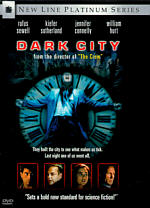
Directed by Alex Proyas. Starring Rufus Sewell, Kiefer Sutherland, Jennifer Connelly, Richard O'Brien, Ian Richardson, William Hurt. Alex Proyas, the acclaimed director of The Crow, brings his unique visual style to this futuristic thriller about a man who discovers that his memories, and reality as he knows it, are artificial creations. A brilliant, complex film, Dark City is a tale of mythic proportions about one man's battle to reclaim his destiny. John Murdoch (Sewell) awakens alone in a strange hotel to find that he is wanted for a series of brutal murders. The problem is that he can't remember whether he committed the murders or not. In fact, most of his memories have completely vanished, and for one brief moment, he is convinced that he has gone completely mad. Pursued by Detective Bumstead (Hurt), Murdoch seeks to unravel the twisted riddle of his identity. As he edges closer to solving the mystery, he stumbles upon a fiendish underworld controlled by a group of ominous beings collectively known as The Strangers. These shadow-like figures possess the ability to stop time and alter physical reality through a process known as Tuning -- by focusing their minds, they are able to change the environment. Through an evolutionary anomaly, Murdoch is also endowed with this power and thus, he alone is able to resist The Strangers' control over his mind. And for that, he must be destroyed. With the help of the inscrutable Doctor Schreber (Sutherland), Murdoch is able to stay a step ahead of his adversaries while he slowly pieces together the labyrinthine puzzle of his past -- his bittersweet childhood, his love for his estranged wife, Emma (Connelly), and the key to a hideous series of murders which he is suspected of committing.
Thank heaven for home video, because it lets us find little treasures that we otherwise wouldn't experience. Dark City definitely falls into that category. Actually, I never thought about seeing the film until after the success of The Matrix. I heard that the two films boasted a number of similarities, and since I really liked The Matrix, I thought I should finally give DC a look. And I'm glad that I did. I prefer The Matrix because, well, I'm an action film kind of guy, but DC certainly holds its own as a more thoughtful alternative. It's weird that because I saw DC months after I viewed The Matrix, it's hard to remember that DC came first. Both films really do offer a lot of similarities, primarily due to plots that revolve around the nature of the "real" world and expository paths that follow somewhat obscure and circuitous routes, but I don't think that The Matrix was a rip-off of DC. Yes, it came out more than a year later, which certainly would seem to have been plenty of time for the makers of The Matrix to see and copy DC, but since the former film spent lots of time in preparation - six months martial arts training for the actors alone! - it's pretty clear that these similarities seem to be coincidences.
And it's pretty entertaining, too! I thought that the movie might lose something the second time around since much of its pleasures are similar to those of a mystery; the viewer spends most of the movie just trying to make sense of what's happening and what the underlying truth is, both of which become irrelevant upon subsequent screenings. DC offers a rich and detailed enough experience, however, that I liked it as much the second time as I did the first; what I lost in impact I gained in nuance. DC definitely draws you in and keeps you hooked. As with The Matrix, Dark City is one of those movies that can even wriggle out of apparent flaws due to the nature of the story. In my review of The Matrix, I noted that some of the computer animation looked fake, but that was actually a good thing due to the way the computer-created objects were supposed to have been generated in "real" life. In DC, it's the acting that often seems flat and wooden. However, it can easily be argued that the performances should come across as vaguely disoriented and uninvolved due to the nature of the story; these are people whose lives get changed radically every few days, so it would seem natural that their personalities appear unformed and tentative. I'm not completely sure that premise excuses everything - part of me thinks that while these folks have indeed gone through frequent personality changes, they don't know that and they think they've been who they are forever; as such, their personas should seem well-established to themselves and their lack of engagement doesn't make sense. However, I suppose the latter supposition requires the memory implants and their execution to be flawless, and it's probable that some bugs exist, so I guess it's sensible that the new personalities come across as pretty blah.
As for the rest of the actors, I've had a hard time fully deciding what to make of Kiefer Sutherland's performance as Dr. Schreber. When I first watched the movie, I hated his acting; he comes across as much too mannered and forced. However, this didn't bother me nearly as much the second time through, and his choices made more sense to me. I'm still not sure I agree with them, and I don't know if I consider it good acting, but Sutherland seems to do an acceptable job in what is mainly an expository role. Jennifer Connelly is one of the world's great babes, but her acting's nothing special. She's okay as John's "wife" Emma, but she seems overly blah. William Hurt provides probably the most spark and depth in his role as Inspector Bumstead; it's nice to see him and he seems to enjoy himself. The villains of the piece - pasty-faced baldies called the "Strangers" - are appropriately ominous and Richard O'Brien seems to invest his role as Mr. Hand with the appropriate relish. Actually, my favorite character in the whole film had to be wee Stranger Mr. Sleep; he's this creepy little kid, and his presence adds a layer of spookiness to the Strangers that otherwise might be absent. As usual, New Line have done an excellent job with this "Platinum Series" DVD. Dark City offers both fullscreen and widescreen presentations. The latter is shown in the movie's theatrical aspect ratio of 2.35:1 and is enhanced for 16X9 televisions.
In regard to the film's Dolby Digital 5.1 mix, it's not a spectacular track - it lacks much of the flashiness we've come to expect - but the audio but is nicely involving. The front soundstage works especially well; there's very nice separation on the front channels. Use of the rear speakers seems more limited than is typical for this kind of film, but it contributes to the immersive sound environment; usually we don't hear many split surround effects, but instead the rears simply add depth to the sound imagery. In regard to the quality of the audio, dialogue, effects, and music all sound strong; they appear clean, crisp, and natural. Dark City doesn't offer "demo" material with its audio, but it definitely provides a nicely complementary sound experience. Since it's a "Platinum Series" release, DC includes some supplements, and most of what's here is pretty good. The main attractions of this DVD are the two audio commentaries. One comes from the crew of the film and it provides a pretty nice "nuts and bolts" description of the movie; we learn some nice insights into how the picture was made and what the filmmakers were trying to achieve. Even better is a track from critic Roger Ebert. He apparently thought that DC was the best film of 1998 and he offers a rich critique of the film. This kind of commentary is very informative and helps the viewer better understand various aspects of the filmmaking process; it'd be great if we heard more of this kind of track. In addition, DC offers a fair amount of text information. An essay from comic book writer Neil Gaiman contains some interesting observations, and we get biographies for six cast members and six crew members. Since Dark City shares some commonalities with silent classic Metropolis, a historical essay discusses that film. We also see two negative reviews that greeted the initial release of Metropolis, one from no less an authority than H.G. Wells! Pretty cool stuff.
Last - and least - is an "interactive game" called "To Shell Beach." After going on a "wild icon chase" through all the supplements, if you click when you're supposed to do so, you'll eventually get to see a brief - and lame - cut and paste animation that semi-recreates a couple of moments from the film. Try it if you must, but be warned - it's not worth the effort! Despite that one misstep, Dark City makes for a very good DVD. The movie itself is very provocative and creative, and it seems to be the kind of film that will stand up to repeated viewings. Both sound and picture quality are very good, and the DVD includes two fine audio commentaries in addition to a complement of other interesting supplements. Dark City is highly recommended.
Previous: Zero Effect | Back to Main Page |