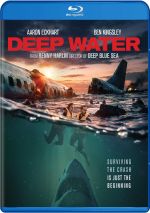
Reviewed by Colin Jacobson (July 6, 2026)
Back in 1999, Renny Harlin directed a moderately successful shark attack flick called Deep Blue Sea. 27 years later, he revisits that topic – and part of that title – via 2026’s Deep Water.
On a flight from Los Angeles to Shanghai, an explosion occurs in the cargo hold. This kills some passengers and requires the plane to land in the ocean.
Because the aircraft hits a coral reef, it splits into three sections. While crew and passengers attempt to figure out how to deal with this catastrophe, they also find themselves targeted as lunch by sharks.
As mentioned, Deep Blue Sea didn’t become a major hit. Nonetheless, it brought in $164 million worldwide, a decent sum for 1999.
Water did much more poorly at the box office. Even with a modest $40 million budget, its terrible $5 million take means it lost buckets of money.
Which seems like a fitting fate. Harlin’s probably made worse films than Water but it becomes a weak effort at best.
At its core, Water offers a potentially compelling effort. Basically a mix of airplane disaster flick and shark attack thriller, a more capable director could make this one a lively ride.
Unfortunately, no one with that level of skill appears here. Actually, with Aaron Eckhart and Ben Kingsley involved, the movie does involve at least two capable actors.
They can’t salvage this mess, and the script creates a lot of the problems. It took four people to write this clumsy screenplay with clunky dialogue and flimsy characters?
Neither Kingsley nor Eckhart does much to try to elevate the weak material. I suspect both knew they found themselves stuck in a dud and just punched the clock.
Never a subtle filmmaker, Harlin hasn’t changed with age. Though now pushing 70, he remains a ham-fisted director.
Harlin telegraphs every possible emotion and plot point. From literally the very start of Water, Harlin paints every moment with ridiculous emphasis and never allows the film any life or breathing room.
In the past, Harlin showed the same issues but even with flaws, he made some entertaining flicks. For instance, 1990’s Die Hard 2 offered a lesser sequel to the 1988 classic but at least Harlin gave us a movie with strong action beats.
Nothing of the sort arises in the thrill-free Water. Despite Harlin’s desperate attempts to give us scares via the disaster and shark attack elements, the end result feels too one-dimensional and cheesy to hit the mark.
Budgetary constraints don’t help the project either. As noted, apparently Water cost $40 million, a sum clearly insufficient to fulfill its goals.
It seems clear that Water used a whole lot of green screen – and ineffective green screen at that. While I imagine the effects crew did their best with these limited financial resources, the end product looks so fake that the unconvincing visuals damage the tale’s ability to impact the viewer.
Not that $200 million for effects would fix the basic problems at the heart of Deep Water. A bad director and a bad script ensure we wind up with a bad movie.