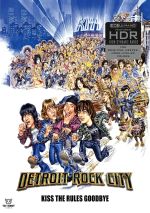
Detroit Rock City appears in an aspect ratio of approximately 2.35:1 on this Blu-ray Disc. The movie looked pretty good.
Sharpness worked fine overall. An occasional slightly soft shot emerged – some of which stemmed from the photographic attempts to make City “look like 1978” – but delineation usually seemed solid.
No issues with shimmering or jaggies materialized, and I saw no edge haloes. Grain seemed natural and print flaws failed to manifest.
Colors went with a pretty natural palette, albeit one that could come across as a bit subdued for the aforementioned period vibe. In any case, the hues were well-rendered within cinematographic choices.
Blacks appeared reasonably tight and shadows offered positive clarity. Though not a visual showcase, the image held up fine.
Given the movie’s subject matter, music dominated the DTS-HD MA 5.1 soundtrack of City. The forward channels showed good stereo presence, and the back speakers added decent reinforcement of the songs and score.
Effects played a smaller role, but they contributed occasional moments of merit. Most of these came from elements meant to accentuate actions, as the track boasted some loud “punctuation” bits at times. Much of the mix stayed focused on music or dialogue, so don’t expect a lot from the soundscape.
Audio quality was fine. Speech sounded fairly natural and concise, without edginess or other issues.
Effects were accurate, while music seemed pretty peppy. Nothing here excelled, but the mix appeared acceptable for a film of this sort.
How did this 2026 Toy Robot Blu-ray compare to the prior BD? Both seemed very similar and I detected no obvious improvements via the 2026 BD.
When we shift to extras, we find three separate audio commentaries. For the first, director Adam Rifkin presents a running, screen-specific look at how he came to the project, story/characters, cast and performances, influences and period details, sets and locations, music, photography, editing, cut scenes and pacing, ratings choices and related topics.
From start to finish, Rifkin makes this a solid chat. He covers a broad array of subjects and gives us a blunt and informative view of the film.
During the second commentary, we hear from screenwriter Carl Dupre, editor Peter Schink, associate producer Tim Sullivan and actors Sam Huntington, Giuseppe Andrews, James DeBello, Lin Shaye, Shannon Tweed, Melanie Lynskey, Miles Dougal, and Richard Hillman. Huntington’s mother pops up briefly as well.
This edited track appears to place most of the participants together whereas DeBello and Huntington join via separate sessions. The discussion gives us notes about story/characters, influences and inspirations, edits and cut scenes, cast and performances, music, and connected domains.
The format annoys at times, mainly because the track’s producers decided to mix separate recordings together with overlapping remarks at times. This gets old and annoying.
In particular, DeBello’s remarks just grate. He offers “irreverent” interjections that add nothing to the experience and instead become a persistent nuisance.
Still, the track largely brings a good look at the various issues. Despite some irritating choices, we learn more than enough along the way to ensure the track merits a listen.
Finally, we locate a commentary from Kiss members Paul Stanley, Gene Simmons, Ace Frehley and Peter Criss, but this doesn’t put the band together to chat. Instead it consists of four separate interviews, and we hear from them one after another.
The track starts with Simmons in a studio and then we get phone discussions between Tim Sullivan and Criss, Stanley and Frehley, in that order.
They discuss the history of Kiss and their involvement in the film. Simmons provides the clearest notes but he also clearly works from a written script, so his segment lacks the looseness of the rest.
Also, Simmons never has been the most reliable self-narrator, as he tends to prefer to promote the legend of Kiss rather than the reality. Still, Simmons gives us enough believable insights to make his part worthwhile, even if his claim that rock music defeated disco seems comical all these years later.
Stanley tends to seem guarded, as he also appears to want to protect the Kiss brand and not be totally frank. Criss offers a bit more insight, though he doesn’t come with a lot of particularly interesting thoughts.
Always the loosest band member, Frehley gives us the most entertaining and honest take on the topics. No, he doesn’t really cut loose – Ace wouldn’t truly bite the hand until he quit the band again a few years after this recording session – but at least he gives the discussion more life.
Even with the flaws, I still like this chat, though I wish Sullivan provided a less “fanboy” vibe as an interviewer. He also seems to think Kiss invented everything, and that means the musicians actually correct him occasionally to remind him the Beatles previously did most of what he credits Kiss for doing.
Six Deleted Scenes fill a total of 18 minutes, 43 seconds. We find “Too Many Cigarettes” (1:20), “Elvis” (2:04), “Highway Patrol” (5:20), “Long Way to Go” (2:19), “The Confessional” (1:58) and “Another Movie” (3:52).
These generally just extend versions of existing pieces, though “Long Way” radically changes the tone of the encounter between Edward Furlong and Shannon Tweed.
“The Confessional” includes the audition tapes for Sam Huntington and Melanie Lynskey. This material is a lot of fun.
,
"Another Movie" allegedly comes from an unfinished film that was to be shot simultaneously along with City. Director Adam Rifkin introduces this piece by saying that they wanted to make an improvised experimental movie that would be made during downtime so that way they could have two films for the price of one.
Unfortunately (?), they only had time to shoot this one segment. I don't know if this is true or a put-on, but the presented scene is pretty dopey. The story behind it seems funny, though.
With Cutting Room Floor Montage, we get a four-minute, 17 second segment that shows the teen band and then lets us see the actors in the recording studio. Meh.
We then find 19 minutes, 50 seconds of Kiss as they lip-synch for the movie’s concert segments. This provides the song “Detroit Rock City” from four different camera angles, a nice touch even if picture quality seems lackluster.
Look Into the Sun (7:57) was shot on video by cast members - mainly James DeBello – as it edits together some random images that are connected by little sound and video effects. It's a mildly amusing but pretty nonsensical view of the production.
We get a more traditional “making of” piece via Misc Stuff (36:56) provides a more traditional “making of” program. It comes with comments from Simmons, Rifkin, Shaye, DeBello, Sullivan, Huntington, Andrews, Frehley, Stanley, Criss, producers Kathleen Hasse and Barry Levine, and actors Natasha Lyonne and Edward Furlong.
The show looks at the project’s roots and development, how Rifkin came to the film, cast and performances, costumes and period details. It becomes a pretty solid summary.
New to the 2026 release, we get three separate interviews. The first involves Adam Rifkin and goes for 19 minutes, 20 seconds.
Rifkin discusses his youthful interest in movies as well as elements related to the development and production of City along with its release and afterlife. Some of the content repeats from elsewhere but we get a fairly good summary nonetheless.
For the next chat, we hear from Lin Shaye (14:40) as she digs into her life, her career and her time on City. The long-time character actor brings us an engaging chat.
Finally, a conversation with production designer Steve Hardie (15:16) goes over his time in movies and his efforts for City. We get another useful reel.
In addition to the film’s trailer, two music videos ensue, as we find “Strutter” from the Donnas and “The Boys Are Back in Town” by Everclear. “Strutter” mixes antics from the Donnas with movie clips, but it does it in a way to become more fun than usual for the genre.
“Boys” combines lip-synch performance with new footage of the actors. It delivers another reasonably good video, though I prefer “Strutter”.
We wrap with a Stills Gallery that includes 117 images from the production as well as publicity elements. It becomes a good compilation.
While it wants to become an irreverent throwback to the wild comedies of the 1970s, Detroit Rock City instead turns into a puerile mess. With unlikable characters and little wit or cleverness, the movie flops. The Blu-ray comes with positive picture and audio as well as a nice roster of bonus features. Though I don’t like the movie, this release brings it home well.
Note that this Toy Robot Blu-ray edition of Detroit Rock City comes only as part of a two-disc set with a 4K UHD rendition of the film. Because fans without 4K UHD capabilities might want the package for the Blu-ray, I felt it deserved a review of its own.