Reviewed by Colin Jacobson (February 25, 2011)
I suppose that I should admit this up front: I've never been terribly interested in the "Arthur" legend. (King Arthur, that is, though Dudley Moore never much interested me either.) It's not something I can easily describe. I certainly understand the appeal of all that "swords and sorcery" stuff, and I actually really like computer games that revolve around the subject (Wizardry, Heroes of Might and Magic), but movies or books about it usually leave me cold.
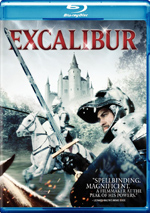
Nothing about 1981’s Excalibur changed my mind. I can't say that it was a poorly made film, but it had enough faults to keep me from maintaining much interest in it.
King Uther (Gabriel Byrne) seeks domain over all that he sees, and he uses the talents of wizard Merlin (Nicol Williamson) to grant him access to Excalibur, the sword of power, so he can achieve his goals. Uther achieves an accord with the Duke of Cornwall (Corin Redgrave), but he blows it when he decides he must do the nasty with Cornwall’s sex wife Igrayne (Katherine Boorman).
To bed her, Uther gets Merlin to make him look like Cornwall. Merlin agrees – for a price: Merlin will possess the product of their union. This means a son who comes along nine months later. Uther doesn’t care for this arrangement, but Merlin prevails, partially because soldiers loyal to Cornwall kill Uther.
Before he dies, Uther buries the sword in a stone - a stone that waits the “one true king” to retrieve it. Merlin casts a spell on the sword that means only the proper heir can remove it. This happens when 16-year-old Arthur (Nigel Terry) needs to grab a weapon for his guardian Sir Ector’s (Clive Swift) son Kay (Niall O’Brien). This leads Arthrut to become king, and we follow the various adventures and relationships, some of which focus on Arthur’s half-sister, sorceress Morgana (Helen Mirren).
I found two main flaws with Excalibur. For one, the acting seemed pretty weak. One major drawback with any film of this sort is the stilted, overly dramatic language the characters have to speak, and this aspect appeared even worse than usual in Excalibur. Almost to a one, the actors chose to really go over the top with their line deliveries; most of them use these incredibly emotive, pseudo-Shakespearian readings that often seem much more artificially intense than is necessary. I got the feeling that none of these folks could ask to borrow a cup of flour without trying to make it sound like a matter of life or death.
That qualifier "trying to" is an important one, for I felt that all of this emotional intensity undermined rather than supported the project. So much of the material came across as ridiculously overwrought. I understand that actors in this sort of film have to walk a very thin line between casual and dramatic; for example, more subdued performances of this kind of material can seem somewhat silly, like Dennis Quaid's semi-Valley Boy work in Dragonheart. Nonetheless, I found the acting in Excalibur to fall too far on the emotive side of the equation, and that made the movie less entertaining to me.
In regard to individual actors, I only thought a couple of them did good work. Actually, only Nigel Terry as Arthur really impressed me to any degree. I didn't care for his voice work, but he did a very good physical job with the role. Arthur is clearly the most demanding part in the film; not only is he the central character, but Terry had to play the role as a young man all the way through semi-old age (his fifties, I'd guess? It's not clear how old Arthur should be at the end of the film). Terry sounded silly, but he used his body and his attitudes to nicely convey the different moods of the king; frequently it appeared that another actor was performing the role, a fact partly due to makeup, but mainly the result of Terry's convincing portrayal.
After Terry, no one else - not even the accomplished Helen Mirren - impressed me. Of the main actors, Nicol Williamson's Merlin was so far over the top that he teetered dangerously on the edge of camp. No, I take that back - Williamson did descend into the world of campiness as Merlin. It's a silly performance that left me cold.
As Arthur's number one guy Lancelot, Nicholas Clay managed to provide a pretty presence, but that's about it; he invested the role with little power, authority, or emotional nuance. Well, at least he's attractive; that's more than I can say for the female in the Camelot love triangle, Cherie Lunghi's Guenevere. Granted, maybe she just doesn't fit my taste in women, but I found her to be rather unattractive. This is the woman who so fascinated our two heroes? She's not a skank or anything, but she's no royal beauty either. Unlike the other hyper-emotive actors, she seems much more subdued; however, that may not be such a great thing, as it reduced her presence to an almost invisible level and she made very little impression on me.
Mirren's Morgana, however - wow! While Mirren’s aged well, I never knew that she'd ever looked so good. Unfortunately, I didn't think much of her acting; she seemed bitten by the "ham bug” as well, and invested far too much of that attitude into her performance.
Interestingly, Excalibur offered early roles to some now well-known actors; Gabriel Byrne, Liam Neeson, and Patrick Stewart all feature in supporting roles. None of them were terribly interesting, though I did find Byrne's bit the most interesting. That's because of all the vocal emoters, he was the king. He went so over the top with his line readings that I barely recognized him. I thought to myself that it sure looked like Byrne but it sure didn't sound at all like him. It was him, though, biting off hunks of scenery at a time. (I suspect that another actor may have dubbed Byrne’s lines. During his audio commentary, director John Boorman mentions Byrne's accent in a not-terribly-complimentary way, and I thought he might tell us that someone else did his voice. If that's the case, however, Boorman never actually says it.)
My second problem with Excalibur was the brevity of the piece. At 140 minutes, it's a long film, but not lengthy enough to adequately cover its story. It simply felt like all of the aspects of the Arthur legend were rushed through and abbreviated. Boorman may have bitten off more than he could chew, and the film might have benefited from focusing more closely on some portions of the legend rather than the whole thing. Excalibur literally includes enough story material for five or six movies; the attempt to pack so much into so little time doesn’t succeed.
Enough griping: so what did Excalibur do well? It's a grand looking film, with lush settings and convincing props and costumes. Excalibur apparently had a relatively modest budget, but Boorman created a film that appeared much more costly. Although the story seemed condensed, Boorman did a nice job of moving things along; he kept the action going and managed to makes the multiple transitions between different eras without much difficulty.
Despite these positives, the end result left me cold. I didn't think that Excalibur was a bad film; it's actually somewhat entertaining at times. I just felt that it had enough shortcomings to substantially mar the affair.