DVD Movie Guide @ dvdmg.com Awards & Recommendations at Amazon.com.
.
Review Archive:  # | A-C | D-F | G-I | J-L | M-O | P-R | S-U | V-Z | Viewer Ratings | Main
ARROW

MOVIE INFO

Director:
Joel Schumacher
Cast:
Michael Douglas, Robert Duvall, Barbara Hershey
Writing Credits:
Ebbe Roe Smith

Synopsis:
An ordinary man reaches his breaking point and starts lashing out against the various flaws he sees in society.

Box Office:
Budget:
$25 million.
Opening Weekend:
$8,724,452 on 1220 screens.
Domestic Gross:
$40,903,593.

MPAA:
Rated R.

DISC DETAILS
Presentation:
Aspect Ratio: 2.39:1
Audio:
English DTS-HD MA 4.0
English LPCM 2.0
Subtitles:
English
Closed-captioned
Supplements Subtitles:
None

Runtime: 113 min.
Price: $39.95
Release Date: 7/21/2026

Bonus:
• Audio Commentary with Director Joel Schumacher, Editor Paul Hirsch, Screenwriter Ebbe Roe Smith, LA Times Writer Shawn Hubler, and Actors Michael Douglas (circa 1993), Michael Paul Chan, Vondie Curtis-Hall, and Frederic Forrest
• “Man on the Edge” Featurette
• “At War With the World” Featurette
• “Going Home” Featurette
• “Deconstructing D-FNS” Featurette
• Trailers
• Image Gallery


PURCHASE @ AMAZON.COM

EQUIPMENT
-LG OLED65C6P 65-Inch 4K Ultra HD Smart OLED TV
-Marantz SR7010 9.2 Channel Full 4K Ultra HD AV Surround Receiver
-Panasonic DMP-BDT220P Blu-Ray Player
-Chane A2.4 Speakers
-SVS SB12-NSD 12" 400-watt Sealed Box Subwoofer


RELATED REVIEWS


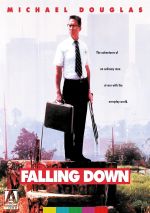
Falling Down: Collector's Edition [Blu-Ray] (1993)

Reviewed by Colin Jacobson (June 30, 2026)

While best known for “style over substance” flicks like The Lost Boys and Batman and Robin, director Joel Schumacher occasionally attempted something a little darker and more serious. In that vein, he created 1993’s Falling Down, a tale of urban anxiety.

Bill Foster (Michael Douglas) leads a quiet life, but he grows increasingly fed up with the little bits of indignation he seems to endure on a daily basis. When he feels pushed too far, he finally snaps.

Stuck in one of LA’s patented never-ending traffic jams, Foster abandons his car on the freeway and declares he’s going home and we follow his circuitous, confrontational path. This leads him on a violent journey that brings soon-to-retire cop Prendergast (Robert Duvall) on his tail.

When Falling hit screens in 1993, it caused quite a stir. After all, it appeared less than a year after the LA riots that greeted the Rodney King verdict, so it seemed awfully timely.

Falling doesn’t directly tap the same subject matter, as the LA riots more firmly connected to racial injustice, while the film visits the degeneration of society in a more general way. Oh, we occasionally get a sense of Foster as a racist.

However, I don’t think that perception feels accurate. Like John Doe from Se7en, he’s more concerned with the actions of the various folks than with their skin color.

Still, there’s the same sense of the social tension that came to the fore in April 1992, so Falling connects with its era. 33 years later, it still feels timely.

This becomes especially true given the way in which very white Bill feels disenfranchised by his country, a vibe the Trump administration attempts to exploit for their own means. I suspect the MAGAs view Bill as a hero, which I don’t think the filmmakers intended.

A more skilled director could’ve really explored this territory in a satisfying way, but Schumacher’s too superficial. He prefers bits of cheap symbolism.

For instance, during the tussle at a Korean convenience store, the participants knock a jar of little American flags to the floor so it breaks and spills the flags on the ground. This kind of imagery seems obvious and tacky, as it doesn’t add anything to the film and simply distracts us.

More problematic, however, is Schumacher’s inability to find a consistent tone for the movie. He doesn’t seem sure if he wants this to be a harrowing journey into madness or a light spoof of societal rudeness.

The film takes itself too seriously to become a satire. However, it’s too silly for the audience to buy it as a realistic drama.

Maybe Schumacher thought he needed some light moments to temper the tension, but most of those bits just feel out of place. Take the scene at the burger joint.

The employees wear goofy hamburger hats that distract us because they’re unrealistic – I’ve never seen silly caps like that at any fast food place – and dopey. It feels like the art director got to Schumacher and they went with the easy laugh instead of realism.

Again, if the movie went down a more consistently satirical path, bits like that would be acceptable. That happens again in the scene with the panhandler who can’t do anything right.

C’mon – who’s dumb enough to claim he hasn’t eaten in days when he has a hamburger in his hand? The movie jumps from darkness to light comedy in the blink of an eye, and all those shifts undercut the various elements.

But Schumacher was never one for subtlety. In the film’s world, everything reinforces the story’s point.

Funny how everyone Foster encounters is so intensely rude. Wouldn’t you think he’d occasionally run into someone who doesn’t act like a total jerk?

But that’d undercut the flick’s theme. Schumacher can’t allow anything to interfere with his one-dimensional portrayal of events.

At least the actors bring some depth to the material. Foster is essentially a caricature of the Angry White Man, but Douglas makes him borderline sympathetic. He’s too nuts and too cruel to become a likable character, but at Douglas ensures that he isn’t just a cartoon.

Duvall brings the most verve to the movie. He gets an underdeveloped character, and the arc with his needy, pushy wife seems unnecessary.

Poor Tuesday Weld gets stuck with the role as the harpy who controls him, and I think the movie would be better without her. Prendergast’s tale works just fine without her intrusions, and Duvall adds a lot of spark to his take on the role.

Falling Down remains an interesting movie despite its flaws. While a different filmmaker could’ve made something great out of it, I will acknowledge that it’s still more than watchable under Schumacher’s direction.

Nonetheless, I can’t help but view it as a missed opportunity. We find a movie that could’ve been much more dynamic with a more skilled storyteller behind the camera.


The Disc Grades: Picture B+/ Audio B/ Bonus B

Falling Down appears in an aspect ratio of approximately 2.39:1 on this Blu-ray Disc. The image held up well over the decades.

Sharpness appeared positive most of the time. A few wide shots showed a smidgen of softness, but not to a substantial degree so the majority of the flick provided good clarity and accuracy.

I saw no issues with jaggies or shimmering, and edge haloes remained absent. Grain felt natural and I witnessed no print flaws.

The palette of Falling Down opted for a generally arid set of colors that reflected a sweltering day and an intense mindset, with a lean toward orange/amber. Within those parameters, the colors worked well.

Blacks seemed dark and tight, and shadows presented good delineation. Overall, this was a quality transfer.

I also thought the DTS-HD MA 4.0 soundtrack of Falling Down fit the film. While the story didn’t provide a vast number of active scenes, it went with an oppressive tone to match the material.

This meant environmental material that created a feeling of tension. A few sequences came across as a bit more involving – such as a drive-by shooting – but most stay in the realm of ambience. These worked fine, and the score showed nice stereo information

Audio quality always satisfied, with speech that appeared natural and distinctive despite a few edgy moments. Music showed nice range and definition, while effects were clear and concise.

The louder bits demonstrated decent bass response. Nothing here dazzled, but the track was perfectly satisfactory.

How did this 2026 Blu-ray compare to the original BD from 2009? The Arrow disc’s DTS-HD MA 4.0 replaced a Dolby TrueHD 5.1 mix from the prior release.

Though Down came out in the “5.1 era”, it appears to have used Dolby Stereo so the 4.0 track seems to represent the theatrical track. Both felt pretty similar, as the 5.1 didn’t do enough to expand the 4.0’s horizons to provide a clear difference.

The 2026 disc’s picture looked better defined and lacked the mild edge haloes of the 2009 disc. Though not an enormous upgrade, the 2026 release brought the superior visual experience.

The Arrow disc mixes old and new extras, and we open with an audio commentary from director Joel Schumacher, editor Paul Hirsch, screenwriter Ebbe Roe Smith, LA Times writer Shawn Hubler, and actors Michael Douglas (circa 1993), Michael Paul Chan, Vondie Curtis-Hall, and Frederic Forrest.

The commentary compiles a bunch of separate interviews and mixes them into this edited piece. The track looks at themes and characters, the film’s tone, story, script and development, cast and performances, editorial choices and the approach to the material, LA locations and the city’s climate in the early 90s, and a few production tidbits.

Despite the presence of so many participants, the commentary suffers from a surprising amount of dead air. Oh, you won’t find acres of space, but matters go silent more often than I’d expect.

Nonetheless, we get a fairly good look at the film here. Story/character notes come to the fore, and the actors contribute nice insights. There’s enough useful information to make this one worth a listen.

Also on prior releases, Deconstructing D-FENS: A Conversation with Michael Douglas runs 10 minutes, 12 seconds and includes the actor’s thoughts about the project and why he took it, his character and performance, the film’s use of LA, and his impressions of some specific scenes. Douglas provides a fairly introspective take on the flick and his involvement in it.

Three new featurettes ensue, and Man on the Edge goes for 18 minutes, 43 seconds. It brings more notes from screenwriter Smith.

The reel looks at Smith's inspirations and influences, the development of his script, changes made to the screenplay, and some related thoughts. Some of this repeats from the commentary but Smith nonetheless brings enough fresh content to make the program worth a look.

At War With the World spans nine minutes, four seconds. This one involves composer James Newton Howard.

We hear about Howard's relationship with Schumacher and his work on Falling Down. Howard provides an appealing take on his score.

For the last featurette, we locate Going Home, a 12-minute, 49-second reel in which we see the Falling Down locations as they exist in 2026. Accompanied by narration from Gillian Wallace Horvat, it becomes a decent overview.

In addition to two trailers, we conclude with an Image Gallery with 162 frames that cover movie stills, behind the scenes shots, ads and promo photos. The collection seems pretty meh overall, though I do find it amusing that all the publicity pictures of Douglas make him look nothing like his film character.

A superficial filmmaker, Joel Schumacher ensures that Falling Down never lives up to its potential. The movie entertains and keeps us occupied, but it suffers from too many flaws to even flirt with greatness. The Blu-ray offers positive picture and audio as well as a good mix of bonus materials. This turns into a solid release for an interesting but erratic film.


.
Review Archive:  # | A-C | D-F | G-I | J-L | M-O | P-R | S-U | V-Z | Viewer Ratings | Main