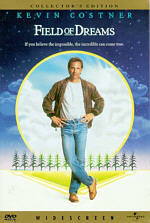
Field of Dreams appears in an aspect ratio of approximately 1.85:1 on this single-sided, double-layered DVD; the image has NOT been enhanced for 16X9 televisions. The lack of 16X9 enhancement was just one of the problems that marred this presentation.
Sharpness occasionally took a hit. Some of this came from the lower resolution of the non-anamorphic transfer. I noticed quite a few instances of jagged edges as well as some shimmering, and wide shots tended to be moderately soft and undefined. Mild edge enhancement came along for the ride as well; haloes contributed to the movie’s occasional impression of softness.
Source flaws were another concern. The film seemed grainer than usual, and I noticed sporadic examples of specks, grit, nicks and other blemishes. Though these never became heavy, they created more than a few distractions.
Colors sometimes looked good, as the movie boasted a rich, natural palette. However, the tones could be too heavy, so I thought colors weren’t as vivid as they should have been. Blacks seemed somewhat inky, and shadows tended to be moderately muddy. This wasn’t a bad enough transfer to fall to “D” territory, but it disappointed nonetheless.
Don’t expect much from the film’s Dolby Surround 2.0 soundtrack either, though it seemed acceptable for a film of this one’s age. The soundfield was pretty subdued through most of the flick. Music showed passable stereo definition, and a few scenes opened up the mix to a minor degree. For instance, the shots at Fenway Park presented decent spread to the side and rear channels. Otherwise, this was a low-key mix without much to impress the listener.
Audio quality also was satisfactory but not much more. A few lines sounded a little stiff, but most of the dialogue was reasonably natural and concise. Effects played a small role and didn’t do much to stand out from the crowd. Those elements were acceptably defined, though, and not an issue. Music fared best of all, as the movie’s score appeared fairly lively and rich. Lows could be slightly loose, but I thought the music was usually pretty good. Overall, this ended up as a pretty average soundtrack.
In terms of extras, we start with an audio commentary with director Phil Alden Robinson and director of photography John Lindley. Both sit together for this running, screen-specific chat. They discuss story issues and the adaptation of the original novel, sets and shooting in Iowa and elsewhere, cast and performances, baseball training, visual issues and cinematography, score and audio, various effects, and general production notes.
Though Lindley tosses in a few good notes, this is Robinson’s show and he dominates the commentary. The director makes this a consistently involving discussion. We learn a lot about the production and get many fine insights across this useful and engaging track.
Most of the DVD’s other supplements fall under the banner of The Field of Dreams Scrapbook. The main attraction here is a one-hour, 28-minute and 45-second documentary entitled A Scrapbbok. It mixes movie clips, archival materials, and interviews. We hear from Robinson, author WP Kinsella, producer Larry Gordon, head baseball coach Rod Dedeaux, production designer Dennis Gassner, farm owner Don Lansing, composer James Horner, and actors Kevin Costner, Burt Lancaster, Amy Madigan, James Earl Jones, Timothy Busfield, and Ray Liotta.
“Scrapbook” looks at the original novel and its adaptation for the screen. From there we go through cast, characters and performances, locations, sets, and connected concerns, a little baseball history, and attempts at baseball realism in the flick. The rest of the show goes into Robinson’s impact on the set and elements of shooting the movie, the score, marketing, and the film’s reception.
“Scrapbook” offers a very good documentary. It touches on most of the production’s appropriate subjects and does so in a rich, satisfying way. Surprisingly, not too much material repeats from the commentary, and that means the pair complement each other. We get a fine examination of Dreams via this solid program.
Hidden inside the “Language Selections” menu for the “Scrapbook”, movie music lovers will find a pleasant surprise: a stereo rendition of James Horner’s Score. This runs during the documentary and appears to offer the entire score for the film. I think it’s odd the DVD’s producers hide this option, but it’s a nice bonus anyway.
Back inside the many “Scrapbook” options, we locate the flick’s Shooting Script. This allows us to flip from page to page and check out the screenplay. The interface is less than user-friendly, but it’s a cool addition to the set.
More frames pop up in the Production Stills. We get a whopping 368 photos from the set and the film. Though the quality is pretty good, again the interface causes problems. You can’t do anything other than flip from one to the next, so God help you if you want to see picture 187 again. Still, I like the photos themselves.
Next we get some Articles About Doc Graham. These cover 98 screens as they tell us about the real-life character who inspired the movie’s “Moonlight”. They’re fascinating historical documents.
Potpourri includes a few stillframe odds and ends. We get facts about Joe Jackson and a few others as well as photos of the legendary player and additional historical baseball figures. The “Potpourri” also includes unused storyboards, publicity shots and ad campaigns before the “Scrapbook” area ends with the movie’s trailer.
A few text elements finish the DVD. Production Notes offer a short synopsis of various filmmaking subjects; we’ve already heard these elsewhere, but they provide a good summary. We also get serviceable Cast & Filmmakers biographies for Robinson and actors Kevin Costner, Amy Madigan, James Earl Jones, Ray Liotta and Burt Lancaster.
While I was prepared to dislike Field of Dreams, I actually found it to be fairly charming and entertaining. Whatever aspects of the film turned me off in the past melted away as I got caught up in its gentle fantasy and emotion. The DVD presents mediocre picture and sound but compensates somewhat with an excellent roster of extras. Though the disc doesn’t give us the film at its best, at least we get a fine flick with a lot of useful supplements.
To rate this film visit the Anniversary Edition review of FIELD OF DREAMS