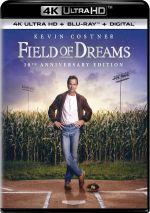
Field of Dreams appears in an aspect ratio of approximately 1.85:1 on this 4K UHD Disc. Though not flawless, this turned into a largely satisfying presentation.
Some softness crept into the image at times, so I thought a few wide shots seemed slightly ill-defined, but not to a significant degree. Instead, the majority of the movie appeared reasonably accurate and concise.
Jagged edges and shimmering didn’t occur, and edge haloes failed to manifest. Grain seemed natural and print flaws remained absent.
Dreams went with a rich, warm palette that came across well. The hues looked vivid and got a nice boost from HDR.
Blacks seemed deep and firm, while shadows were usually good. Like many Universal 4K UHD releases, Dreams could lean too dark at times but this failed to become a mild distraction more than a couple times.
HDR gave whites and contrast extra emphasis. Outside of the occasional murky low-light scene, I felt very happy with this image.
Downconverted to DTS-HD MA 7.1, positive thoughts greeted the DTS X audio of Dreams as well. I expected Dreams to come with a subdued soundfield, and that was almost always the case. Music demonstrated fine stereo imaging, and the mix conveyed a good sense of the various settings.
On occasion, we got a little more life from the material. For instance, the first instances of the ghostly voice popped up in different localized spots, and a few baseball scenes opened up to the rears as well.
Those examples created a little auditory pizzazz in this gentle mix but didn’t stand out as awkward or unnatural. The general impression left by the soundfield was one of minor reinforcement.
Audio quality seemed fine. A few lines sounded a little stiff, but most of the dialogue was natural and concise.
Effects played a small role and fit in with the track well. Those elements appeared accurate and well-defined.
Music fared best of all, as the movie’s score appeared lively and rich. This wasn’t a slam-bang soundtrack, but it was more than satisfactory for this material.
How did the 4K UHD compare to the Blu-ray version? Despite a shift from the BD’s DTS-HD MA 5.1 to the UHD’s DTS X, I thought audio ended up as a wash. The soundscape remained limited enough that the DTS X track didn’t make much of a difference.
On the other hand, the UHD’s visuals boasted obviously superior colors and definition, and it also lost some edge haloes and print flaws. The UHD could look darker than the BD at times but that became a minor trade-off given the other improvements.
In terms of extras, the 4K UHD brings an audio commentary with director Phil Alden Robinson and director of photography John Lindley. Both sit together for this running, screen-specific view of story issues and the adaptation of the original novel, sets and shooting in Iowa and elsewhere, cast and performances, baseball training, visual issues and cinematography, score and audio, various effects, and general production notes.
Though Lindley tosses in a few good notes, this is Robinson’s show and he dominates the commentary. The director makes this a consistently involving discussion. We learn a lot about the production and get many fine insights across this useful and engaging track.
The remaining extras appear on the included Blu-ray copy, where From Father to Son: Passing Along the Pastime runs 38 minutes, 41 seconds. It features notes from Robinson, producers Lawrence and Charles Gordon, actors James Earl Jones, Timothy Busfield, Dwier Brown, Amy Madigan, Ray Liotta, and Frank Whaley, Sports Illustrated’s Tom Verducci, and ballplayers/coaches Barry Zito, Dusty Baker, Mike Scioscia, Mickey Hatcher, Ben Sheets, Chris Capuano and Jeff Huson.
The program looks at the project’s path to the screen, casting, shooting in Iowa and stories from the shoot, and some reactions to the film and its elements. “Pastime” mixes good notes about the flick with praise and sentiment.
Perhaps that’s appropriate for a heartstrings-tugger like Dreams, but I must admit the goopy elements get a little stale. Nonetheless, we find some nice stories about the film and learn a fair amount in this generally enjoyable piece.
13 Deleted Scenes appear. Including optional introductions from Robinson, these full a total of 16 minutes, 50 seconds. (They go for 11:00 without the intros.)
As you can tell by the running times, all of these sequences are quite brief. They vary in quality, but they remain consistently extraneous, so I’m glad Robinson cut them.
In his intros, the director offers thoughts about the segments and sometimes tells us why he dropped them from the flick. He includes some nice notes, though I wish he’d always cover the reasons for the deletions.
After this, we find a Roundtable with Kevin Costner, Bret Saberhagen, George Brett and Johnny Bench. This 29-minute, 56-second piece features the actor and the three former Major Leaguers as they chat about the movie as well as how baseball impacts father/son relationships and other facets of their lives.
A lot of this tends to be gushy praise. However, some of the comments prove interesting, especially as the ballplayers discuss various aspects of their careers.
All of this is decent, but honestly, the most fun part of the show comes from outtakes at the end. We see Costner and the players sign baseballs and bicker playfully. That part feels more real than the rest and is amusing to see.
Next comes a featurette called Galena IL Pinch Hits for Chisholm MN. It lasts five minutes, 35 seconds as Galena historian Steve Repp takes us on a tour of the town that “played” Chisholm in the film. Repp gives us some nice notes about Galena in this short but useful piece.
A Diamond in the Husks goes for 17 minutes, 41 seconds and features a tour of the Iowa field used in Dreams. It also features some comments from the owners of the site as well as Robinson, visitors and field workers, and members of the “Ghost Players” team that plays at the spot.
A few minor tidbits emerge here, but most of the show feels like a long love letter and ad for the location. It’d be fun to visit, but I don’t need nearly 18 minutes of fluff about it.
After this we locate a Bravo special called From Page to Screen. It fills 46 minutes, six seconds and includes notes from Costner, Jones, Robinson, Madigan, Lindley, Charles and Larry Gordon, Busfield, book editor Larry Kessenich, author WP Kinsella, and Universal Studios chairman Tom Pollock.
“Page” examines the original novel, problems getting financial support and the book’s adaptation, more studio complications and production elements, and the film’s reception. “Page” works best when it holds true to its title and looks at the book and its path to the screen.
It loses some steam when it delves into the movie shoot, mostly because we already learn a lot about these elsewhere and “Page” doesn’t offer much new info. Still, it becomes an enjoyable and frequently useful program.
In addition to the film’s trailer, we locate a documentary called Field of Dreams Scrapbook. In this one-hour, 29-minute, 51-second show, we hear from Robinson, author WP Kinsella, producer Larry Gordon, head baseball coach Rod Dedeaux, production designer Dennis Gassner, farm owner Don Lansing, composer James Horner, and actors Kevin Costner, Burt Lancaster, Amy Madigan, James Earl Jones, Timothy Busfield, and Ray Liotta.
“Scrapbook” looks at the original novel and its adaptation for the screen. From there we go through cast, characters and performances, locations, sets, and connected concerns, a little baseball history, and attempts at baseball realism in the flick. The rest of the show goes into Robinson’s impact on the set and elements of shooting the movie, the score, marketing, and the film’s reception.
“Scrapbook” offers a very good documentary. It touches on most of the production’s appropriate subjects and does so in a rich, satisfying way.
Surprisingly, not too much material repeats from the commentary, and that means the pair complement each other. We get a fine examination of Dreams via this solid program.
Given prior experiences, I felt prepared to dislike Field of Dreams, but I actually found it to be fairly charming and entertaining. The aspects of the film that turned me off in the past melted away as I got caught up in its gentle fantasy and emotion. The 4K UHD offers positive picture and audio along with a terrific roster of supplements. No one will use the movie as demo material, but this ends up as a nice reproduction of a charming film.