|
COLUMBIA TRISTAR
|
| |
|
MOVIE INFO
|
|
Director:
Rupert Wainwright
Cast:
Tom Welling, Maggie Grace, Selma Blair, DeRay Davis, Kenneth Welsh, Adrian Hough, Sara Botsford, Cole Heppell, Mary Black
Writing Credits:
Cooper Layne, John Carpenter (1980 screenplay), Debra Hill (1980 screenplay)
Synopsis:
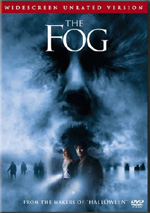
Tom Welling (TV's Smallville), Maggie Grace (TV's Lost) and Selma Blair (Hellboy) star in this senses-shattering tale of demonic retribution, directed by Rupert Wainwright (Stigmata) and written by Cooper Layne. Trapped within an eerie mist, the residents of Antonio Bay have become the unwitting victims of a horrifying vengeance. One hundred years ago, a ship carrying lepers was purposely lured onto the rocky coastline and sunk, drowning all aboard. Now they're back, long-dead mariners who've waited a century for their revenge. Seeking out the decendents of those reponsible for their deaths, they lurk enshrouded within a supernatural fog of terror. Beware, any and all who stand in their way.
Box Office:
Budget
$18 million.
Opening Weekend
$11.752 million on 2972 screens.
Domestic Gross
$29.511 million.
MPAA:
Rated NR
| |
|
DVD DETAILS
|
Presentation:
Widescreen 2.35:1/16x9
Audio:
English Dolby Digital 5.1
French Dolby Digital 5.1
Subtitles:
English
French
Closed-captioned
Runtime: 90 min.
Price: $28.95
Release Date: 1/24/2006
Bonus:
• Audio Commentary with Director Rupert Wainwright
• Deleted Scenes
• Three Featurettes
• Previews
| |
|
PURCHASE @ AMAZON.COM
|

| |
|
EQUIPMENT
|
Sony 36" WEGA KV-36FS12 Monitor; Sony DA333ES Processor/Receiver; Panasonic CV-50 DVD Player using component outputs; Michael Green Revolution Cinema 6i Speakers (all five); Sony SA-WM40 Subwoofer.
| |
[an error occurred while processing this directive]
|
The Fog: Unrated (2005)
|
|
Reviewed by Colin Jacobson (January 12, 2006)
For horror fans, history’s been repeating itself at the multiplexes over the last couple of years. With remakes of Dawn of the Dead, Texas Chainsaw Massacre and The Amityville Horror, it’s like the Seventies all over again.
Finally the movie studios have started to bump into the Eighties. 2005’s take on The Fog reworks the 1980 original from John Carpenter. Whether this foreshadows other remakes of Eighties horror remains to be seen, but my guess is “yup”!
A location along the Oregon coast, Antonio Island rapidly approaches a big ceremony to dedicate a new statue of Antonio Bay’s founders. The citizens plan a major gala to commemorate this, but it turns out that something dark comes along with these men. Apparently Antonio Bay was founded under sinister circumstances, and the ghosts of the victims have come back to seek their revenge under cover of the fog.
And there’s your story! The Fog offers a very simple plot, as it provides nothing more than a basic ghost story. The deceased return to satisfy their urges, and the living try to stop them. In the latter category, we meet a few specific residents of Antonio Island. Stevie Wayne (Selma Blair) lives with her young son Andy (Cole Heppell) and runs KAB, the local radio station. Its only DJ, she operates it from a lighthouse, and that gives her the best vantage point for the progress of the fog.
A few other characters round out the main set. Nick Castle (Tom Atkins) runs fishing charters along with his pal Spooner (DeRay Davis). The latter initially encounters the nastiness in the fog when he parties with Nick’s cousin Sean (Matthew Currie Holmes) and some babes. Spooner ends up as the only survivor of this encounter, though no one believes his tale of killer fog.
In the meantime, Nick reunites with estranged girlfriend Elizabeth William (Maggie Grace). Elizabeth ducked out of town abruptly about six months earlier, and she returns for no apparent reason. She and Nick pick up where they left off, though, and they spend the rest of the film together as they try to avoid death. We also see Elizabeth’s supernatural connection to the past. Kathy Williams (Sara Botsford) organized the statue celebration, while Father Malone (Adrian Hough) is the only one with any knowledge of the menace.
If you check out the synopsis in my review of the 1980 Fog, you’ll find I merely updated parts of it for this movie. The pair hew pretty closely to the same plot, though this one focuses more young hotties like Nick and Elizabeth and less on stodgier characters like Kathy and Father Malone. Spooner was nowhere to be found in the John Carpenter flick. Clearly the producers of the 2005 edition realized that all modern horror movies require a black sidekick for comic relief, so he ended up here.
Never did I consider Carpenter’s Fog to be a great flick, but it was certainly a pretty good one. Carpenter eschewed true scares and replaced them with creepy atmosphere. He succeeded in this attempt to make something different than the average horror movie. The 1980 Fog was dank and ominous, and it certainly offered an unusual story.
The 2005 iteration can’t make claims for any of those distinctions. Obviously it doesn’t offer a fresh plot since it just rehashes the original. It tries much harder for scary moments, and it fails at those. It nods in the general direction of creepiness but also lacks any elements that give us the willies.
So what does it provide? For me, not much more than a headache. The Fog substitutes lots of slow-motion shots of CG effects and people in pain for atmosphere and spooky ambience. It either telegraphs its potentially scares or it produces them so ridiculously out of nowhere that they do nothing other than provoke confused head-scratching.
Never a film with a strong plot, the 2005 Fog dumbs things down even worse. It lacks much rationale behind the attack of the dead, and it doesn’t clearly communicate how the living can ward off the deceased. The characters fail to turn into real personalities. Heck, other than Spooner, they don’t even qualify as vaguely interesting stereotypes! They exist as people with no backstories or current character traits. They’re arguably the least interesting movie roles I’ve seen in years.
Granted, the actors don’t help. Indie queen Blair seems badly miscast as she replaces Adrienne Barbeau. I never found Barbeau to be all that hot, but Blair lacks her moderately sultry presence so she strikes out as a radio personality. She also doesn’t seem believable as a single mom, and she usually just looks embarrassed to be stuck in this turkey.
Although Blair’s quirky personality doesn’t fit her role, at least she shows signs that she possesses a personality. That’s not the case for our leads. In fact, I’d classify Welling and Grace as character vampires. Not only do they fail to convey any spirit in their roles, but also they actively suck the life out of their parts and all others around them. The movie becomes a black hole into which all spark and dimensionality vanishes when those two are on screen. Sure, they look great, but they demonstrate no personality at all.
I suppose someone could have created an effective remake of The Fog. I’m not sure why anyone thought a new version was a good idea since the original was already effective. Nonetheless, I can’t imagine a reworking of The Fog that could prove less interesting and appealing than this one.
Note that this DVD presents an unrated extended version of The Fog. It adds about three minutes to the “PG-13” rated theatrical cut. Don’t expect a lot of sizzle from these scenes, as most were axed for pacing reasons. They don’t seem to flesh out matters much and I don’t think they make much of a difference.
|
The DVD Grades: Picture B+/ Audio B+/ Bonus B-
|
|
The Fog appears in an aspect ratio of approximately 2.35:1 on this single-sided, double-layered DVD; the image has been enhanced for 16X9 televisions. Though not stellar, the transfer offered a more than satisfactory picture.
Only minor issues related to sharpness occurred. Some wider shots looked just a little soft. Otherwise definition seemed quite positive, as I felt the image was usually crisp and detailed. I saw no signs of jagged edges or shimmering, and only mild edge enhancement appeared. Source flaws were absent from this clean transfer.
Befitting a moody horror flick, The Fog often went with a restrained sense of color. Some daytime shots showed nice autumnal tones, but much of the flick stayed with sickly blues and greens. The colors were perfectly solid given the visual design. Blacks came across as dark and firm, and I felt shadows appeared concise and easily visible. The light softness kept this image from “A” level, but it seemed quite satisfying nonetheless.
Similar thoughts greeted the Dolby Digital 5.1 soundtrack of The Fog. While it wasn’t quite strong enough to merit an “A-“, it worked quite well. The soundfield concentrated both on general creepiness and on specific scares. The latter presented the most dynamic noises, as the ghosts banged and stomped around the screen with good localization and impact. The other aspects engulfed us well to create a strong sense of atmosphere. No, the movie didn’t scare me, but I couldn’t blame this active and engaging soundtrack.
Audio quality was very good. Speech always sounded natural and concise, with no edginess or intelligibility issues. Music appeared lively and dynamic. The score was fairly aggressive and packed the appropriate punch. Effects were also positive. They blasted to life well and presented strong range and fidelity. Again, the mix was just a smidgen below “A” level as it provided a satisfying piece of work.
The DVD’s extras start with an audio commentary from director Rupert Wainwright. He offers a running, screen-specific track. Wainwright covers a mix of basics. Mostly he discusses shooting in Vancouver and location issues, sets, effects and other visual areas, and changes made to the unrated cut of the film. Wainwright doesn’t display a lot of energy or insight into the production, as he often does little more than narrate the story. A fair amount of dead air also occurs. This ends up as a drab commentary that fails to give us much good information.
Seven Deleted Scenes fill a total of 12 minutes, 49 seconds of footage. The clips run between 46 seconds and six minutes, 45 seconds. All last less than two minutes except for that nearly seven-minute snippet. Most of these offer pretty minor character filler, though we do get a longer version of the tense re-encounter between Elizabeth and her mom. There’s also an alternate version of Dan’s encounter with the fog, and the almost seven-minute clip shows more of the villainy that killed the folks who now haunt Antonio Island. Does any of this actually seem useful? Not really, at least not in the sense the clips would help the movie. They’re not bad to see, though.
We can watch these with or without commentary from Wainwright. Should you expect anything livelier than his feature track? Nope. Actually, that’s a little unfair, as he offers a few decent notes about the scenes, and at least he tells us why they got the boot. His information still lacks much depth, unfortunately.
Next we find three separate featurettes. Whiteout Conditions: The Remaking of a Horror Classic runs eight minutes, 21 seconds as it presents a mix of movie clips, behind the scenes elements, and interviews. We hear from Wainwright, producer David Foster, writer Cooper Layne, and producer John Carpenter. We get information about the adaptation of the original film and changes made along the way. They address the characters, the backstory, the depiction of the fog, and other issues. Despite the piece’s brevity, it acts as a pretty good look at story topics. It runs through them briskly and offers nice details.
The 10-minute and four-second Seeing Through the Fog includes comments from Wainwright, Carpenter, Foster, and actors Tom Welling, Maggie Grace, Selma Blair, and DeRay Davis. We learn a little about the origins of the first flick, finding a director for the remake and Wainwright’s take on it, casting, location shooting, and the concept of horror remakes. After the pretty good “Whiteout”, “Seeing” seems much more ordinary. It lacks insight and just rehashes some basics that don’t do much to inform us.
Finally, Feeling the Effects of The Fog goes for 14 minutes, 27 seconds, and it presents notes from Wainwright, Foster, Carpenter, special effects coordinator Bob Comer, key prosthetic makeup effects Toby Lindala, visual effects supervisor Chris Watts, and visual effects designers Greg and Colin Strause. As indicated by the title, this show focuses on effects. We learn about creating the fog elements, ghost/leper makeup, CG enhancement of these pieces, and various other effects work.
The featurettes end on a positive note with this tight program. It covers many different effects topics in a solid manner. It runs through the highlights with reasonable depth and detail, and it also fills out things in an interesting manner. It never becomes too technical or geeky. It’s a nice piece.
The DVD opens with a few ads. We get promos for The Da Vinci Code, Underworld Evolution and The Legend of Zorro. These also appear in the Previews area along with trailers for Memoirs of a Geisha, The Pink Panther (2006), Monster House, Rent, Zathura, Underworld, The Exorcism of Emily Rose and The Cave.
A remake of The Fog could have improved upon the original. I liked John Carpenter’s 1980 edition but certainly didn’t find it to be without flaws. Unfortunately, the 2005 rendition is a complete dud that makes its predecessor look brilliant. Never scary, spooky or even remotely intriguing, the remake turns out to be a boring mess. The DVD offers very good picture and audio along with an erratic package of supplements. While we get a pretty good DVD for The Fog, I simply can’t recommend a movie as terrible as this one.
|
|
[an error occurred while processing this directive]
|
|