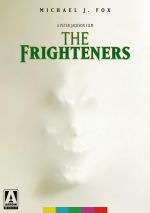
The Frighteners appears in an aspect ratio of approximately 2.35:1 on this Blu-ray Disc. Despite some inherent drawbacks, the image looked positive.
The movie’s slew of visual effects created the only “concerns”, as they meant some mild softness at times. Still, the majority of the movie brought good delineation,
No issues with jagged edges or shimmering occurred, and I saw no edge haloes. Grain felt appropriate and I saw no print flaws.
I can’t say I anticipated a bright palette from a ghost story, but Frighteners managed to present a surprisingly broad color template. And it did so well, as the hues looked pretty dynamic and lively.
Blacks came across as dark and tight, while shadows were smooth and concise. The “issues” formed by visual effects kept the presentation from “A”-level consideration but I thought it worked well.
Downconverted to Dolby TrueHD 7.1, the film’s Dolby Atmos soundtrack proved more than satisfactory. Overall audio quality was solid.
Speech always sounded distinctive and natural, with no edginess or other concerns. Effects were accurate and firm, with strong low-end, and music felt vivid and full.
Frighteners presented a fairly active soundfield. While it didn’t go nuts, the many ghost-related moments gave it room to expand.
Those elements zipped and zoomed around the room to create a good sense of the settings. The mix remained more subdued during moments without spirits, but since so many of those occurred, the track came to life quite frequently.
Add to that good stereo imaging for the music and this was a satisfying soundfield. The audio suited the film and helped make it exciting.
How did this 2026 Arrow Blu-ray compare to the original BD from 2011? The Director’s Cut offered a new Atmos remix, though fans of the theatrical version will “only” find DTS-HD MA 5.1 audio.
The new Atmos track offered a soundscape a bit more engulfing than the old BD’s 5.1, but more importantly, it tamed the overwhelming bass from that release. This made the Atmos version much more listenable.
Visuals showed a good upgrade, as the Arrow BD lacked the print flaws and digital tampering of the 2011 disc. This turned into an obvious step up in terms of both audio and picture.
This Arrow set packs old and new extras, and we find both the movie’s 1996 theatrical version (1:50:02) and its 1998 Director’s Cut (2:02:35) on the same disc. I already discussed my feelings about theatrical vs. Director’s Cut in the body of my review, so I won’t belabor the point. Suffice it to say I think the longer version becomes the more satisfying of the pair.
For the Director’s Cut, we find an introduction from director Peter Jackson. In this two-minute, 41-second clip, Jackson talks about the film’s influence on Lord of the Rings, its connection to the rest of his career, and changes made for the Director’s Cut. Jackson provides a nice little lead-in for the film.
Alongside the Director’s Cut, we hear more from Jackson in his running, screen-specific audio commentary. At the start, the director expresses some anxiety about the prospect of chatting for two hours.
He needn’t have worried, as he fills the time well. Jackson covers all the expected issues.
He talks about changes made for the “Director’s Cut”, working with the actors, locations and sets, visual effects, story and character points, the movie’s tone and original rating, various trivia and challenges along the way. Jackson proves amiable and informative as he gives us a good look at the production.
Disc One completes with a trailer and then we move to Disc Two where we find an open matte version of the film. As implied, this expands the film’s aspect ratio to 1.78:1.
This means added information at the top and bottom of the screen. Left unanswered: what purpose this serves.
Did Jackson really want the movie to go in this ratio but became forced to crop it to 2.35:1? Ya got me.
This makes the open matte Frighteners a curiosity but not a necessary one. The movie works just fine in its original 2.35:1 dimensions.
Note that the “open matte” platter comes with the same specs as the OAR one. We get both cuts of the movie along with the commentary, the intro and the trailer.
From there we go to Disc Three and the majority of the set’s extras. The Making of The Frighteners runs four hours, 31 minutes, 31 seconds, and opens with a one-minute, 57-second intro from Jackson, as he lets us know about the LD history of the documentary.
From there the show uses the standard format, as we get movie snippets, behind the scenes footage, and interviews. We hear from Jackson, executive producer Robert Zemeckis, creature effects designer Richard Taylor, Weta systems administrator Jon Labrie, CG supervisor Matt Aitken, CG supervisor John Sheils, visual effects supervisor Wes Takahashi, CG supervisors Wayne Stables and Gray Horsfield, character animators Christian Rivers and Kyle Balda, composer Danny Elfman, technical director Stephen Regelous, digital effects producer Charlie McClellan, and actors Jim Fyfe, Trini Alvarado, Michael J. Fox, Chi McBride, John Astin, Jake Busey, Jeffrey Combs, and Dee Wallace.
The show goes through the creation of the script and the development of the project, casting and characters, rehearsals, improvisation and additional changes to the screenplay. From there we move through New Zealand locations and making the area look like the US, practical and CG effects and issues related to those areas, ghost and Reaper design, acting challenges and Jackson’s cameo.
The program continues with the actors’ stunts and injuries, deleted scenes and characters, miniatures, time pressures due to a release date change, the movie’s score and sound design, the film’s theatrical rating, and final thoughts.
Back in its day, LD fans regarded this as a groundbreaking documentary. Now that we’re in this day, it still looks pretty amazing. It certainly qualifies as one of the longest documentaries made to supplement a movie.
But size isn’t everything, so it becomes important that “Making” delivers the goods. That it does. We get a terrific feel for the production and receive a great deal of information about all the appropriate areas. We also see many fine shots from the set, elements that come to the spotlight during one 26-minute montage of those pieces.
Even the bloopers are pretty good, such as when Fox forgets he’s not making another Back to the Future movie. Combined with the storyboards, this becomes an exhaustive and still very entertaining and engaging piece.
The Arrow BD version of the documentary spans much longer than its Universal Blu-ray predecessor. That occurs because the Arrow “Making” includes a 45-minute, 36-second collection of storyboards that existed in a separate domain on the Universal BD.
The 1998 laserdisc plopped this section of boards inside the documentary so it never made sense to me the Uni BD extracted them. Anyway, they now reside where they always belonged.
After an intro from Jackson, we see all of the storyboards created for the film. These cover the first two-thirds or so of the flick and they end when Frank battles the Reaper in the cemetery. (As Jackson tells us, they didn’t have time to finish the boarding process.)
Jackson offers commentary along with the drawings, so we learn about changes made for the final product and the reasons for the variations. I like the fact we get all of the boards.
While I’m not a big storyboard fan, it’s cool to be able to see every one they created. The inclusion of boards not filmed and Jackson’s commentary makes this a particularly valuable component, though, and means it becomes a very worthwhile element.
Shot in 2022, No Way to Make a Living occupies one hour, 34 minutes, 51 seconds. It involves Taylor, Takahashi, Wallace, Busey, director of photography John Blick, production designer Grant Major, and editor Jamie Selkirk.
“Make” looks into how some of the participants became involved with Peter Jackson, the development of Frighteners, and a wide mix of production notes. Most of these evolve via anecdotes.
After a commentary and a four-hour documentary, there might not seem to be many stones left to unturn related to Frighteners. Happily, “Make” proves this incorrect.
Of course, we get some inevitable repetition, but not a whole lot. “Make” manages to bring a lot of new details to the table and it turns into an engaging program.
Also from 2022, we get a Conversation With Richard Taylor. This one takes up 41 minutes, 21 seconds.
Taylor looks at the founding and growth of Weta Workshop as well as the work on Frighteners. We find plenty more good info here.
Disc Three concludes with an Image Gallery that includes 58 stills. We get shots from the movie, elements from the set, and some publicity. This becomes an underwhelming finish to the package.
The Frighteners provides an erratic flick but a generally entertaining one. While it doesn’t compare to Jackson’s better-known efforts, it has more than enough good moments to make it enjoyable. The Blu-ray offers very good picture and audio along with an excellent set of extras. This becomes a stellar release for an interesting film.