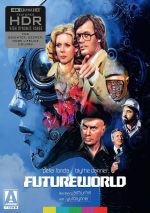
Futureworld appears in an aspect ratio of 1.85:1 on this 4K UHD Disc. This turned into a solid Dolby Vision presentation.
Overall delineation seemed satisfying. A few wider shots could feel somewhat soft, but the majority of the movie felt accurate and tight.
Neither jagged edges nor moiré effects became an issue, and I saw no edge haloes. Grain seemed natural, and I saw no print flaws.
The movie’s palette usually came across as fairly natural, albeit with a lean toward blue/green at times. The colors felt lively, and HDR added impact to the tones.
Blacks seemed deep and dense, while low-light shots appeared well-rendered. HDR gave whites and contrast extra punch. Though still a product of its era, the image worked well.
In addition, the LPCM monaural mix of Futureworld felt perfectly positive for its era. Dialogue sounded natural, as speech intelligible and without edginess or other issues.
Music and effects came across as acceptably clear. They lacked much range but they also didn’t suffer from distortion or other issues. Ultimately, this became a good soundtrack for mid-1970s thriller.
As we shift to extras, we launch with an audio commentary from film historian Daniel Kremer. He provides a running, screen-specific look at the project’s origins and development, story/characters, cast and crew, various production elements, the movie’s reception and legacy.
Kremer digs into Futureworld in fine fashion. He delves into a wide variety of subjects in this well-organized and compelling chat.
Two video programs follow, and Future Present runs 23 minutes, 29 seconds. Producer Paul N. Lazarus III becomes the participant here.
Lazarus discusses his role on Futureworld as well as aspects of the production. Some of this repeats from Kremer’s commentary but Lazarus nonetheless brings enough new info to make it worth a look.
From 1976, NASA: Science Fact and Fiction goes for seven minutes, 32 seconds. It shows us footage from the set along with remarks from Lazarus, producer James Aubrey, director Richard Heffron, visual effects coordinator Brent Sellstrom and actor Blythe Danner.
A basic promo piece, NASA doesn’t provide too many revelations. However, we get some good glimpses of the shoot so it becomes watchable.
Along with a trailer, a TV spot and five radio spots, an Image Gallery provides 199 shots that mix movie elements and publicity stills. It becomes a fairly blah compilation.
Westworld offered a promising story that didn’t pan out and the same holds true for the tedious Futureworld. Despite potential intrigue and drama, the end result proves slow and boring. The 4K UHD comes with very good picture, era-appropriate audio and a few bonus features. This becomes a quality release for a forgettable movie.