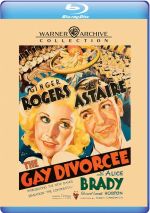
The Gay Divorcee appears in an aspect ratio of 1.37:1 on this Blu-ray Disc. Given the film’s advanced age, it came with anomalies, but it largely satisfied.
Sharpness usually fared well. A few shots came across as a little ill-defined, and I can’t claim the movie exhibits especially precise delineation on a consistent basis.
Nonetheless, the image stayed mostly distinctive and concise. I saw no problems with jagged edges or shimmering, and edge haloes remained absent.
Grain seemed light enough that combined with the modest softness, I couldn’t help but wonder if it underwent a bit of noise reduction. Still, this didn’t turn into an obvious issue, and the film lacked obvious print flaws.
Blacks seemed deep and dense, and low-light scenes demonstrated positive clarity. Overall, the image held up pretty well over the years.
As for the DTS-HD monaural soundtrack of Divorcee, it never stood out as great. Nonetheless, it seemed more than acceptable when I considered its age.
Speech occasionally showed some edginess. However, those moments occurred infrequently, and the lines always remained intelligible.
Effects remained well within the realm of acceptability for their age and only showed minor distortion. Although music lacked much dynamic range, the score and songs remained reasonably clear. Nothing here excelled but the track worked fine for something from 92 years ago.
Four vintage shorts appear here. We find two live-action reels via Art Trouble (20:50) and Masks and Memories (32:14) as well as animated reels I Like Mountain Music (6:57) and Shake Your Powder Puff (6:20).
In Trouble, two rich kids hire house painters to take their place in Paris. Some amusement results, but Trouble seems most noteworthy because it stars occasional Third Stooge Shemp Howard but mainly thanks to an uncredited appearance from James Stewart in his first-ever film role.
Via Masks, some revelers try to entice their fuddy-duddy uncle to leave the house and enjoy Mardi Gras. This mainly exists as an excuse for uninspired musical numbers in this less than enchanting short.
Note that while Trouble could use a more formal restoration, it largely looked pretty good. On the other hand, Masks literally appeared to have been filmed off a TV set, as it demonstrated invasive scan lines along with ample print flaws.
Perhaps Masks simply doesn’t exist in any form better than what I saw. Nonetheless, it offered pretty awful picture quality.
Mountain features magazine subjects who come to life. It’s cute and interesting for archival reasons but not actually very entertaining.
Shake displays a barnyard concert from a bunch of animals. It brings more laughs than usual for early animation.
Along with the movie’s trailer, we get two audio-only archival pieces. A Radio Promotional Trailer (13:45) simply combines breathless narration along with songs and dialogue from the movie. While I appreciate its historical value, it feels forgettable.
Aired March 3, 1946, we get a Screen Guild Players radio adaptation of Divorcee (27:58). While Edward Everett Horton reprises his role as Egbert, Frank Sinatra takes over for Fred Astaire and Gloria DeHaven subs for Ginger Rogers.
Normally a less-than-28-minute version of a 105-minute movie would come with major reductions in plot and character material. However, because so much of Divorcee revolves around song and/or dance numbers, we don’t get reams of story so we find less to cut.
Without the visual ability to depict dancing, this version makes the Astaire character solely a vocalist, and this means we hear a lot of songs from Sinatra. We get so many tunes that the radio adaptation minimizes plot even more than normal for such a short broadcast.
That makes this narrative basic as can be. Sinatra doesn’t really fit the role but this becomes a fun addition nonetheless.
An early effort from the classic pair of Ginger Rogers and Fred Astaire, The Gay Divorcee offers a gossamer light story. Nonetheless, its leads demonstrate the ample chemistry that made them stars and we get enough charm and wit to make this an enjoyable production. The Blu-ray comes with fairly positive picture and audio as well as a mix of bonus materials. Divorcee winds up as a fluffy but enjoyable combination of romance, comedy and music.