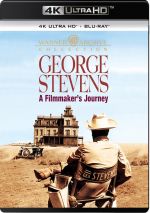
George Stevens: A Filmmaker’s Journey appears in an aspect ratio of 1.33:1 on this 4K UHD Disc – much of the time. The documentary used those dimensions for the interview clips shot specifically for the project.
However, the ratio changed when we saw movie clips. Those came across in their original theatrical dimensions, so we found a variety of framing choices.
Note that the non-1.33:1 ratios used the appropriate TV real estate. They didn’t come windowboxed within the 1.33:1 frame.
Journey felt like an odd choice for a 4K UHD release, but the scan made the documentary look pretty good – well, within the constraints of the sources. With a slew of film clips, the project encountered many potential challenges.
Happily, it appeared that the movie segments enjoyed some good clean-up work and didn’t simply replicate the flaws found on the footage in its original 1984 release. This didn’t mean the film clips looked perfect, but they largely seemed well-depicted and a big step up from what we saw in prior incarnations of Journey.
The same went from the circa 1980s interview clips. Taken from a 35mm source, these didn’t dazzle but they replicated the footage well.
This meant sharpness that felt reasonably concise, it not tremendously crisp. I didn’t get the impression that the crew worried all that much about stellar photography for these elements, but they brought more than acceptable delineation.
No issues with jagged edges or moiré effects manifested, and I saw no edge haloes. Grain seemed natural – if a bit heavy – and the interview segments lacked print flaws.
For these 1980s clips, colors leaned a bit heavy and ruddy. Still, the hues seemed mostly well-formed, and HDR added a smidgen of pep to the tones.
Blacks felt deep, and HDR brought some minor emphasis to whites and contrast. I can’t claim that the 4K UHD treatment made a lot of sense for this particular documentary, but the end product made it look as good as it ever will, I suspect.
Inevitably, the quality of the film’s DTS-HD MA monaural soundtrack also varied dependent on the source. The examples of Stevens’ movies showed appropriate reproduction within the capabilities of their various eras.
The rest of Journey concentrated heavily on dialogue, with only minor aspects of score as essentially a background feature. The music stayed subdued and acceptably clear, albeit not a prominent component.
Speech remained easily intelligible and without edginess or issues. For a 42-year-old documentary, the movie’s audio seemed perfectly adequate.
Three Academy Museum Lectures appear here, all from noted filmmakers. 2023 brought notes from Christopher Nolan (20:19) to accompany a screening of Shane, while 2026 provided remarks from both Guillermo del Toro (24:14) and Martin Scorsese (4:50) to go along with a showing of The Greatest Story Ever Told.
Nolan and Scorsese reflect on the senior George Stevens and his influence on them, while del Toro offers a mix of Stevens history with his thoughts about Story. All three bring good notes and avoid too much happy talk.
A second disc provides a Blu-ray copy of Journey. It includes the same extras as the 4K UHD.
With George Stevens: A Filmmaker’s Journey, we find a generally interesting look at a Hollywood legend. Although the documentary suffers from too many movie clips, it does more right than wrong. The 4K UHD comes with adequate picture and audio as well as a few bonus features. This becomes a good release for a generally informative documentary, even if it does seem like a perplexing candidate for 4K UHD treatment.