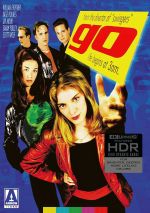
Go appears in an aspect ratio of approximately 2.40:1 on this 4K UHD Disc. Despite its intentionally raw vibe, the film delivered a solid Dolby Vision presentation.
Sharpness worked fine. A few darker shots came across as a little soft but most of the film felt accurate.
No issues with jaggies or shimmering appeared and the transfer showed no signs of edge haloes. Grain seemed natural – albeit heavy – and print flaws failed to appear.
With a mix of lively settings – raves! Vegas! – colors got some room to shine, even if the aforementioned gritty feel meant they didn’t dazzle. Still, the hues fared nicely and received a positive bump from HDR.
Blacks appeared dark and tight, while low-light scenes brought generally good clarity. HDR added some zing to whites and contrast, though this also became limited due to the cinematography. No one will mistake this as a demo image, but the image did what it needed to do.
In addition, the movie’s DTS-HD MA 5.1 soundtrack proved satisfying. Music dominated the movie and used all five channels well. We didn’t get a ton of discrete material from the songs, but they opened up the mix in a pleasing way.
Effects tended to be more subdued, though some exceptions occurred, especially during the Vegas scenes. A long car chase provided nice movement, and a few other sequences throughout the movie allowed for decent use of the side and rear speakers.
The soundscape didn’t turn super active. Nonetheless, it utilized the elements well.
Audio quality seemed solid. Music remained the most important element, and the various songs demonstrated fine clarity and range.
Speech was clear and natural, while effects offered positive definition and accuracy. All of this was good enough for a “B”.
How did this 4K UHD compare to the film’s original Blu-ray from 2009? Though it swapped DTS-HD MA for the old disc’s Dolby TrueHD 5.1, both seemed to provide virtually identical audio.
On the other hand, the Dolby Vision UHD brought better definition as well as stringer colors and blacks and it lost the BD’s print flaws. This wound up as a major upgrade over the mediocre BD.
When we shift to extras, we begin with two separate audio commentaries, the first of which comes from director Doug Liman and editor Stephen Mirrone. Both sit together for this running, screen-specific look at story and editing, sets and locations, cast and performances, cinematography, music and production design, and a few other issues.
Liman and Mirrone provide a pretty good look at Go. It’s a little more technical than I’d like, as we don’t learn a ton about the actors or the script, but we get enough material of that sort to satisfy. The track gives us an engaging overview of the flick.
New to the Arrow release, the second commentary features critics Bryan Reesman and Max Evry. Both sit together for their running, screen-specific view of the project’s roots and development, cast and crew, factual liberties, various production details and their thoughts about it.
Evry and Reesman provide an effective chat that covers the film in a broad number of ways. Every once in a while the discussion threatens to turn into “annotated IMDB” territory, but it comes with more than enough useful material to deliver a worthwhile track.
A ”Making Of” Featurette runs six minutes, 22 seconds. It includes Liman, writer/producer/2nd unit director John August and actors Sarah Polley, Katie Holmes, Timothy Olyphant, Desmond Askew, Taye Diggs, James Duval, Breckin Meyer, Scott Wolf, William Fichtner and Jay Mohr.
Produced back in 1999, the program exists to promote the film. It tells us a lot about the story and very little about the production so you can safely skip it.
14 Deleted Scenes last a total of 25 minutes, 16 seconds. These offer a combination of finished sequences and outtakes.
All feel interesting, but the outtakes are the most fun. They show some enjoyable improv bits and allow a little of a glimpse behind the scenes.
Two new interviews follow, and we start with From the Word Go. It runs 21 minutes, 54 seconds and involves John August.
Here we learn about what brought him into movies as well as the development of his Go screenplay, its path to the screen and aspects of the production. August covers a slew of useful domains in this informative chat.
A View Askew comes next. Actor Desmond Askew becomes the subject of this 20-minute, 41-second chat.
Askew covers his career and his Go experiences. He brings some good tales from the shoot.
Shot by August during the production of Go, God offers a short film that spans 11 minutes, 23 seconds. Briefly seen in Go, Melissa McCarthy acts as the main participant.
McCarthy plays a flighty young woman who literally enjoys God as her BFF. It becomes a clever piece and I like our chance to see McCarthy as an adjunct to Go since the movie represented her film debut.
We can watch God with or without commentary from August, McCarthy and editor Doug Crise. They sit together to discuss the movie’s origins and aspects of the production in this useful little chat.
Along with the movie’s trailer, we get an Image Gallery with 27 stills that mix shots from the film and publicity photos. It lacks much of interest.
The Arrow release loses three music videos from the prior Blu-ray.
While Go should probably be in a late 1990s time capsule, it still manages to entertain more than 25 years later. The movie suffers from a few more ups and downs than I’d like, but it throws out enough wild antics to keep us interested. The 4K UHD comes with positive picture and audio as well as a solid collection of supplements. Arrow delivers a high-quality release for a largely entertaining flick.