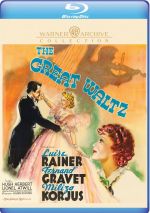
Reviewed by Colin Jacobson (October 1, 2026)
When musician biopics from the 1930s or 1940s end up on my doorstep, they tend to revolve around then-fairly current folks. For something a little different, 1938’s The Great Waltz went back almost a century for its subject.
Set in Austria circa 1845, Johann Strauss II (Fernand Gravet) works as a bank clerk. However, he remains obsessed with the composition of waltzes, a desire that gets him fired from his job.
This pays off, as Strauss becomes able to succeed in his musical career. Issues impact his personal life, as he becomes romantically torn between his faithful wife Poldi Vogelhuber (Luise Rainer) and gifted opera singer Carla Donner (Miliza Korjus).
At the start of the film, we get a notice that the movie will dramatize “the spirit rather than the facts” of Strauss’s life. Given this disclaimer, I’ll judge Waltz solely on its cinematic merits and ignore any potential flights of fantasy.
Though this feels like a weaselly way to make a movie. Without doing a deep dive into Strauss’s biography, I’d guess that the truth didn’t offer much fodder for a compelling drama so the producers decided just to make up a fictional narrative.
That said, it feels odd that Waltz completely invents two of the three lead characters. While Strauss obviously existed, neither Poldi nor Carla did.
All this exists mainly as an excuse to play Strauss’s music anyway. That happened a lot with biopics of this sort – and still does, as they often care more about presenting popular tunes than telling a quality story.
That said, Waltz manages to mix a lot of drama in between all those performances. In addition to the romantic triangle, we see a political revolution in the late 1840s as well as issues related to Strauss’s career.
Those factors make Waltz fairly watchable, even if it seems oddly glib. The film plays a lot of potential drama for laughs and it feels weirdly unconcerned with Strauss’s infidelity.
When Strauss actively cheats on Poldi, Waltz makes the romance between Strauss and Carla seem frisky and fun. We get no sense of internal conflict in Strauss.
Indeed, the scene plays the Strauss/Carla relationship in such a frothy manner that I wondered if I’d blacked out at some point and missed a scene in which Poldi left Strauss or died. Surely a movie from 1938 wouldn’t treat infidelity in such a casual way, right?
It does, though we eventually see more of the impact when the flick concentrates on Poldi’s side. Unfortunately, Waltz gives Rainer – coming off of Oscar trophies for two consecutive years – little to do other than seem supporting or sad.
At least Rainer easily surpasses the awful Korjus. A singer by trade, the producers clearly hired her for her voice, as Waltz represented her cinematic debut and she would only act in one film after that.
Let’s put “act” in quotes, though, as Korjus seems utterly unable to portray any emotion beyond her ever-present smirking smile. No matter the circumstance, there’s that odd Cheshire Cat grin!
We’re supposed to see Carla as a charismatic wild child, but instead, Korjus makes her a complete non-entity. Whatever vocal talents Korjus boasted, she finds herself utterly overmatched as an actor.
Gravet – actually named “Gravey” but likely called “Gravet” to avoid connections to the meat topping – fares best of the bunch. Of course, it helps that Strauss enjoys the only actual character arc here, but Gravet still brings personality and impact to the part.
Despite its weird attitude toward its lead role’s infidelity and its scattered focus, Waltz still comes with moderate entertainment value. It may deliver fiction but it fares better than some of its genre peers in terms of watchability at least.