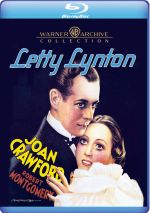
Letty Lawson appears in an aspect ratio of 1.37:1 on this Blu-ray Disc. This turned into a solid image, especially for a 94-year-old “lost film”.
Sharpness worked surprisingly well. A few slightly soft shots emerged – some related to “glamour” photography – but the majority of the movie boasted terrific delineation.
I witnessed no issues with jagged edges or shimmering, and edge haloes remained absent. The movie came with a fine layer of grain and lacked print flaws.
Blacks felt dark and dense, while low-light shots brought appealing delineation. Expect a shockingly good presentation.
Though not as impressive, the film’s DTS-HD MA monaural soundtrack became perfectly fine for its era. Speech could be a little flat – probably via the use of some noise reduction – but the lines were concise and easily intelligible.
Typical of movies from this one’s period, both music and effects seemed thin but they lacked obvious distortion or other issues. I found no real reasons to complain about this track.
We get a mix of extras here, and these open with a documentary called Prince of Hollywood. It runs one hour, 14 minutes, four seconds and involves film historians Bob Thomas, Scott Eyman, Michael Blake, Gavin Lambert and Cari Beauchamp, MGM story editor Sam Marx, producer Sam Goldwyn Jr., directors George Sidney and King Vidor, actor John Gilbert's daughter Leatrice Fountain, editor Margaret Booth, actor Helen Hayes, and screenwriter Anita Loos.
"Prince" looks at the life and career of early movie mogul Irving Thalberg. It provides a rich and involving look at the legend.
Under Radio Shows, we find a whopping five different segments. The disc includes “Good News (1)” (52:27), “Good News (2)” (56:53), “Lux Radio Theatre” (59:33), “The Silver Theatre” (29:37) and “Gulf Screen Guild Theater” (31:25),
That’s a lot of vintage audio! “Good News (1)” brings “Good News of 1938” offers a mix of skits and scenarios, one of which involves Joan Crawford as she plays a soliloquy called “Dark World”.
This begins around 20:45 and lasts until 28:25, though we get additional chatter from Crawford as the show progresses. It seems fairly dreary but it and the rest of the material offers value for fans of 1930s media.
With “Good News (2)”, we find “Good News of 1939” so it follows the same structure as its 1938 predecessor, and Crawford reappears at 29:00 to perform with host Robert Young in a drama called “The Moon Is On Fire”. This runs until 40:45.
I can’t call “Fire” a particularly interesting piece. Still, it beats the mawkish “Dark World”.
Crawford reappears at 44:30 along with Fanny Brice and Billie Burke for a comedy called “If Women Went on Hunting Trips As Men Do” that lasts until 49:30. It shows dated gender concepts but it brings much more life than “Moon” and offers amusement.
Finally, the broadcast ends with a song that involves the whole cast and that includes Crawford. It becomes a fun finale.
Oddly, while “Good News of 1939” involves three actors from The Wizard of Oz, none of them bring up that film. I would guess that the broadcast aired prior to the August 1939 release of Oz.
Crawford stars in all the other radio shows, though none of them adapt Lynton. “Lux” adapts A Doll's House and aired June 6, 1938, while Train Ride ran May 7, 1939 and None Shall Part Us comes from October 15, 1939.
All three prove melodramatic and not tremendously entertaining. Still, their presence adds value to the set, especially for fans of vintage radio programs.
A film not seen for many decades due to legal issues, Letty Lynton brings a spotty mix of romance and drama. It starts slowly and gets better along the way, though it never quite turns into a genuinely good movie. The Blu-ray boasts excellent visuals as well as acceptable audio and an appealing set of supplements. While this becomes an inconsistent flick, the Blu-ray treats it very well.