|
HBO
|
| |
|
MOVIE INFO
|
|
Director:
Stephen Hopkins
Cast:
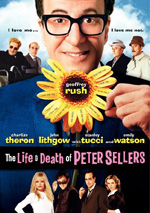
Geoffrey Rush, Charlize Theron, Emily Watson, John Lithgow, Miriam Margolyes, Peter Vaughan, Sonia Aquino, Stanley Tucci, Stephen Fry, Henry Goodman
Writing Credits:
Roger Lewis (book), Christopher Markus, Stephen McFeely
Tagline:
I love me ... I love me not.
Synopsis:
An HBO Films production, The Life And Death Of Peter Sellers is a kaleidoscopic look inside the unique mind of Peter Sellers. Despite his Hollywood success, his comic virtuosity belied a troubled private life plagued by self-loathing, insecurity and abusive behavior. The film peers behind the many faces of Peter Sellers to reveal how this comic genius actually teetered on the edge of madness.
MPAA:
Rated NR
| |
|
DVD DETAILS
|
Presentation:
Widescreen 1.78:1/16x9
Audio:
English Dolby Digital 5.1
English Dolby 2.0
Subtitles:
English
Spanish
French
Closed-captioned
Runtime: 122 min.
Price: $26.98
Release Date: 5/10/2005
Bonus:
• Audio Commentary with Director Stephen Hopkins and Actor Geoffrey Rush
• Audio Commentary with Writers Christopher Markus and Stephen McFeely
• Deleted Scenes
• “Making The Life and Death of Peter Sellers”
| |
|
PURCHASE @ AMAZON.COM
|

| |
|
EQUIPMENT
|
Sony 36" WEGA KV-36FS12 Monitor; Sony DA333ES Processor/Receiver; Panasonic CV-50 DVD Player using component outputs; Michael Green Revolution Cinema 6i Speakers (all five); Sony SA-WM40 Subwoofer.
| |
[an error occurred while processing this directive]
|
The Life And Death Of Peter Sellers (2004)
|
|
Reviewed by Colin Jacobson (April 21, 2005)
Peter Sellers showed an almost unparalleled ability to lose himself in characters and to take on disparate personalities. 2004’s The Life and Death of Peter Sellers tries to dig under the surface and reveal the man behind the masks.
Death starts in the Fifties as we see Sellers (Geoffrey Rush) star on British radio’s Goon Show. He wants to break into films but hits roadblocks such as casting agents don’t think he’s attractive enough for movies. However, when he puts himself in disguise, he convinces the agent of his talent and he launches his movie career.
Much of Death follows Sellers’ work in flicks, with particular highlights such as The Pink Panther and Dr. Strangelove. Those segments also introduce us to filmmakers Blake Edwards (John Lithgow) and Stanley Kubrick (Stanley Tucci). In addition, we see Sellers’ home life and meet his wife Anne (Emily Watson), son Michael (James Bentley) and daughter Sarah (Eliza Darby) along with his mother Peg (Miriam Margolyes) and father Bill (Peter Vaughan).
Peg plays an extremely important role in Peter’s life. With her encouragement, he maintains a focus on his career to the exclusion of all else, and he also remains the eternal child underneath his doting but domineering mother. Peter can’t break free from his mother’s influence, but he doesn’t want to, as he prefers to defer to her in all matters.
Home and career collide when Peter costars with sexy Sophia Loren (Sonia Aquino) on the set of The Millionairess. Peter immediately falls for the Italian bombshell and does whatever he can to be around her. He thinks she reciprocates his interest although she remains completely oblivious to his romantic intentions, and that means he badly misinterprets her signs. Although she rebuffs him, Peter reads things wrong and eventually leaves Anne.
The rest of the movie follows Sellers’ career and private life. We see him make the flicks I mentioned and others, all of which leads toward his apparent dream role in 1979’s Being There. We also watch Sellers’ eventual romance with starlet Britt Ekland (Charlize Theron) and his health concerns as we move toward his demise in 1980.
I hope that last sentence doesn’t sound like a spoiler, but I don’t think it gives away too much to indicate that a flick called The Life and Death of Peter Sellers ends in his passing. For the most part, Death plays as a fairly standard bio-pic, though it does take some unusual paths. Most of those stem from the periodic shots in which dresses Sellers/Rush up as loved ones. This first occurs early in the flick when he literally steps into his father’s shoes. Since it comes so close to the film’s start, it throws us; did Rush play the dad all along and we didn’t notice? However, it later becomes much clearer that this is a device to remind us of Sellers’ capabilities as a chameleon and also to get some insight into his psyche.
Although it seems a bit precious, it actually works. Granted, it telegraphs many of the flick’s themes. Rather than just hint at Sellers’ issues, it spells them out. Nonetheless, it’s a clever twist that does reveal useful information.
At the film’s heart, Death attempts to answer “Who was the real Peter Sellers?” It seems to come back with “There wasn’t one”. That’s the movie’s main theme: Sellers lost himself in other personalities because he lacked one of his own. Too deeply attached to his mother, he subsumed his own persona to serve her will.
This gives us insight, though I think the story beats us over the head with that theme too much. It doesn’t leave us much room for interpretation, particularly how it paints Peg as a villain. For instance, when father Bill lies on his deathbed, Peg doesn’t contact Peter since she doesn’t want to distract him from his work. In addition, when Peter misses his daughter’s birthday, Peg worries more about how it’ll look in the press.
While it may offer a one-sided depiction of things, it nonetheless remains interesting to get a feel for the real Sellers. Not that we find a pretty picture, as Sellers comes across as exceptionally weak-willed and superficial. When he finally talks back to Peg, it’s in character. He’s totally clueless socially; he presents no concept of his rejection when Loren shoots him down. He’s also quite self-loathing but he clearly has no clue how to alter his situation.
The 53-year-old Rush was too old for the role. Sellers was only 54 when he died, and Death asks Rush to portray him from about age 30 up until that point. Despite this, Rush does quite a good job in the part. He really becomes quite convincing; I occasionally mistook Rush for the real Sellers in some spots, and he pulls off reproductions of Sellers’ film work convincingly. The screen doesn’t allow Rush a lot of room for depth, but he brings extra oomph and dimensionality to the part and helps make the flick more successful.
Half bio-pic and half psychological investigation, The Life and Death of Peter Sellers works sporadically. Actually, it remains consistently entertaining, but it doesn’t leave enough room for interpretation to become something really impressive. Still, it boasts a good cast and nice performances to become a reasonably intriguing piece.
|
The DVD Grades: Picture B/ Audio B-/ Bonus B+
|
|
The Life and Death of Peter Sellers appears in an aspect ratio of approximately 1.78:1 on this single-sided, double-layered DVD; the image has been enhanced for 16X9 televisions. Although the film showed many positive elements, it was a little off at times and never quite excelled.
One of the erratic elements came from sharpness. Most of the movie looked fairly concise and detailed. However, some shots demonstrated moderate softness and could be a little fuzzy. No issues with jagged edges or shimmering occurred, but some mild edge enhancement showed up throughout the movie. While I saw no problems with source defects, the image did appear a bit grainy at times.
As for the film’s palette, it went with a somewhat faded, blown-out look. The colors tended to be cold and pale, but that wasn’t a problem. It fit within the movie’s design and seemed appropriate. Some segments offered more vibrant colors, especially when Sellers got involved with Ekland; those sequences featured the film’s most dynamic tones. Blacks looked nicely dark and firm, while low-light shots mostly demonstrated solid delineation and clarity. A few shadows were a bit thick, however, as some interiors were too dim. The movie lacked the definition to become terribly well-rendered, but it was good enough for a “B”.
One wouldn’t expect much ambition from the Dolby Digital 5.1 soundtrack of a character study like The Life and Death of Peter Sellers. One would expect incorrectly, as Death included a surprisingly active mix. In fact, I’d call it too active, as the track occasionally used the speakers in a distracting manner.
This became evident with the opening scene. The recording of the Goon Show put dialogue from an announcer and heavy crowd noise in the rear channels along with music. All of this felt too heavy, as the back speakers overwhelmed the action. Much of the movie went with a better balance, but I still thought quite a few segment occurred in which the surrounds became too prominent in the mix and created a distraction.
When the track showed more sensible distribution of audio, it worked better. Music demonstrated good stereo imaging, and various elements popped up in appropriate places. The surrounds also sometimes featured natural placement and involvement, but I still thought they were too active too much of the time.
For the most part, audio quality was positive. Occasional lines sounded a bit edgy, but the speech usually appeared natural and distinctive. Music fared quite well. The score and songs showed strong definition and range, with clear highs and tight bass. Effects came across as concise and accurate. They usually didn’t play a significant role in the proceedings, but they were reproduced well. They did become more prominent occasionally, such as during Sellers’ near-death fantasy. It feels weird to shave points off my grade due to too much ambition, since I usually criticize soundtracks for the opposite issue. However, the use of the surrounds was an issue, and I thought the mix deserved a “B-“.
A mix of extras show up on the DVD, and we start with two separate audio commentaries. The first comes from director Stephen Hopkins and actor Geoffrey Rush, both of whom sit together for a running, screen-specific discussion. A character-based movie can use a character-based commentary, and that’s what we get here. The piece goes over a few film-specific elements such as editing, casting, locations and deleted sequences, but those don’t pop up tremendously frequently. Instead, the track emphasizes the history behind the story as well as insight into the characters, the performances, and the situations.
Often I find little use for commentaries recorded by actors, but Rush provides an exception to that rule. Indeed, his parts of the track may well create the best actor commentary I’ve ever heard. He really digs into his thoughts about what he wanted to do with Sellers, and his remarks prove immensely illuminating. Hopkins doesn’t slack off, as he also chimes in frequently and the two compliment each other well. They make the commentary briskly paced and always involving as they dig deep into history and thematic elements. Put simply, this is an absolutely terrific commentary that’s one of the best I’ve heard in a while.
For the second commentary, we hear from screenwriters Christopher Markus and Stephen McFeely. Both men sit together for this running, screen-specific track. Unsurprisingly, they focus mostly on story topics. We hear about research and adapting the book, writing the script and various drafts, liberties taken and the facts behind things, and changes between the screenplay and the final product. We get a good feel for all the issues behind their writing, and we learn additional notes about the real Sellers. The track drags at times and it doesn’t compare with the Hopkins/Rush commentary, but it offers more than enough useful material to merit a listen.
Eight deleted scenes last a total of 21 minutes and 16 seconds. Many of these feature additional shots of Sellers in character as others like a doctor, his fortuneteller, and some suits at HBO. We also get a good bit in which we see the tension between Sellers and Blake Edwards, and we check out more from Sellers’ later life; those parts include his relationship with his fourth and final wife. Nothing here seems stellar, but the pieces are consistently interesting to see.
The DVD finishes with The Making of The Life and Death of Peter Sellers. This 12-minute and 12-second featurette mixes movie clips, behind the scenes elements, and interviews. We hear from Rush, Hopkins, Blake Edwards, and actors Emily Watson, Charlize Theron, Stephen Fry, Miriam Margolyes, and Stanley Tucci. They chat about Seller’s life and career as well as movie topics like Rush’s transformation into different characters. We don’t learn a lot of useful information here, mainly because the commentaries cover so much ground. Edwards’ remarks are pretty good, though, especially when he reflects on his relationship with Sellers.
The Life and Death of Peter Sellers only fitfully succeeds. However, it does enough right to remain generally interesting, largely due to a terrific lead performance from Geoffrey Rush. The DVD presents adequate to good picture and audio plus some nice extras highlighted by an excellent commentary from the director and star. Death would make for a good rental.
|
|
[an error occurred while processing this directive]
|
|