Reviewed by Colin Jacobson (August 11, 2025)
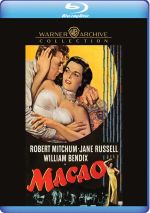
1951’s His Kind of Woman brought the first cinematic pairing of stars Robert Mitchum and Jane Russell. It didn’t take long for the two to reunite, as they showed up together again for 1952’s Macao.
On the island of Macao, goons led by local gangster Vincent Halloran (Brad Dexter) murder NYPD Lieutenant Daniel Lombardy (John Daheim) and dump his corpse into the waters off Hong Kong. International Police Commander Stewart (Edward Ashley) gets the assignment to investigate.
Three strangers – Nick Cochran (Mitchum), Julie Benton (Russell) and Lawrence C. Trumble (William Bendix) – meet on a boat to Macao and become semi-friends, though Nick’s romantic advances aimed at Julie initially fail. They find themselves involved in the antics related to Lt. Lombardy’s death, especially because one of them may hide a secret identity.
When I reviewed His Kind of Woman, I noted that a newspaper blurb claimed Russell and Mitchum formed “the hottest combination that ever hit the screen”. That didn’t really prove accurate, as although they both looked good, they failed to provide tremendous chemistry
In the case of Woman, some of that stemmed from the fact the Mitchum and Russell spent surprisingly little time onscreen together. While they got the top billing, the movie turned into more of a “buddy flick” that usually paired Mitchum with Vincent Price.
Macao allows its leads to show greater spark than they did the prior year, but not a lot more. Mitchum and Russell remain oddly inert as a romantic couple and still fail to display a lot of chemistry.
Not that I think Macao falters because its stars don’t ignite. The movie comes with its own problems behind their lack of sparks.
Though only in his late 50s during the film’s production, Macao brings a late career effort from director Josef von Sternberg. Best-known for early 1930s flicks like The Blue Angel, Shanghai Express and Blonde Venus, von Sternberg’s career slowed significantly in the 1940s.
Indeed, Macao marked von Sternberg’s first credit as feature director since 1941’s The Shanghai Gesture. He apparently performed unbilled work on 1946’s Duel in the Sun and he made propaganda flicks for the US government during WWII but he nonetheless spent a chunk of that period essentially retired.
Macao doesn’t imply that audiences missed out on much across that time period. While von Sternberg does nothing to actively harm the film, he also fails to give it verve or life.
For a tale with so much potential romance and crime and violence involved, Macao feels curiously flat. Even at a mere 81 minutes, the film pushes ahead at a slow pace and seems strangely aimless.
With so little time at its disposal, one might expect Macao to provide a crackling noir effort. Instead, it dawdles and feels aimless too often.
Granted, the film starts in an intriguing manner. After the murder of Lombardy and then a lively introduction to the main characters, it looks like Macao will launch into a dynamic tale.
Unfortunately, Macao then stalls and struggles to get back into gear. Even as it nears its climax, the narrative just never clicks.
None of these factors mean Macao becomes a bad film. It just lacks the energy and intrigue it needs to satisfy.