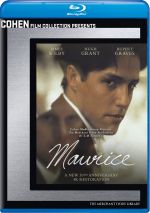
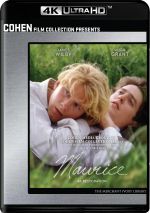
Maurice appears in an aspect ratio of 1.66:1 on this Blu-ray Disc. This became an appealing presentation.
Overall delineation looked good. Some wider shots came with a little softness, but the majority of the flick boasted solid accuracy.
Neither jagged edges nor shimmering popped up, and I saw no edge haloes. Grain seemed appropriate and print flaws remained absent.
As expected for a period piece, Maurice came with a palette that leaned toward a nostalgic amber in the early scenes and more of a chilly blue as the tale progressed. The hues seemed well-developed.
Blacks came across as dark and tight, while low-light shots brought positive clarity. The movie held up well.
Should one expect sonic fireworks from a character drama shot in 1987? Nope, and the film’s DTS-HD MA 5.1 soundtrack came with the limitations I anticipated.
The soundfield remained restrained, with music as the most prominent element. The score spread across the front speakers well and used the surrounds in a modest manner.
Effects lacked a lot to do and became gentle environmental support for the most part, with only a few scenes that broadened modest horizons. Nothing about the soundscape stood out as memorable.
Audio quality worked fine for its era, with speech that seemed fairly natural. Some lines leaned a little metallic but the material was still fine.
Music seemed lush and full, while effects became accurate, albeit without much real punch. The mix felt satisfactory for a nearly 40-year-old drama and that was about it.
All the set’s extras show up on a second Blu-ray. James Ivory and Pierre Llhome on the Making of Maurice runs 15 minutes, 44 seconds and involves director Ivory and cinematographer Llhome.
They tall about why Ivory recruited Llhome and the DP's challenges with the English crew, photography and lighting, cast and performers, and controversies about the subject matter. They offer a fairly good view of these domains.
Ivory and Llhome appear again for a live Q&A that goes for 22 minutes, 59 seconds and brings their thoughts about cinematography, aspects of their careers, influences, casting, and general thoughts. This acts as a positive complement to the prior show.
The Story of Maurice spans 30 minutes, 29 seconds. This one features screenwriter Kit Hesketh Harvey, and actors Hugh Grant, James Wilby, and Rupert Graves.
The reel examines the source and its adaptation, casting, characters and performances, working with Ivory and the film's reception. Finally we get participants other than Ivory and Llhome and their perspectives make this a valuable piece.
Next comes a Conversation with the Filmmakers. It goes for 12 minutes, 51 seconds and includes notes from Ivory, composer Richard Robbins, and producer Ismail Merchant.
Here we cover the novel and its path to the screen, story/character elements, music, locations, various complications and the movie's release. We locate another useful program here.
A Director’s Perspective (40:08) brings a two-person conversation. We find a chat between Ivory and Tom McCarthy, director of 2015’s Oscar-winning Spotlight.
They look at story/characters and changes from the novel, cast and performances, what attracted him to Maurice, achieving a period feel, costumes, editing, McCarthy helps move along the discussion well and we find some worthwhile info from Ivory.
28 Deleted/Alternate Scenes occupy a total of 39 minutes, three seconds. We can watch these with or without commentary from Ivory.
While we get a lot of extra footage, I can’t claim this compilation brings anything especially memorable. The cut clips tend to reinforce themes and domains already apparent in the final film so don’t expect snippets that feel significant.
One segment presents a young character Maurice hopes to woo, though, and that becomes the most meaningful addition, even if it feels like it echoes beats in the final film. We also get an extended look at naked men who frolic in the shower, if that floats your boat.
Ivory’s commentary discusses some basics about the scenes. However, he barely talks so don’t expect substance.
Disc One opens with ads for Churchill, The Official Story and Julian Schnabel: A Private Portrait. Disc Two includes trailers for the 1987 release of Maurice as well as its 2017 reissue.
A period look at gay relationships in the early 20th century, Maurice seems well-meaning. However, it offers a clumsy narrative without full-blooded characters and feels more like awkward social commentary than a compelling narrative. The Blu-ray comes with appealing picture and audio as well as a pretty useful set of supplements. I wanted to like Maurice but thought it lacked real substance.