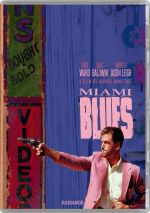
Miami Blues appears in an aspect ratio of approximately 1.85:1 on this 4K UHD Disc. Though it showed its era, this became a solid Dolby Vision presentation.
Sharpness worked fine. A few wider shots became a bit tentative but the overall impression seemed positive.
No issues with jaggies or moiré effects appeared, and edge haloes remained absent. Grain felt natural – albeit somewhat heavy – and print flaws failed to manifest.
Colors looked appealing. The film opted for an aqua and orange palette that suited the setting and the disc reproduced the hues nicely, with an appealing boost from HDR.
Blacks were fairly deep, and shadows showed good clarity. HDR meant whites and contrast enjoyed added power. Given the nature of 1990 stocks, I thought this was a nice representation of the source.
As for the film’s DTS-HD MA stereo soundtrack, it provided serviceable audio. Music demonstrated nice stereo spread, but effects didn’t have a lot to do.
We got some general atmosphere but nothing memorable occurred. This remained a pretty low-key mix and one that felt like a relic since 1990 was late in the game for basic stereo without surround support.
Audio quality was fine for a 36-year-old soundtrack. Speech remained natural and concise, with only a smidgen of roughness along the way.
Music showed nice fidelity and range, and effects appeared fairly accurate and robust. The track didn’t boast a ton of oomph, but it showed decent low-end, mostly related to the music. This became an average mix.
How did this Radiance 4K UHD compare to the 2015 Shout! release? The UHD went with DTS-HD MA stereo vs. LPCM, and to my surprise, it seemed more robust, albeit with a similar soundfield.
The UHD's Dolby Vision visuals demonstrated immense improvements, as it offered better definition, colors and black and also lost the nagging print flaws from its predecessor. This turned into a considerable picture upgrade.
When I compared the 4K UHD to the simultaneously released Radiance Blu-ray, it showed the same audio upgrade. It feels odd that Radiance used two different sound encodes for discs in the same set, but there you go.
The UHD showed growth in terms of accuracy and all the rest, but not the major leap we got from the 2015 disc. Still, the UHD became the best representation of the movie.
No extras appear on the 4K UHD but we get some on the included Blu-ray copy. Also found onthe old BD, we get the film’s trailer and circa 2015 interviews with actors Alec Baldwin and Jennifer Jason Leigh.
During this 26-minute, one-second compilation, they discuss their casting, characters and performances, shooting in Florida, reflections on the film, and working with director George Armitage. It’s great that the disc’s producers managed to get the stars to talk about Blues, but the end result seems less than fascinating.
A few decent notes emerge. However, I don’t think we learn a lot about the movie.
The remaining extras come new to the Radiance release, and David Jenkins provides an 11-minute, 58-second “appreciation” of the film from the writer/author. Jenkins delivers a good history of those involved and the production in this informative chat.
Maxim Jakubowski brings an 11-minute, 16-second chat from the writer/crime fiction expert in which he focuses on the source novel and its adaptation to the screen. We find a nice summary of these domains.
A Gallery provides 18 stills that combine publicity elements and shots from the set. It becomes a brief but competent compilation.
An odd mix of styles and tones, Miami Blues occasionally entertains. However, it seems too disjointed to become anything consistently satisfying. The 4K UHD provides very good visuals along with decent audio and a moderately informative set of interviews. Blues has its moments but doesn’t pack enough of them to gel.