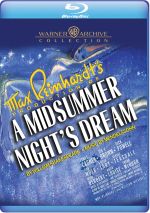
A Midsummer Night’s Dream appears in an aspect ratio of 1.37:1 on this Blu-ray Disc. This became a somewhat spotty presentation.
Admittedly, some of the visual issues likely stem from the original cinematography. Dream used a moderately airy feel to suit the fantasy elements, and it also came with lots of ambitious for the era effects.
Nonetheless, a fair amount of the film seemed soft for no apparently photographic purpose. Definition varied from very good to oddly tentative without consistent rhyme or reason.
Otherwise, I felt pleased with the image, as I witnessed no signs of jaggies or moiré effects and edge haloes failed to manifest. Grain seemed appropriate and print flaws didn’t interfere.
Blacks leaned a little gray but they usually offered reasonable depth, and low-light shots brought positive clarity. Despite various positives, this still ended up as an inconsistent image.
I also thought the film’s DTS-HD MA monaural seemed a little erratic for its era, mainly due to a tinnier than typical impression. Dialogue remained intelligible but could veer somewhat metallic.
Similar impressions greeted music and effects, as both appeared moderately thin and without range. Even given the standards of the period, the mix felt somewhat lackluster.
The disc includes a mix of extras and these launch with an audio commentary from film historian Scott MacQueen. He provides a running, screen-specific look at the source and its adaptation, cast and crew, aspects of the production and the film’s reception/legacy.
Taped in 2007, MacQueen gives us a thorough look at the creation of the film. Via the use of 1930s documents, he delivers a strong historical perspective and fleshes out those elements with plenty of other details to turn this into a terrific chat.
Entitled A Dream Comes True, we get a circa 1935 featurette about the creation of Dream that spans seven minutes, 30 seconds. It offers a glossy and contrived view of the production but still brings an interesting time capsule.
Next comes a Screen Test (8:38) of Olivia de Havilland’s audition for a planned film called Danton that never came to fruition. That makes it an intriguing look at the young de Havilland.
Along with the movie’s trailer, we wrap with eight shorts. This section presents Shake Mr. Shakespeare (20:11), Warner Bros. Studio Café (1:51), Presenting Mr. Dick Powell (1:31), Presenting Miss Anita Louise (1:19), Presenting Miss Jean Muir (0:58), Presenting Mr. Frank McHugh (1:25), Presenting Mr. Ian Hunter (1:06), and Presenting Miss Olivia de Havilland (1:04).
Via Shake, we locate a 1930s musical reel in which a filmmaker falls asleep and then imagines Shakespearean characters come to life and pursue careers in Hollywood. It seems as silly as that concept implies.
Café shows Dream actor Joe E. Brown and fellow thespian Pat O’Brien as they eat lunch and talk about the movie. This becomes nothing more than an ad for the flick but it shows some cleverness.
As for the six Presenting reels, each shows the respective actors as they offer tidbits meant to promote Dream. They lack substance but offer some vintage charm.
Thanks to a ‘spare no expense’ approach from the studio, this 1935 A Midsummer Night’s Dream often becomes a visual delight. However, the rest of it flops, as the adaptation suffers from poor pacing, awkward storytelling and a slew of terrible performances. The Blu-ray brings positive picture and audio as well as a nice batch of bonus features. The movie becomes a lovely failure.