Reviewed by Colin Jacobson (February 22, 2026)
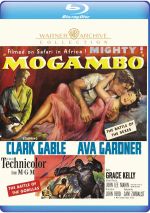
Best known for classic Westerns like 1939’s Stagecoach and 1954’s The Searchers, director John Ford didn’t always tell tales set in the American Southwest. With 1953’s Mogambo, Ford takes us to another continent.
In Kenya, big game trapper Victor Marswell (Clark Gable) captures exotic animals to sell to circuses and zoos. New York socialite Eloise "Honey Bear" Kelly (Ava Gardner) shows up at his camp in search of a wealthy maharaja who wooed her but bailed on this trip.
Nonetheless, Eloise finds a romantic connection with Victor. However, when anthropologist Donald Nordley (Donald Sinden) arrives, Victor becomes smitten with his wife Linda (Grace Kelly) and this leads to inevitable complications.
Unbeknownst to me as I went into Mogambo: it exists as a remake of 1932’s Red Dust. That one also starred Gable in an equivalent part with Jean Harlow in the Gardner role and Mary Astor as the Kelly character.
Mogambo relocates the story from French Indochina to Kenya and also changes Gable from rubber plantation owner to big game trapper. We also shift to Ford from Red Dust director Victor Fleming but screenwriter John Lee Mahin remains the author of both.
Because I just watched Dust about three weeks before I saw Mogambo, the 1932 flick remains active in my mind. To my surprise, the two seem less similar than I might expect.
They come with identical bones and basic narratives. However, Mahin’s updated script changes enough to make Mogambo seem fairly different from its predecessor.
One big change: Gable’s appearance. Not that anyone would expect the actor to look the same at 52 as he did at 31, but Gable aged a lot over those 21 years.
Granted, thanks to smoking, drinking and other factors, folks in their 50s tended to look much older in the 1950s than they do now. Nonetheless, Gable’s wrinkled and puffy face means he feels like a stretch as the romantic lead.
That becomes especially true because he works with much younger female costars. The sight of Gable contrasted with the 30-year-old Gardner and the 23-year-old Kelly makes him seem even older and craggier.
That said, Gable’s charm remained evident. A heart attack felled Gable before he even hit 60 but if he already veered toward ill health in 1953, it didn’t show in his performance or personality, as the actor still manifested his particular form of dashing charisma here.
Kelly and Gardner fill out their roles well, though Mahin’s screenplay doesn’t allow them much range. Both exist as archetypes and not much more, but the actors bring some personality to the parts.
Mogambo can drag, probably because it went with a much longer running time than its predecessor. Whereas Red Dust spanned a taut 83 minutes, the remake stretches for another 34 minutes.
Unfortunately, Mahin’s script doesn’t find much to warrant that extra cinematic real estate. Instead, we find a lot of “travelogue” style shots of Africa.
These provided appealing footage. Our glimpses of Africa prove to become the most compelling aspects of the film.
Beyond this material, we don’t get much more than fairly tedious romantic melodrama. Ford can’t bring off the relationships well so it becomes tough to care about what happens with the various roles.
I occasionally wondered if Mogambo went into production because Ford wanted a paid vacation in Africa. Actually, they shot interiors in English soundstages, but the cast and crew still spent a lot of time in various exotic locations.
Many problems descended on Mogambo thanks to various forms of unrest in these spots. I suspect the story of the shoot would become a fascinating tale.
I would bet that a look behind the scenes of Mogambo would prove more compelling than the movie itself. I didn’t care for Red Dust and its 1953 update proves no more satisfying.