DVD Movie Guide @ dvdmg.com Awards & Recommendations at Amazon.com.
.
Review Archive:  # | A-C | D-F | G-I | J-L | M-O | P-R | S-U | V-Z | Viewer Ratings | Main
SONY

MOVIE INFO
Director:
Bennett Miller
Cast:
Brad Pitt, Philip Seymour Hoffman, Jonah Hill
Screenplay:
Steven Zaillian, Aaron Sorkin

Synopsis:
Oakland A's general manager Billy Beane's successful attempt to assemble a baseball team on a lean budget by employing computer-generated analysis to acquire new players.

Box Office:
Budget:
$50 million.
Opening Weekend:
$19,501,302 on 2993 Screens.
Domestic Gross"
$75,605,492.

MPAA:
Rated PG-13.

DISC DETAILS
Presentation:
Aspect Ratio: 1.85:1
Audio:
English DTS-HD MA 5.1
French DTS-HD MA 5.1
Spanish DTS-HD MA 5.1
Subtitles:
English
French
Spanish
Closed-captioned
Supplements Subtitles:
None

Runtime: 133 min.
Price: $34.99
Release Date: 4/28/2026

Bonus:
• Blooper Reel
• Deleted Scenes
• “Reinventing the Game” Featurette
• “Drafting the Team” Featurette
• “Playing the Game” Featurette
• “Adapting Moneyball” Featurette
• Trailer


PURCHASE @ AMAZON
EQUIPMENT
-LG OLED65C6P 65-Inch 4K Ultra HD Smart OLED TV
-Marantz SR7010 9.2 Channel Full 4K Ultra HD AV Surround Receiver
-Sony UBP-X700 4K Ultra HD Dolby Vision Blu-ray Player
-Chane A2.4 Speakers
-SVS SB12-NSD 12" 400-watt Sealed Box Subwoofer


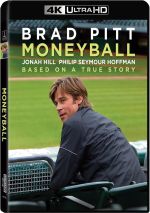
Moneyball [4K UHD] (2011)

Reviewed by Colin Jacobson (April 14, 2026)

With 2011’s Moneyball, we get an unusual sort of baseball film: one focused behind the scenes. It looks at the manner in which sabermetrics impacted sports.

After the 2001 playoffs, Oakland A’s Billy Beane (Brad Pitt) searches for a new way to improve his team despite severe budgetary restrictions. While in a trade discussion with Cleveland Indians GM Mark Shapiro (Reed Diamond), Beane notices the influence displayed by player analyst Peter Brand (Jonah Hill).

Intrigued, Beane finds out that Brand has developed a variety of statistical analyses to better discern player potential and value. Beane gloms onto Brand’s ways to figure out how to improve the team within their financial confines. We follow the way their partnership grows and impacts the team during the 2002 season – as well as conflicts that come from those focused on the old ways of player analysis.

Moneyball offers a weird subject to be adapted for the big screen, as the original book focused on statistics and their usage, not the people. A more literal translation would’ve made sense as a documentary but not as a feature film.

While the folks behind Moneyball have done a nice job of developing the dramatic side of things, we still find vestiges of its source, mainly via the way the movie occasionally feels like the analytical argument found in the book. At times, the flick comes across as a cinematic attempt to prove the correctness of Beane’s statistical preferences and to discredit the old scout-based methods.

Fans might want to screen a double feature of Moneyball and 2012’s Trouble with the Curve, as the latter acts like a counterpoint to the former. While Moneyball mocks scouts and traditional techniques, Curve embraces them.

I suspect good baseball teams understand the value of both. However, movies don’t tend to favor subtleties, so these stories veer toward the “either/or” side of the street.

Because of this, Moneyball can feel like propaganda. It gives us a hamfisted portrayal of scouts as out of touch and doesn’t offer them the credit they deserve.

No matter how hard the analytics guys may argue otherwise, competitive sports will never be an exact science. The human factor prevents the true objective use of numbers for all circumstances, even if Moneyball tries to convince us math rules all.

I do enjoy the “inside baseball” aspects of Moneyball. I love the sport and the glimpse behind the scenes – even if heavily fictionalized – can be a blast to see.

In addition, Pitt fills the lead role well. He doesn’t do much to expand beyond his usual onscreen personality, but he gives Beane a good mix of cockiness and humility that suits the character.

Given Beane’s path from “can’t-miss” prospect to down-on-his-luck former pro, he needs the slightly beaten down feeling Pitt adds. I just wish Moneyball managed a less heavyhanded approach – and it’d be nice it favored the facts more than it does.

In particular, the movie ignores some key factors in the team’s success such as shortstop Miguel Tejada and starting pitcher Barry Zito. You’d think the MVP and the AL Cy Young winner might’ve had something to do with the squad’s winning ways, but they get nary a mention in Moneyball because they don’t fit the narrative.

Zito and Tejada weren’t cast-off spare parts who matched the “moneyball” theme. In the movie, they’re non-entities, even if in real life, the A’s season owed a whole lot more to them than to the players we see on display.

In addition, Moneyball takes the somewhat odd approach to its climax, as the team’s 20-game winning streak acts as emotional peak. As awesome as that string of victories may have been, it became meaningless in the long run because no one cares about regular season success.

The 2002 A’s – like every other Beane-run squad – flamed out in the playoffs. Moneyball needs to accentuate the winning streak because it lacks any other climax.

Dramatically, this works fairly well. However, it still creates an odd “actual ending” to the movie, as Moneyball needs to remind us that the 2002 A’s flopped in the playoffs.

All of this leaves Moneyball as an entertaining but flawed sports drama. Honestly, it feels like an update on Bad News Bears much of the time. Moneyball keeps us entertained but doesn’t work as well as I’d like.


The Disc Grades: Picture B/ Audio B-/ Bonus B-

Moneyball appears in an aspect ratio of approximately 1.85:1 on this 4K UHD Disc. The image worked fairly well but it didn’t excel.

Although sharpness usually satisfied, occasional soft spots appeared. While these didn’t become a major distraction, they brought some inconsistencies.

I saw no issues with jaggies or shimmering, and edge haloes failed to appear. Print flaws also didn’t pop up, so the movie stayed clean and clear.

In terms of colors, Moneyball tended toward a somewhat green feel. Given the A’s uniforms, that made sense, but other scenes still gave us a mild green/teal tint. This wasn’t heavy and it made sense within the film’s design parameters.

Shadows felt well-rendered, but blacks could seem a bit crushed. Expect a largely appealing but up and down visual presentation.

Don’t expect much from the subdued DTS-HD MA 5.1 soundtrack of Moneyball. Still, the soundfield opened things up to a moderate degree. Music showed nice stereo presence, and the soundscape broadened when appropriate.

This mostly meant ballgame scenes, as the track featured good use of the side and rear channels to recreate the stadium atmosphere. This was a restricted mix, but it was satisfying.

Audio quality was good. Speech appeared natural, and the lines never demonstrated intelligibility problems.

Music was dynamic and lively, as the score showed nice range and delineation. Effects were also accurate, with nice clarity. The breadth of the soundfield wasn’t special enough to rate anything above a “B-”, but I thought the track suited the film.

How does this 4K UHD compare to the original Blu-ray from 2011? Both offered identical audio.

At times, the UHD became sharper, but the format’s higher resolution made soft-ish shots more obvious. The absence of HDR meant that blacks and colors didn’t get a real boost. The UHD came with some scenes that fared better than they did on the BD but I didn’t see it as a real upgrade.

2013 also brought a ”mastered in 4K” Blu-ray that included the same audio as the 2011 disc but upgraded visuals in a modest manner. How did the 4K UHD compare to that 2013 disc?

Obviously both used the same audio and both looked an awful lot alike in terms of picture quality. Again, the softness seemed more apparent and the absence of HDR meant colors and blacks lacked the expected bump. I can’t steer fans away from the 4K UHD but I also can’t claim it obviously fares better than its BD counterparts.

The 4K UHD includes the same extras from the 2011 Blu-ray. Allegedly to maximize bit rate, the 2013 “mastered in 4K” version dropped all bonus features.

Along with a trailer, we get a blooper reel. Called “Brad Loses it”, this piece runs three minutes, 10 seconds.

It focuses on one scene in which Brad Pitt couldn’t avoid the giggles. That concentration makes it more interesting than most outtakes collections.

Three Deleted Scenes fill a total of 12 minutes, one second. These include “Billy Tells Art: Play Bradford” (4:45), “Tara and Billy Dinner” (2:09) and “Peter Offered GM Job” (5:07). “Bradford” is another scene that makes Art Howe look like a boob, so it would have been redundant.

In “Dinner”, Billy mostly talks about how victories are meaningless if they don’t occur in the last game of the season, and “Job” shows what would have happened if Billy left Oakland. “Job” would’ve been a decent addition but the other two seem less valuable.

We also find four featurettes. We get “Billy Beane: Reinventing the Game” (16:01), “Drafting the Team” (20:54), “Playing the Game” (19:26) and “Adapting Moneyball” (16:31).

Across these, we hear from director Bennett Miller, author Michael Lewis, screenwriters Steve Zaillian, Stan Chervin and Aaron Sorkin, A’s GM Billy Beane, ballplayers Scott Hatteberg and Alex Rodriguez, producers Rachael Horovitz and Michael de Luca, baseball Michael J. Fisher, baseball consultant Chad Kreuter, Associate Producers for MLB Nick Trotta and Robin Jaffe, production designer Jess Gonchor, costume designer Kasia Walicka Maimone, key costumer Edward T. Hanley, director of photography Wally Pfister, and actors Brad Pitt, Jonah Hill, Philip Seymour Hoffman, Ken Medlock, Brent Jennings, Chris Pratt, and Stephen Bishop.

The programs look at Beane’s career, aspects of “Moneyball” and the real people behind the story, the 2002 A’s, cast, characters, performances, and reproducing baseball action, sets and locations, costumes and period details, visual design and cinematography, and bringing the book to the screen.

All of the featurettes work well and give us solid info about the movie. These add up to a good collection of programs.

Part drama, part propaganda, Moneyball entertains despite its flaws. I’m not wild about its factual liberties and ham-fisted ways, but with a talented cast and a fun premise, the movie works reasonably well. The 4K UHD provides generally good picture and audio as well as a nice array of bonus features. Moneyball doesn’t deliver a slam-dunk movie, but I like it, even if this 4K UHD didn’t seem like an obvious upgrade over its Blu-ray predecessors.


.
Review Archive:  # | A-C | D-F | G-I | J-L | M-O | P-R | S-U | V-Z | Viewer Ratings | Main