|
NATIONAL ENTERTAINMENT MEDIA
|
| |
|
MOVIE INFO
|
|
Director:
Katherine Dieckmann
Cast:
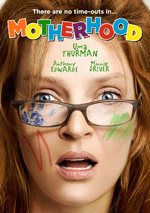
Uma Thurman, Anthony Edwards, Minnie Driver, David Schallipp, Matthew Schallipp
Writing Credits:
Katherine Dieckmann
Tagline:
There are no time-outs in ...
Synopsis:
Raising kids is never easy. Eliza, a stay-at-home mom of two, hilariously finds this out in seemingly endless day where she must plan a birthday party, deal with her scatter-brained husband, save her car from being towed, and write an essay for a parenting magazine before the fast-approaching deadline. Starring Uma Thurman, Anthony Edwards and Minnie Driver.
Box Office:
Budget
$5 million.
Opening Weekend
$50.081 thousand on 48 screens.
Domestic Gross
$92.900 thousand.
MPAA:
Rated PG-13
| |
|
DVD DETAILS
|
Presentation:
Widescreen 1.78:1/16x9
Audio:
English Dolby Digital 5.1
English Dolby Stereo 2.0
Subtitles:
English
Spanish
Closed-captioned
Supplements Subtitles:
None
Runtime: 94 minutes
Price: $24.98
Release Date: 2/23/2010
Bonus:
• Audio Commentary with Writer/Director Katherine Dieckmann and Producer Rachel Cohen
• Bonus Interviews
• Trailer
• Previews
| |
|
PURCHASE @ AMAZON.COM
|

| |
|
EQUIPMENT
|
Panasonic 50" TH-50PZ77U 1080p Plasma Monitor; Sony STR-DG1200 7.1 Channel Receiver; Panasonic DMP-BD60K Blu-Ray Player using HDMI outputs; Michael Green Revolution Cinema 6i Speakers (all five); Kenwood 1050SW 150-watt Subwoofer.
| |
[an error occurred while processing this directive]
|
Motherhood (2009)
|
|
Reviewed by Colin Jacobson (February 26, 2010)
What the heck happened to Uma Thurman’s career? Not that long ago, she looked like she’d become a major movie star. However, since her peak in the mid-late 1990s, she’s not done a lot of note. This has been more obvious since the Kill Bill flicks of 2003/2004.
Now we find Thurman in 2009’s Motherhood, a movie with such a low theatrical profile that it might as well have been direct-to-video. Motherhood played on no more than 48 screens and didn’t even make the $100,000 mark!
I’ve always liked Thurman, so I hope her fortunes improve in the future. Because of my established affection for her, I figured I’d give Motherhood a look. The film follows the day in the life of a harried mother. Eliza Welch (Thurman) is a stay-at-home mom who uses a motherhood-related blog to express her creative side. Husband Avery (Anthony Edwards) earns just enough to sustain their rent-controlled apartments in New York’s West Village and family needs, but he seems lost in his own world and doesn’t contribute much to household activities.
On this particular day, Eliza confronts two challenges. For one, her daughter Clara’s (Daisy Tahan) sixth birthday party will take place that night, so she needs to get all those ducks in a row. In addition, Eliza finds a contest to earn a gig as a columnist in a parenting magazine, but she needs to write 500 words about what motherhood means to her by midnight.
Back when I was a kid – which wasn’t that long ago – it seemed like mothers did their jobs without trumpeting their accomplishments. Over the last few decades, the “Mommy Cult” has become predominant, and boy, are these women eager to tell you how much/everything they do for their kids!
To some degree, Motherhood mocks the obsessive mothers, but it more frequently embraces them. The first scene clearly indicates which way the movie will go. We see all the work Eliza must do while her spacey husband sits around and relaxes.
This sets up the film’s “Martyr Mother” viewpoint right from the start, and it rarely lets go. Yes, it does allow Avery to become more three-dimensional late in the movie, but that feels like a grudging concession on the part of the filmmakers. They really prefer to stick with the concept that mothers run the world and everyone else is superfluous.
That idea would be annoying enough, but the film’s smug attitude makes it even more obnoxious. Perhaps if the movie took place someplace other than the West Village, it might come across as more universal. However, it feels like a Woody Allen take on motherhood; like most of the Woodman’s flicks, Motherhood limits itself to a kind of upper middle class worldview that won’t connect especially well elsewhere.
Yes, the filmmakers try to give Eliza and Avery more of an “Average Joe” feel. We learn that they can afford their two apartments due to rent control, and we hear about some financial troubles. Sorry, but I don’t think they deserve a telethon anytime soon. If they can afford to raise two kids in two Manhattan apartments on one salary, then they don’t merit a whole lot of sympathy.
Especially since Eliza comes across as such a self-absorbed character. Everyone around her is supposed to seem annoying so we can see Eliza’s challenges. However, she irritates as much – if not more – than they do. Eliza seems unable to take anything in stride, and she freaks out about many little things, all while she blames everyone else.
So that’s another strike against the movie. With a more sympathetic lead character, it might’ve evoked a better response, but since the main participant seems like a whiner, we don’t invest a lot in the tale.
It doesn’t help that Motherhood eventually abandons its depiction of mundane day-to-day challenges. This first occurs when Eliza has a near-fling with a hunky – and intellectual, of course – messenger. Eliza then enters formal mental breakdown mode.
At that point, the flick totally leaves the realm of reality. The combination of these two extremes ensures that we no longer can connect to the original theme, and the plot twists don’t add anything. They just make Eliza look flakier, and that’s a gamble the movie can’t afford to take.
As much as I’ve always liked Thurman, she can’t help here. Unfortunately, I’m more inclined to see her as a detriment to the film. Thurman tends to stay in broad comedy mode most of the time, so her line readings and gestures annoy more than anything else. Granted, I don’t think a good performance could’ve saved the flick, but Thurman does nothing to enhance it.
And that’s too bad, as I think there’s a kernel of an interesting movie to be found here. Motherhood tries too much to play up all the struggles of mothers while it also engages in smug condescension and silly plot twists. None of these components work, and when packaged together, they really flop.
|
The DVD Grades: Picture B-/ Audio C/ Bonus C
|
|
Motherhood appears in an aspect ratio of approximately 1.78:1 on this single-sided, single-layered DVD; the image has been enhanced for 16X9 televisions. Though it never excelled, the transfer seemed acceptable.
For the most part, sharpness appeared adequate to good. Wide shots tended to look somewhat soft and ill-defined, but the majority of the movie came across as reasonably concise. No jagged edges appeared, but I noticed some moiré effects, and a little edge enhancement popped up as well. In terms of source defects, I witnessed an occasional speck but nothing more than that.
The film went with a natural palette that looked fine. Colors never exactly popped off the screen, and they sometimes seemed a little runny, but overall, they were reasonably vivid. Blacks appeared dark and dense, while shadows demonstrated good clarity. This was more than adequate SD presentation.
As for the film’s Dolby Digital 5.1 soundtrack, it couldn’t have been much more low-key if it tried. General ambience ruled the day, as nothing more exciting than street noise ever appeared. Even those elements were forgettable, and the subdued score failed to add much zest. The soundfield worked fine for this kind of story, though.
Audio quality seemed acceptable. Speech appeared natural and concise, as the lines always remained intelligible. As I noted, neither music nor effects boasted much oomph; both remained exceedingly restrained throughout the movie. Within those constraints, though, they were adequate. This was a simple mix that deserved an average “C”.
When we shift to extras, we open with an audio commentary from writer/director Katherine Dieckmann and producer Rachel Cohen. Both sit together for this running, screen-specific look at the project’s roots and story issues, cast, characters and performances, sets and shooting in New York, music and editing, changes from the original script, personal inspirations, and a few other areas.
Dieckmann and Cohen combine for a decent commentary. Dieckmann dominates and offers reasonable insights into the film. The pair also throw in a fair amount of praise along the way, but that tendency doesn’t overwhelm. The track includes just enough useful material to make it worthwhile.
The disc also includes some Bonus Interviews. All together, these run a total of 15 minutes, 29 seconds. We hear from Uma Thurman (5:39), Minnie Driver (2:22), Anthony Edwards (2:19) and Dieckmann (5:09). They discuss cast and performance, story and characters, appealing aspects of the script, shooting in New York, and Dieckmann’s take on the material. Expect a fairly banal collection of comments here; very little insightful or interesting material shows up along the way.
In addition to the film’s trailer, we find some Previews. The disc features ads for Camille, The Song of Sparrows, Ballet Shoes, Mail Order Bride, The Gambler, The Girl and The Gunslinger, and Departures.
Back in 1989, Parenthood demonstrated that one could make a good movie about the day to day struggles of a typical family. 2009’s Motherhood fails to follow in the Ron Howard flick’s footsteps, as it creates a grating, arrogant view of the world. Dragged down by its annoying, self-involved lead character, it doesn’t deliver a concise view of mothers. The DVD provides reasonably good picture, mediocre audio and a few extras. Skip this silly, unconvincing “slice of life”.
|
|
[an error occurred while processing this directive]
|
|