Reviewed by Colin Jacobson (April 21, 2009)
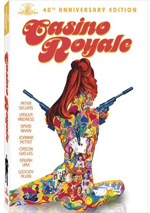
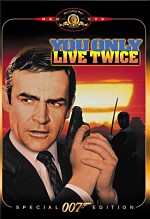
For the second time in history, 1983 saw two competing Bond films hit movie screens. The first occasion occurred in 1967, but that instance was not much of a competition. The "official" Bond release - You Only Live Twice - went up against a silly comic spoof called Casino Royale. Though the latter attracted its own audience, there was no real sense of competition, since Royale didn't attempt to top the
"real" Bond picture at its own game.
However, that wasn't the case in 1983, when the stakes escalated quite high. In June, Octopussy - the "official" release – appeared. It included Roger Moore as 007 and featured all of the series' staples like the theme music. Much of the crew behind the film also had years of Bond experience.
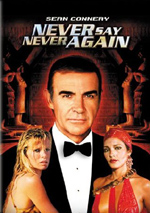
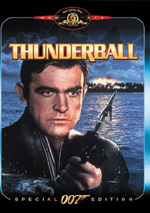
The competition arrived in October 1983 with much fanfare but little connection to the then-21-year-old franchise. This was Never Say Never Again, a remake of 1965's Thunderball. While the film could use the Bond name and other characters, it didn't get the music and it lacked the consistent cast and crew found on the "real" 007 pictures. However, it did have one ace in the hole: the return of classic Bond portrayer Sean Connery.
Connery initially called it quits on 007 after You Only Live Twice, but a couple of factors - a big payday for his favorite charity and his own lack of screen success since 1967 - combined to bring him back to the role for 1971's Diamonds Are Forever. After that, however, it really did look like the end of the line for Connery as 007. Ironically, though one would think the producers of the series would have opted for young blood in the part, they cast Moore, a man three years older than then-43-year-old Connery for 1973's Live and Let Die! Despite that fact, Moore held up for an additional 12 years and another six films before he retired from the part after 1985's A View to a Kill.
I haven't been able to discover why Connery once again accepted his license to kill for Never, the tale behind its creation is interesting. Here's the tale in a nutshell: in the late Fifties, film producer and director Kevin McClory approached Ian Fleming. He wanted to make a Bond movie but felt that instead of adapting an existing tale, they should create one from scratch so it could better fit within a big-production framework. Before too much time passed, McClory, Fleming and screenwriter Jack Whittingham completed a script called "Latitude 78 West".
In 1960, McClory lost a financial backer and the movie looked dead. While on vacation, Fleming went ahead and wrote up a story based on the script that he called "Thunderball". When McClory found out, he and Whittingham used legal means to hold it up since they felt Fleming was not authorized to use the story they co-created. Courts agreed, and McClory eventually won all film and TV rights to "Thunderball".
When this case settled, it was 1963 and two Bond movies - Dr. No and From Russia With Love - had already become big hits. McClory proposed that the official producers of the series, Cubby Broccoli and Harry Saltzman, make the film version of "Thunderball" and they agreed. They were concerned that someone else would offer a competing picture that might damage the good name of the franchise, a fear that proved correct when some parts of the public blamed them for Casino Royale although they had nothing to do with it.
Within the contract struck for the film of "Thunderball", McClory committed not to produce another version of the story for 10 years. At the time, I'm sure Broccoli and Saltzman saw no reason to challenge this loophole. Even if Bond proved a continued success in the world of 1975, it seemed unlikely someone would want to remake such a relatively recent film.
Unfortunately for them, they were completely incorrect. Once the clock struck 10 (years), McClory announced plans to make another Bond movie based on "Thunderball". Despite the fact this seemed to be well within his rights, Broccoli challenged McClory and the pair returned to court. (Due to financial difficulties, Saltzman had sold his interests in the production company; 1974's The Man With the Golden Gun was the final Bond movie to bear his credit.)
Legal wranglings continued for a few years, but eventually McClory won his case. Finally, in 1983, a non-official Bond film hit the market.
Despite Broccoli's fears, the market proved able to handle two Bond pictures. Both did fairly well at the box office, and Never did nothing to harm the overall image of the franchise.
In fact, much of the public appeared to find Never to be the better film of the two. Undoubtedly, these opinions were aided by the presence of Connery. To many folks, he's the only "real" 007 and Moore's tenure in the role had harmed the stature of the series.
In 1983, I was 16 and had only ever seen two Bond movies: 1979's Moonraker and 1981's For Your Eyes Only. Although I enjoyed both of those, for reasons I don't recall, I hadn't bothered to take in Octopussy during its theatrical run. However, I did show an interest in Never, largely because I'd begun to believe the hype. I grew up with Moore as Bond and always saw him as the best person in the role, mainly because I didn't know better. I had seen little of Connery and - since I was ignorant of the chronological facts - thought of him as an old guy who appeared in some dated movies. (Hey, the Sixties seemed like a really long time ago!)
Nonetheless, by 1983, I started to hear how much better Connery was supposed to be, so his presence in Never made it intriguing. As such, it was the 1983 Bond film I saw, and I recall that I thought it was pretty good.
More than 25 years later, I'm infinitely better-versed in Bond history since I've seen all 22 of the "official" films, most of them more than once. Now that I'd taken in all of those Bond DVDs, I was curious to rediscover Never Say Never Again. Sure, it impressed a painfully ignorant 16-year-old, but would it work for a slightly less ignorant 41-year-old?
Nope. Frankly, I was quite surprised at how weak I found Never to be. I won't call the film a complete flop, but it felt like imitation Bond at best, and it often seemed to be a pretty cheap rip-off of the franchise.
Never indeed remakes Thunderball; although it's not a perfect copy, it will look very familiar to fans of the 1965 hit. Actually, the film starts off pretty well; although the opening sequence - which follows the credits, unlike all Bond movies since 1963 - reminded me an awful lot of the start to From Russia With Love, it was a fun and engaging beginning to the movie.
Unfortunately, the project almost immediately goes downhill after that. Cast as "M", Edward Fox provides a frightfully shrill and prissy portrayal. Granted, he's not supposed to be the same "M" played for so many years by Bernard Lee; as with Judi Dench in the Nineties Bonds, this is another person who has taken charge of the secret service. While I understood the desire to distance the character from Lee's able persona, Fox goes much too far in the campy and grating direction; this "M" is played as a complete idiot, which is absolutely inappropriate for the role.
One of my main complaints about Never came from work like this. The "official" Bond films worked because the actors so rarely played things overtly for laughs; humor functions better within this sort of environment when it lacks the "wink-wink, nudge-nudge" factor.
The producers of Never apparently felt differently, because we find too many of these broad and inane performances. Almost as bad as Fox was Rowan Atkinson as Nigel Small-Fawcett. Getting beyond the stupid penis joke inherent in his name, Atkinson makes the character insipid and annoying. I dreaded any of his appearances, as he added nothing to the movie and actively detracted from it at times.
Most of the remainder of the actors seemed fairly weak as well, though none of them were as poor as Fox and Atkinson. Connery was Connery; despite the flaws of the project itself, he helps make the project semi-tolerable at times just because he is who he is. Actually, he looked terrific in the role. He seemed younger and more vibrant than he did in Diamonds Are Forever, despite the additional 12 years in between projects.
Also strong is Klaus Maria Brandauer as villainous Largo. Unlike every other cast member, he outdoes his predecessor (Adolpho Celi) and provides a deft and nuanced performance. He creates a baddie who shows signs of mental instability but also appears suave and charismatic, and he never lets the nutbag side of the role become overwhelming; he portrays those aspects of the role in a rather subtle manner.
Despite the best efforts of Connery and Brandauer, however, Never is beyond redemption. Although many other Bonds seem strongly a part of the eras in which they were released - Live and Let Die stands out in that regard - Never feels much more dated than the others. From the absolutely miserable score to the costumes and sets to the absolutely absurd videogame showdown between Bond and Largo, everything about the movie screams "early Eighties". Somehow the producers managed to find every cliché of the period and pack it into one film.
Although one would assume that much of Never would feel like déjà vu since it remakes Thunderball, I didn't expect as many overt steals from other Bond films. As I already noted, the opening is strongly reminiscent of From Russia With Love, and I also found Bond's fight with thuggish Lippe to look and feel a lot like his climactic confrontation with Odd Job in Goldfinger. These don't come across as "homages"; they feel like cheap thievery and nothing more.
Although I'm not very wild about some Bond films, I find something to enjoy in each of them and I rarely feel bored with them. Unfortunately, that wasn't the case with Never Say Never Again. The movie provides a weak remake of a classic Bond picture and frequently was tedious and flat. Even the charismatic presence of the great Sean Connery couldn't save this clunker.