DVD Movie Guide @ dvdmg.com Awards & Recommendations at Amazon.com.
.
Review Archive:  # | A-C | D-F | G-I | J-L | M-O | P-R | S-U | V-Z | Viewer Ratings | Main
UNIVERSAL

MOVIE INFO

Director:
Sydney Pollack
Cast:
Meryl Streep, Robert Redford, Klaus Maria Brandauer
Writing Credits:
Kurt Luedtke

Synopsis:
In 20th-century colonial Kenya, a Danish baroness/plantation owner has a passionate love affair with a free-spirited big-game hunter.

Box Office:
Budget:
$31 Million.
Opening Weekend:
$3,637,290 on 922 Screens.
Domestic Gross:
$87,071,205.

MPAA:
Rated PG.

DISC DETAILS
Presentation:
Aspect Ratio: 1.85:1
Audio:
English DTS-HD MA 5.1
French DTS 5.1
Subtitles:
English
French
Spanish
Closed-captioned
Supplements Subtitles:
English

Runtime: 161 min.
Price: $26.98
Release Date: 4/27/2010

Bonus:
• Audio Commentary with Director Sydney Pollack
• “A Song of Africa” Documentary
• Deleted Scenes
• Trailer


PURCHASE @ AMAZON.COM

EQUIPMENT
-LG OLED65C6P 65-Inch 4K Ultra HD Smart OLED TV
-Marantz SR7010 9.2 Channel Full 4K Ultra HD AV Surround Receiver
-Panasonic DMP-BDT220P Blu-Ray Player
-Chane A2.4 Speakers
-SVS SB12-NSD 12" 400-watt Sealed Box Subwoofer


RELATED REVIEWS


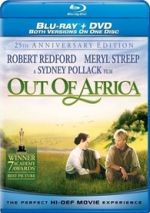
Out of Africa [Blu-Ray] (1985)

Reviewed by Colin Jacobson (February 12, 2026)

With 1985’s Out Of Africa, we find what would seem to be the prototypical "Oscar" movie as it contains virtually every element that the Academy appears to favor. Well, at least they traditionally did so, as the Best Picture prizes have gone to less “Oscar-bait” movies in recent years.

Still, Africa fits the standard mold as a lush, romantic period piece that offers languid shots of gorgeous scenery and almost qualifies as an epic. It presents a mix of happiness and tragedy and comes with a pretty long running time of 161 minutes.

Africa got its almost-inevitable prize, but did it deserve it? Ehh, maybe, maybe not.

I can't say too much about the movie that I actively dislike, but I can definitely state that it doesn't do much for me. It brings a lovely piece but can lean dull too much of the time.

In 1913, wealthy Danish aristocrat Karen Dinesen (Meryl Streep) marries roguish Baron Blor Blixen (Klaus Maria Brandauer). They move to Nairobi to pursue farming.

Along the way, Karen meets British big-game hunter Denys Finch Hatton (Robert Redford) and a spark connects. While Karen deals with life in Africa and her unconventional relationship with her husband, she also finds herself persistently drawn to Denys.

When I look at goes right with Africa, I find the primary appeal stems from the natural gifts of the continent. The landscapes and various nature shots really do seem gorgeous, and they make me - someone not fond of the outdoors – want to visit.

We find generally good acting, though I must admit Streep's "accent of the week" routine could get a bit tiresome. I often find it hard to gauge the strength of her performances because it gets so difficult to peer through her newest voice.

Still, I can't legitimately criticize Streep for her attempt to convey her character in a genuine way. My own petty gripes aside, she does a fine job as Karen.

On the other hand, we find Redford as a British adventurer without the slightest hint of that accent. Actually, I spent much of the movie wondering if the character was supposed to be British.

Given that no Americans appear in the movie, I figured Denys came from the UK, and the “Denys Finch Hatton” offers almost a comically “English name”. Nonetheless, Redford's performance confounded me.

In his audio commentary, director Sydney Pollack addresses that issue. Apparently Redford tried an English accent but it ended up being more distracting than it became worth.

Perhaps, but I still feel Redford seems all wrong for the part. Finch Hatton intends to appear elusive and mysterious, but Redford presents an awfully broad, gregarious presence.

Denys should seem aloof and difficult to pin down, and Redford simply can’t achieve those properties. The role demands an actor more like Ralph Fiennes than the quintessentially All-American Boy Redford.

Pollack relates that he hired Brandauer for this role as a scoundrel and philanderer after he saw him in the James Bond film Never Say Never Again. He felt that Brandauer could play a terrible person who nonetheless seemed likable to the audience, qualities he feels came through in Bror.

Unfortunately, I disagree. No slam on Brandauer but Bror always seems a complete jerk who never generates the slightest sense of affection for him. The character comes across very poorly despite whatever the intentions may have been.

Ironically, this ultimately seems good for the film, since it a) allows us to sympathize more with Karen and b) makes her affair with Finch Hatton acceptable. I often railed about films like The English Patient or The Bridges of Madison County, pictures that make a virtue out of infidelity on the part of women.

These kinds of movies bother me because you never see the same thing happen when a man cheats. However, Africa treats these affairs more objectively. We dislike Bror due to his actions but Pollack doesn't slant the movie heavily against him as one would expect.

Similarly, Pollack portrays Karen's relationship with Denys in a "matter of fact" manner. While we sense how special it is for her, Pollack doesn’t play it up in the "greatest romance ever" fashion often witnessed and this factor makes these scenes much more palatable for me.

As for the rest of the film, let's just say it doesn't do much for me. It clearly offers a well-made piece of work, but I find Africa to become overly long and fairly monotonous.

Characters grow and change - except for nasty old Bror, I suppose - but time passes a little too quickly and events just seem to happen a little too magically. Africa seems watchable and mildly interesting at times but not more than that.


The Disc Grades: Picture D+/ Audio B/ Bonus B+

Out of Africa appears in an aspect ratio of approximately 1.85:1 on this Blu-ray Disc. De-noised and processed within an inch of its life, this became a problematic transfer.

Sharpness was a significant issue. Some shots demonstrated good delineation, but much of the flick showed drab definition.

The image generally ranged from vaguely soft to downright blurry. The flick lacked virtually any of the clarity and detail we expect from Blu-ray.

No issues with jaggies or shimmering occurred, but edge haloes were a frequent distraction. In terms of source flaws, I saw occasional specks and nicks, but nothing heavy.

I got the impression heavy digital noise reduction affected the image. It showed very little grain and came across with an unnatural sheen that stripped it of life.

Colors appeared bland. The movie lacked natural tones, as the hues usually came across as somewhat wan and pinkish.

Few instances of full colors materialized, as these felt lackluster. Black levels mainly appeared adequately deep, but they varied.

Sometimes these appeared too gray and soft, and on other occasions they could look too dark. Shadow detail usually seemed appropriate, though the occasional overly dark blacks sometimes made this area look too opaque.

I found myself consistently dissatisfied with this transfer. At its best it became passable, but it usually looked worse than that.

On the other hand, the film's DTS-HD MA 5.1 soundtrack worked pretty well for its era. The forward soundstage appeared pretty well-defined, with much stereo activity occurring.

All three front channels offered some nicely spaced and separated audio. The surrounds were more limited, but the rear channels provided adequate reinforcement for the front and they could become active at times.

Quality of the audio was also pretty good for its age. Dialogue was easily intelligible and fairly natural, so a little reediness occurred, but the lines usually worked well.

Effects and music showed some roughness, but they had fairly nice range and heft. Nothing here dazzled, but the mix was above average given its era.

How did Blu-ray compare to the circa 2000 DVD? Audio worked better, as the DTS-HD mix seemed a bit more involving and dynamic. It still showed its age, but it felt more pleasing than its Dolby Digital 4.1 predecessor.

As for the visuals, it became a toss-up to pick which one you prefer. I actually thought both exhibited pretty similar definition, and the DVD might even offer slightly superior sharpness.

At the very least, its softness didn’t stand out as such a big distraction. It seemed noisier and dirtier, but without the excessive processing, it looked more film-like.

I could make out facial textures on the DVD, whereas those details got erased on the Blu-ray. Neither presentation proved to be terribly satisfying, but the DVD felt a bit more pleasing to me, perhaps just because it didn’t look like someone smothered it in noise reduction.

When we move to the extras, first comes an audio commentary from director Sydney Pollack. He presents a running, screen-specific discussion.

Pollack covers a nice variety of subjects, from historical facts to location issues to many facets behind both the technical and the creative sides of the production. We learn about casting and performances, casting and sets, and many other topics.

The track does suffer from a fair number of gaps, but these become somewhat forgivable due to the length of the film and also because most of Pollack's comments seem compelling. He repeats himself a couple of times but generally provides a lot of useful and illuminating information about the film.

More of the same appears in Song Of Africa, a one-hour, 12-minute and 45-second documentary. We see interviews with Pollack, actor Meryl Streep, composer John Barry, screenwriter Kurt Luedtke, and biographer Judith Thurman.

We also witness some brief interviews from the set itself - all with Pollack - plus some documentary footage from real life.

“Song” discusses historical aspects of the story, sets and locations, cast and crew, characters and performances, shooting in Africa, the score, and a few other production elements.

Inevitably, it repeats some info from Pollack’s commentary, but the historical perspective adds a lot. I also like Streep’s comments, largely because she’s a very entertaining storyteller. Though it’s too bad more participants don’t appear, this ends up as a solid program.

Note that the Blu-ray’s version of the documentary runs longer than the DVD’s. This one adds about 23 minutes of content.

A few other supplements round out the package. The film's theatrical trailer appears, complete with cheesy, tres-Eighties synthesizer score.

I guess John Barry's score wasn't ready yet, but still! With the terrible music featured in the trailer, it's a miracle anyone went to see the movie.

We end with 15 minutes, two seconds of Deleted Scenes. The set includes 19 of these, which means you shouldn’t expect anything extended from them.

Virtually all of them provide brief snippets that act as minor character embellishments. Given the theatrical cut’s already extended running time, I can’t find anything here that I’d consider to be worth adding, so these feel like pretty forgettable little tidbits.

On the flipside of the Blu-ray, you’ll find a standard DVD Version of Africa. This appears to provide a literal replication of the old 2000 DVD.

While I can't whole-heartedly recommend Out Of Africa, I can't really steer you away from it either. No, the film doesn't do a lot for me, but I can understand why a lot of others like it and why it became so successful. The Blu-ray presents good audio and some nice supplements but it demonstrates decidedly subpar picture quality. This turns into a disappointing release.


.
Review Archive:  # | A-C | D-F | G-I | J-L | M-O | P-R | S-U | V-Z | Viewer Ratings | Main