Reviewed by Colin Jacobson (December 8, 2025)
My prior experiences with the work of director Anatole Litvak came from 1939’s Confessions of a Nazi Spy and 1948’s The Snake Pit. Neither of them worked for me, but because hope springs eternal, I decided to give 1941’s Out of the Fog a look.
In Brooklyn, aging pals Jonah Goodwin (Thomas Mitchell) and Olaf Johnson (John Qualen) like to fish and the dream of a retirement in which they can own their own boat and take it where they’d like. Their situation complicates when small-time gangster Harold Goff (John Garfield) pressures them for “protection” money that saps their savings.
Harold also woos Jonah’s daughter Stella (Ida Lupino), a young woman bored with her life and desirous of a little adventure. Faced with these problems, Jonah and Olaf come up with an extreme plan to solve their concerns.
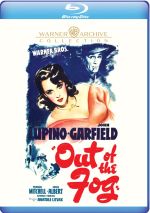
A look at the movie poster featured as this Blu-ray’s cover highlights the names Lupino and Garfield in big letters. The graphics also focus heavily on Lupino, with small images of Garfield as well and a tiny hint of Mitchell.
This qualifies as false advertising. While the promos imply Fog will concentrate primarily on the Stella/Goff affair, that turns into more of a plot point than anything else.
It seems logical to assume Fog will become more of a battle for Stella’s soul than anything else, especially given the presence of Stella’s bland but solid and true boyfriend George Watkins (Eddie Albert).
Instead, the Stella side of things exists more as a catalyst for her father Jonah to act. He becomes the classic example of an ordinary man pushed too far until he needs to take extreme measures.
To some degree, Fog tries to have it both ways, as we do spend a decent amount of time with Goff and Stella. Still, those scenes remain more like narrative fodder than the actual main purpose of the story.
Which seems fine with me, honestly, and this probably makes Fog work better than if it’d pursued a standard love triangle in which the young woman must choose between the reliable but less than thrilling beau and the exciting but detrimental one.
That exists as a subtext and a catalyst for Jonah’s decisions but Fog devotes surprisingly little time to the actual Stella/Goff connection. While this probably disappointed moviegoers 84 years ago, it helps add spice to Fog.
At times, Fog delivers a somewhat comedic vibe, but Garfield always seems ominous. That helps ensure that we take him seriously as a threat and we buy into the dilemma that confronts Jonah and Olaf more readily.
This means we find more drama than I might otherwise expect. Jonah and Olaf come across as so milquetoast that we can’t imagine they’ll actually harm Goff, but their situation becomes so untenable that tension ensues.
As a result, we get a pretty taut little thriller. It winds up with a bizarrely cheerful finale, but otherwise, I think Fog turns into a positive effort.