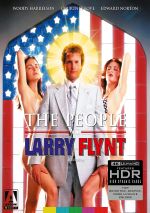
The People Vs. Larry Flynt appears in an aspect ratio of approximately 2.40:1 on this 4K UHD disc. Expect a high-quality Dolby Vision presentation here.
Sharpness seemed excellent, as the movie remained crisp and concise from start to finish. Virtually no examples of softness marred the presentation, as it appeared distinct and accurate.
I saw no problems with jagged edges or shimmering, and I also witnessed no signs of edge haloes. Grain felt natural and the film lacked print flaws.
Flynt offered a naturalistic palette, and the tones looked consistently positive. The movie exhibited colors that came across as warm and rich at all times, and they got a nice boost from HDR.
Black levels seemed dense and full, while shadow detail was clear and appropriately opaque. HDR have whites and contrast extra oomph. I felt highly pleased with this strong image.
The DTS-HD MA 5.1 didn’t fare quite as well, but that becomes inevitable because of the audio’s lack of scope and its chatty nature. Dialogue dominated People and that didn’t lead to an active soundfield.
Music showed vivid stereo dimensionality, and the film demonstrated a pretty good sense of ambience. Elements like jets moved neatly across the front, and they also kicked into the surrounds at times. Scenes like the “Americans for Free Press” rally presented a good feeling of echo and atmosphere as well, and I liked the punch given to a sequence with fireworks. The mix didn’t present much ambition, but the soundfield seemed satisfactory for this kind of film.
Audio quality worked fine, as dialogue appeared neat and distinctive. Although they didn’t become a particularly active aspect of the track, effects remained concise and accurate, and they showed decent heft when appropriate.
Music worked best, as the score and songs demonstrated good vibrancy and dynamics. The audio didn’t demonstrate much ambition, but the soundtrack of Flynt seemed strong enough to earn a “B”.
The Arrow 4K UHD mixes old and new extras and we open with two separate audio commentaries, the first of which features actors Courtney Love, Woody Harrelson and Edward Norton. All three apparently provided their own screen-specific discussions, but they sat separately and the results were edited together for this track.
Better than most actor commentaries, this one offers a lot of good material, though it comes with a few frustrations. Love heavily dominates the piece.
Norton only pops up a few times, though he adds some good insight into his work. He also explains why director Miloš Forman doesn’t provide his own commentary: allegedly the director doesn’t think his English seems understandable enough!
Harrelson also appears sporadically, but he chimes in with more frequency than Norton as he gives us some notes about his work and anecdotes from the set. Harrelson proves to be engaging and lively during his occasional remarks.
As indicated, however, most of the track features Love, and she seems nicely frank and chatty. Love discusses her casting and complications related to that due to her prior drug problems.
Love also talks about conflicts on the set and working with the others plus her research into the role and various different elements. Her occasional remarks about her romance with Norton offer intrigue.
While most of it seems positive, some parts of the actors commentary fall flat. It suffers from a fair number of gaps, and at times, Love does little more than narrate the movie.
Despite those issues, however, the piece mostly works well. It offers interesting coverage of the film from the actors’ point of view.
The second commentary features writers Scott Alexander and Larry Karaszewski, both of whom sit together for this running, screen-specific track. They chat about their roots in the business and moved through their inspiration to do the Flynt story, obstacles encountered along the way, factual tidbits, the reality of the story, and lots of anecdotes about the making of the flick.
The writers fill the time well and make this a terrific little track. We get tons of useful information so expect a very strong commentary from Karaszewski and Alexander.
Everything else appears on a separate Blu-ray Disc, and we find two Deleted Scenes. “Running for President” (1:01) shows a look at Flynt’s 1983 press conference to declare his political intentions, while “Kentucky House” (1:31) depicts the reproduction of his childhood home that he built into his LA mansion.
The latter offers more of a look at Flynt’s parents, but it doesn’t really give us a better understanding of them. “President” doesn’t really go anywhere, at least as depicted. I don’t know if an additional scene would flesh out this area of Flynt’s life, but this clip fails to tell us much.
The deleted scenes can be viewed with or without commentary. Woody Harrelson discusses his affection for “President”, while Larry Karaszewski chats about “House”.
Harrelson does little to convince us that “President” deserved to make the final cut, while Karaszewski tells us how he likes the non-professional actors used for “House”. You won’t miss much if you skip either commentary – or both.
After this we get two documentaries. Free Speech or Porn? runs 30 minutes, 11 seconds and we hear from Alexander, Karaszewski, Norton, Harrelson, Love, director Miloš Forman, producers Janet Yang, Michael Hausman and Oliver Stone, actors James Cromwell, Vincent Schiavelli, and Brett Harrelson, costume designer Arianne Philips, production designer Patrizia von Brandenstein, and real-life personalities Larry Flynt, Alan Isaacman, and Reverend Jerry Falwell.
”Porn” repeats some information heard in the commentaries, but mostly it gives us fresh details about the production. It examines the movie in a fairly standard way, as it goes through the project’s genesis and tells us about casting, adaptation issues, Forman’s involvement, dealing with the subject matter, costume and production design factors, and reactions to the film.
The latter elements seem especially interesting as we hear of the backlash against Flynt, and it’s also cool to get a little info from real-life Flynt, Falwell and Isaacman, though none of the trio tell us much.
As for the non-interview footage, some short glimpses of the screentests for Love and Norton seem like highlights. Overall, “Porn” provides a pretty entertaining discussion of Flynt.
Narrated by Dennis Hopper, Larry Flynt Exposed gives us a 29-minute, 27-second synopsis of the publisher’s life. It shows interviews with Flynt, Woody Harrelson, Karaszeweki, wife Liz Flynt, Jerry Falwell, Alan Isaacman, brother Jimmy Flynt, photographers Suze Randall, Ladi von Jansky, Larry Flynt Publications Special Project Director Vince Crisp, LFP VP/Creative Director James Baes, former federal prosecutor Bo Anderson, and LFP Executive Vice President Tom Candy.
Told logically and concisely, “Exposed” elaborates on material from the film and allows us to get a good sense of Flynt’s real story. It goes through the different elements seen in the movie and provides various viewpoints.
The participation of all the real-life personalities helps make “Exposed” work best, as it’s very interesting to get their perspectives on the events. “Exposed” works as an excellent supplement to the movie and it nicely fleshes out Flynt’s story.
Most of the remaining extras didn’t appear on the prior releases, and Hail Larry goes for 27 minutes, 48 seconds. It brings a new interview with Woody Harrelson.
The actor discusses how he came to the film, meeting the actual Larry Flynt, his co-stars, various experiences during the shoot, and some retrospective thoughts. Inevitably Harrelson repeats some material from the commentary but he adds enough new notes to make the chat worth a look.
Satire in Satin spans 29 minutes, 48 seconds. Here we find remarks from Columbia Pictures’ ex-production president Lisa Henson and producer Janet Yang.
Recorded together in 2026, they relate how the project came to the screen and what appealed to them about as well as cooperation from Larry Flynt, casting, production notes, and overall reflections. I like that Yang and Henson converse with each other, as that helps give the reel an interactive energy.
Also shot in 2026 for this set, Only in America occupies 28 minutes, 42 seconds. This reel features more from Karaszewski and Alexander.
The writers tells us about their relationship and the development of this film, casting and encounters with the people who inspired the characters, story/characters, the movie's release and reception. Though we get a few notes already heard in their commentary, the writers offer a lot of good new insights.
From 2022, À la lumière de l'évidence lasts 31 minutes, one second. The program gives us a chat with cinematographer Philippe Rousselot.
We get notes about how he came to the project as well as his collaboration with Forman and aspects of his work on the film,
Aired March 1997, an excerpt from The Charlie Rose Show takes up 22 minutes, 11 seconds. We get a chat between Rose and Miloš Forman.
They cover then-current politics and controversies related to the film, casting, and various reactions to the movie. Taped right before the 1997 Oscars, Forman seems a bit defensive but he gets into some useful domains.
Along with a trailer and six TV spots, the disc concludes with four Image Galleries. These cover “Promotional Material” (152 frames), “Behind the Scenes” (62), “Treatment for Oliver Stone” (3) and “Script” (146). All offer value but "Treatment" and "Script" prove most useful.
The People Vs. Larry Flynt boasts a lot of talent behind and in front of the camera, which makes it seem like a disappointment. While some parts of it work well, the movie doesn’t delve deeply into its characters or themes, and it comes across as somewhat erratic and superficial. The 4K UHD provides terrific visuals, good audio and a fine array of supplements. Though I don’t love the movie, this turns into an excellent release.