Reviewed by Colin Jacobson (July 13, 2026)
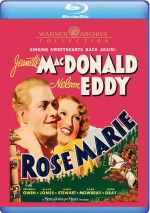
One of the most famous screen duos in movie history, Jeanette MacDonald and Nelson Eddy made eight films together from 1935 to 1942. For the second in this run, we go to 1936's Rose Marie.
Jack Flower (James Stewart) escapes from a Canadian prison and allegedly kills a Mountie. His sister Marie de Flor (MacDonald) learns this from a man named Boniface (George Regas) and they head into the wilderness to find Jack.
Sergeant Bruce (Eddy) gets the assignments to apprehend Jack. This leads to an unlikely romance as they both attempt to find the fugitive for different reasons.
As mentioned, MacDonald and Eddy starred together in eight movies. Rose Marie represents only the second one of these I’ve seen, though, as it follow my late 2025 screening of 1938’s Sweethearts.
That one left me cold, as it brought a slow and dull experience. With livelier plot, though, I hoped Rose Marie might fare better.
It does, though not to a tremendous degree. On the positive side, Rose Marie boasts a stronger narrative than the awfully thin Sweethearts.
To some degree, these MacDonald-Eddy movies existed more as an excuse to give us crooning from the leads. That holds true for Rose Marie, as the film finds contrived ways to get them to break into song.
Still, this occurs less often than during Sweethearts, as we get more actual story this time. Not that one should expect a tight plot from Rose Marie, however, as it really does feel like a collection of musical numbers around which the filmmakers created a narrative.
I’ll take the more compelling series of events, even if “better plot than Sweethearts” exists as a low bar. I welcome any improvement, no matter how minor.
And the growth in story development does remain modest. This means the degree to which one enjoys Rose Marie will likely depend on how much one digs the vocal stylings of MacDonald and Eddy.
In my case, the answer comes back “not at all”. I get that audiences dug their quasi-operatic crooning 90 years ago, but I’ll be darned if I can figure out why, as their singing veers on nails/chalkboard territory for me.
If MacDonald and Eddy boasted stronger acting skills, I might not mind my disaffection for their songs. However, neither shows range or charm as dramatic performers.
Rose Marie compensates with a good supporting cast, even if we find surprisingly little of the pre-fame James Stewart. One of eight films he made in 1936, Jack’s actions may motivate the plot but he can feel like a MacGuffin, as Stewart appears on-screen only briefly.
Nonetheless, Stewart’s talent and charm shines even in those short moments. His skills put those of our leads to shame.
Other “names” like Una O’Connor, David Niven and Reginald Owen appear as well. Like Stewart, their work tends to remind us how bland MacDonald and Eddy were as actors.
With superior dramatic performers and fewer songs, Rose Marie could deliver a predictable but good tale. As executed, unfortunately, it becomes a tedious dud.
Confusing footnote: though the song on which the movie takes its title was called “Rose-Marie”, the film itself drops the hyphen – usually. Some places write it as Rose-Marie but given that the 1936 poster pictured on this disc’s cover spells it Rose Marie, I went with that.