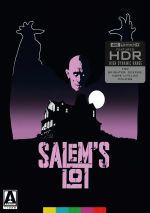
Salem’s Lot appears in an aspect ratio of approximately 1.33:1 on this 4K UHD Disc. Expect a pretty solid Dolby Vision image.
Sharpness generally seemed positive. Some minor softness interfered at times, but those moments appeared infrequent so the program usually looked nicely delineated and well defined.
I saw no examples of moiré effects or jagged edges, and the presentation included no edge haloes. Grain leaned heavy but seemed natural, and I saw no print flaws.
Colors came across as bright and accurate. The movie went with a natural palette, and the tones felt solid and vibrant, with a nice boost from HDR.
Black levels stayed nicely deep and dense, while shadow detail showed positive consistency. HDR added oomph to whites and contrast. Only a few slightly soft shots kept the image from “A-“ consideration, as it looked very good.
I also felt pleased with the DTS-HD MA monaural soundtrack of Salem’s Lot. Audio quality seemed a little thin at times, but the mix usually worked fine.
Dialogue appeared reasonably natural, though speech tended to be somewhat flat on occasion. Still, I heard no concerns related to intelligibility or edginess, and the lines always appeared distinct.
Effects lacked great range or vividness, but they seemed to represent the elements acceptably well, and they showed no distortion or other problems in that domain.
Music was similarly average, though the score did present some modest bass response at times. Overall, the soundtrack of Lot did nothing to elevate the material, but it didn’t harm it either, and it was fine given its age and origins.
How did the 4K UHD compare to the 2016 Blu-ray release? Both came with identical audio.
On the other hand, the UHD’s Dolby Vision image offered obvious upgrades in terms of sharpness, colors and blacks. This turned into a nice step up in quality.
On two separate 4K UHD discs, we get both the movie’s original TV mini-series version (3:03:25) as well as its theatrical cut (1:50:11). How do the two differ?
Intended for “international” audiences, obviously the much shorter theatrical Lot loses plenty of material from the mini-series. A film can’t run 73 fewer minutes and not come with extreme edits. It does come with some alternate takes and more of an “R”-rated vibe via a few shots of violence that seem more graphic than those in the TV edition.
I prefer the longer Lot as it comes with more room to breathe. Still, I feel happy that this set includes the international theatrical Lot since it provides a valid rendition of the film as well.
Note that if you watch the TV Lot, you can view it either as two separate parts ala the original broadcast (total time 3:11:52) or as that 3:03:25 version mentioned previously. The two-part Lot gains extra time from “TV preview” material so don’t expect more story material.
Also note that the picture/sound quality comments above reflect the longer TV version. However, the “theatrical” rendition offers seemingly identical picture and audio, though it provides an LPCM mono track instead of the TV cut’s DTS-HD MA monaural.
I expected “theatrical” to come with cropped 1.85:1 framing but instead it delivers the same 1.33:1 as “TV”. This seems odd and I find it hard to believe it ran in cinemas 1.33:1 but there you go.
The set includes three separate audio commentaries, the first two of which accompany the TV mini-series Lot. Also found on the old Blu-ray, we get a chat from director Tobe Hooper as he offers a running, screen-specific look at how he came onto the project, sets and locations, cast and performances, effects, story/characters and related topics.
Expect a slow, largely dull commentary. Hooper offers a smattering of decent insights, but he leaves a lot of dead air, and when he speaks, he tends to keep matters fairly banal. You'll learn a little about the movie from this chat but not enough to justify the three-hour investment.
New to the 2026 Arrow set, we also find a TV version commentary from film critics Bill Ackerman and Amanda Reyes. Both sit together for a running, screen-specific look at the source and its adaptation, story/characters, cast and performances, genre areas, sets and locations, TV in the film's era, various production elements and their thoughts about the movie.
With three hours at their disposal, Reyes and Ackerman give us lots of useful notes about Lot and its connected domains. This becomes an engaging and illuminating track.
Alongside the theatrical Lot, we find a commentary from film critic Chris Alexander. During his running, occasionally screen-specific piece, Alexander examines changes from the TV version to the theatrical cut, cast/crew, genre topics, his take on the property and ancillary thoughts.
At the start, Alexander tells us that he doesn’t plan out his commentaries so we should expect a loosey-goosey affair. That proves true, though he does manage to make the chat more coherent than I might fear.
That said, Alexander leans more toward appreciation for Lot as well as personal anecdotes than movie-related insights. Though Alexander gives us a lively affair, the informational value remains inconsistent.
On Disc One, we get two sections under Alternate TV Footage. “Commercial Bumpers” (0:16) simply shows the little presentation that came to before ad breaks. It’s for completists only.
“Antlers Death” (0:21) shows a slightly altered shot of a murder. It becomes a minor addition.
Disc One finishes with a Shooting Script Gallery that encompasses 196 stillframes. As expected, it includes the entire screenplay and that makes it a cool addition to the set.
Plenty of video programs appear on Disc Two, and King of the Vampires spans 21 minutes, nine seconds. It involves Stephen King biographer Douglas E. Winter.
The program covers his introduction to King's work, his thoughts about Salem's Lot both novel and film and aspects of Lot's production and release. We get a decent overview but I don't think Winter brings much that we don't hear elsewhere.
Second Coming lasts 26 minutes. Here we hear from horror author Grady Hendrix.
Billed as an “appreciation”, Hendrix looks at horror novels in the 60s/70s as well as the evolution of King's career and the impact of Salem's Lot. I always worry that "appreciations" will just revolve around praise, but Hendrix offers good notes here.
Next comes New England Nosferatu. During this 13-minute, eight-second reel, we find notes from filmmaker Mick Garris.
The show looks at aspects of King's tales, horror in the 1970s, and the impact of Lot. Garris provides some worthwhile thoughts but this one leans more toward praise.
Fear Lives Here occupies six minutes, 56 seconds. It provides thoughts from filmmaker Elijah Drenner.
With this program, we get a tour of locations used for Lot. This becomes an interesting update on these spots.
After this we head to We Can All Be Heroes. Via this nine-minute, 19-second show, we find remarks from film critic/historian Heather Wixson.
During “Heroes”, Wixson offers thoughts about Lot and some introspection related to it. This becomes a less than enthralling piece that leans too much on story narration and plaudits.
Finally, A Gold Standard for Small Screen Screams lasts 19 minutes, 50 seconds. This show boasts info from film critics Joe Lipsett and Trace Thurman.
“Standard” looks at the novel's path to TV and its adaptation plus a view of it from the "queer perspective" and filmmaking techniques. While we get a fair amount of material heard elsewhere, "Standard" still involves some fresh thoughts.
We get trailers for the “theatrical” Lot as well as 1987’s Return to Salem’s Lot and 2024’s streaming re-adaptation of Lot. Interesting, the promo for the cinematic release of the original Lot uses the 1.85:1 ratio I expected from the disc’s presentation of the whole film.
Disc Two finishes with an Image Gallery with 89 stills that show movie elements, publicity shots and ads. It becomes a good compilation.
Though it comes with ups and downs, much of Salem’s Lot works well. The movie overcomes drawbacks of its 1970s TV movie origins to deliver a moderately involving and creepy horror effort. The 4K UHD presents pretty good picture and audio as well as a long array of bonus materials. Salem’s Lot becomes a mostly enjoyable Stephen King adaptation.