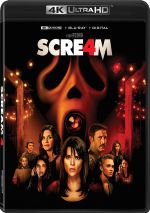
Scream 4 appears in an aspect ratio of approximately 2.35:1 on this 4K UHD Disc. This became a good Dolby Vision image.
Sharpness was largely solid. A few wider shots seemed a little soft but the movie usually demonstrated pretty solid accuracy.
No issues with jagged edges or shimmering occurred, and I saw no edge enhancement. Source flaws weren’t a factor.
Colors went with a heavily golden/amber tone. Within those choices, the hues seemed appropriately rendered and HDR gave the tones added dimensionality.
Blacks became deep, and shadows offered appealing clarity. Whites and contrast enjoyed a boost from HDR. This felt like a “B+“ presentation to me.
Downconverted to Dolby TrueHD 7.1, I thought that the Dolby Atmos soundtrack of Scream 4 seemed fine. Given that we didn’t find a lot of action here, the mix tended to keep things spooky and atmospheric.
It threw out the occasional jolt but mostly stayed with environmental material. The louder scenes offered nice involvement, while the quieter ones placed us in the action in an effective manner.
Audio quality appeared good. Speech was natural and distinct, with no issues related to edginess or intelligibility.
Effects sounded clean and accurate, with good fidelity and no signs of distortion. Music was perfectly fine, as the score showed positive dimensionality. This track was good enough for a “B“ and matched the movie’s mood.
How did the 4K UHD compare to the original BD from 2011? It brought Atmos audio that expanded auditory horizons somewhat, though the “scary movie” nature of the mix left growth limited.
As for image, the Dolby Vision UHD looked better defined and brought stronger colors and blacks. It became a good upgrade over the old BD.
This set mixes extras from the prior disc and additional ones, and we open with an audio commentary from director Wes Craven and actors Emma Roberts, Hayden Panettiere, and Neve Campbell. Craven, Roberts and Panettiere sit together for a running, screen-specific chat while Campbell shows up for a “special guest appearance”.
Via the phone, Campbell pops up fairly early in the film and remains until roughly its mid-point. Panettiere leaves not much later, so a substantial portion of the conversation features only Craven and Roberts.
The commentary covers some story and character topics, deleted/changed scenes, cast and performances, sets and locations, cinematography and various effects. Don’t expect a wealth of good information here, though, as the chat tends to feel fairly insubstantial.
The actors often talk about how much they like this or that, and we just don’t learn a whole lot. The piece moves along well enough to keep us with it, but it’s never better than mediocre.
18 Deleted Scenes run a total of 26 minutes, two seconds. The majority of these offer fairly quick expository bits, so they flesh out some character and story elements in a minor way. None of them prove to be especially interesting.
An “Alternate Opening” changes the manner in which the Woodsboro girls die at the film’s start. It doesn’t affect the plot – they’re just as dead in the final cut – but it does deliver something a little different.
As for the “Extended Ending”, it takes the theatrical version’s finale and adds some character moments as a coda. It’s not effective.
We can view the deleted scenes with or without commentary from Craven. He gives us some notes about the sequences and occasionally – but not always – tells us why he cut them.
Craven wasn’t an especially engaging presence during the main commentary, and he’s still pretty low-key here. He throws out a few decent details but doesn’t add a lot.
A Gag Reel goes for nine minutes, 21 seconds. Much of the reel shows the standard goofs and giggles, though we get more practical joke-style scares as well, where usually someone will jump from behind a door or the like. A few funny moments emerge – mostly via improv from Anthony Anderson – but don’t expect a lot of hilarity.
After this we get the 10-minute, 30-second The Making of Scream 4. It features notes from Craven, Campbell, Roberts, Panettiere, and actors Anthony Anderson, Adam Brody, Courteney Cox, Alison Brie, and David Arquette.
The show offers quick thoughts about story and characters, cast and performances, Craven’s work and the continuation of the series. This is a basic promotional piece, so there’s not much of interest on display.
Archival material appears in a few domains, as we find EPK B-Roll (17:23), EPK Soundbites (32:55) and Junket Interviews (18:44). In terms of participants, "Soundbites" features Cox, Arquette, Campbell, Panettiere, Roberts, Brody, Anderson, and Craven, while "Junket" involves Cox, Arquette, Campbell, Roberts, Panettiere, Brody, Anderson, Brie, and actor Brittany Robertson.
"B-Roll" gives us basic footage from the set. I always enjoy this kind of material and we get a good compilation.
Alas, "Soundbites" offers the usual superficial fluff standard for EPKs as they offer basics about the shoot. Nothing of real note emerges, though the manner in which Anderson and Brody interact provides amusement.
"Junket" fails to fare any better. I'm glad the disc included these elements but "Soundbites" and "Junket" are basic puffery.
The set ends with two trailers and one TV spot.
A second disc provides a Blu-ray copy of the film. It includes the same extras as the 4K UHD.
For reasons probably due more to flagging careers than to creative inspiration, a successful horror franchise came back to life with Scream 4. The film didn’t do much at the box office and it lacked the zing and power to inspire “cult classic” affection. The 4K UHD delivers good picture and audio along with a reasonable collection of bonus materials. Scream 4 failed to reinvigorate the series.