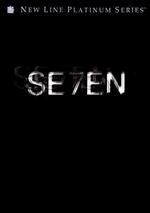
Se7en appears in an aspect ratio of approximately 2.40:1 on this single-sided, double-layered DVD; the image has been enhanced for 16X9 televisions. While usually very satisfying, the transfer occasionally faltered.
My main complaint came from the presence of edge enhancement. I noticed those haloes on more than a few instances, and they robbed the movie of some fine detail. Most of the time I thought sharpness looked quite good, but the film lacked the consistent definition I expected.
No moiré effects showed up, and only some minor instances of jagged edges crept into the image. As for source flaws, the film could be a little grainy at times; though I expect that usually came from the original photography, I also suspect that some digital artifacts added to this impression. Otherwise, a handful of small specks materialized but 99 percent of the movie looked clean.
Se7en used an extremely limited palette; for all intents and purposes, it was a monochromatic movie because the colors were so muted and they were used so infrequently. What hues I saw looked clear and accurate without any signs of bleeding or noise. Due to the color scheme and the overall dim lighting of the movie, it’s important that Se7en feature strong black levels, and the DVD didn’t disappoint. Dark tones looked deep and rich, and contrast was solid.
Shadow detail seemed clear and defined; low-light situations came across as appropriately heavy but without excessive thickness. Se7en usually presented a nice image, though it fell short of greatness. I felt enough of it looked positive for a “B”, but the artifacts and edge haloes nearly led to a “B-“.
I felt pleased with the soundtracks of Se7en. The DVD featured both a DTS ES 6.1 mix and a Dolby Digital EX 5.1 version. Though both were strong, I preferred the DTS track. My comments will initially discuss the DTS edition; a final paragraph will relate the ways in which the Dolby Digital mix differed.
The DTS version provided a solid soundfield throughout the film. The forward environment appeared quite broad and engaging. Discrete audio filled the front three speakers with a good deal of appropriate activity, all of which brought the movie to life effectively. The surrounds kicked in strong support information which bolstered the overall impression and made the audio nicely involving and realistic. Se7en lacked any truly “showy” moments, but the overall ambiance seemed excellent and the ultimate result is a soundfield that appeared nicely defined.
Audio quality also was quite good. At times dialogue appeared slightly sharp and tinny, but for the most part speech was crisp and natural with no signs of edginess or problems related to intelligibility. Music seemed bright and clear and displayed strong dynamics; Howard Shore’s score came across as smooth and accurate, and the songs from Nine Inch Nails and Bowie that opened and closed the film respectively were nicely defined.
Effects sounded clean and packed a solid punch when necessary; the louder segments of Se7en were strong and powerful without any signs of distortion. All in all, the DTS track provided a well-rounded sonic image that provided an involving and impressive experience.
For the most part, I felt that the Dolby Digital mix seemed fairly similar to the DTS track, but some differences existed. The soundfield appeared less clearly defined and lacked the same immersive impression of the DTS version. The DD edition also came across as a bit thinner and without the same punch; the mix displayed decent bass but didn’t match the depth and dynamics of the DTS track. On its own, the DD version worked well, but in direct comparison with the DTS edition it came up a little short.
This “Platinum Edition” DVD release of Se7en replaces an old “movie-only” version and improves on it in virtually every way. Not only does it place the film itself all on one side of a disc - the old one was a “flipper” that spread the movie to two sides - but also it adds a wealth of supplements as well.
Most of these appear on the second DVD, but we start with a whopping four audio commentaries on the first disc. Each examines a different aspect of the film and is titled as such. The first one is called The Stars and features director David Fincher and performers Brad Pitt and Morgan Freeman. Fincher and Pitt were recorded together while Freeman was taped separately; the results combine the two sessions into one neatly edited piece.
The three provide a lively and engaging program that covers a wide variety of topics about Se7en. Both Pitt and Fincher are veterans of many commentaries and they consistently display bright and lively chemistry. These two offer a lot of great anecdotes and information about the creation of the movie, and they don’t shy away from criticizing aspects of the work; this clearly isn’t one of those “happy talk” commentaries that simply gushes about how great everything was.
Freeman’s statements tend to be less Se7en-specific but are no less interesting or involving than those from Pitt and Fincher. While Freeman touches upon a fair number of issues related to Se7en, his comments are more strongly dedicated to his thoughts about acting and films in general. It’s fascinating to hear such a talented performer discuss his craft, and we learn some wonderful insights. Ultimately, “The Stars” is a fine commentary that entertained and informed me consistently.
Although “The Stars” is probably the best of the four commentaries, the second one - The Story - is nearly as good. This track again involves Fincher as well as writer Andrew Kevin Walker, editor Richard Francis-Bruce, New Line President of Production Michael De Luca, and film professor/author Richard Dyer, who also acts as host. Some of this piece discusses the formal logic of storytelling in films. Dyer does a nice job of dissecting the components of the tale and the way it’s told.
The other participants stick more strongly to experiential details and let us know a lot about the creation and construction of the film. Walker is most informative here, especially when he talks about what led him to write the story and other factors that influenced it.
Called The Picture, the third commentary provides a more technical view of Se7en. Prior participants Fincher, Dyer and Francis-Bruce again appear here, along with director of photography Darius Khondji and production designer Arthur Max. I found this to be the driest of the four commentaries as it’s definitely the most technically-oriented.
I enjoyed the segments that discussed the “whys” of the film design but got a little more bored when confronted with the “hows”; Khondji especially tends to rattle off some minutiae that occasionally got a little old. However, the overall piece was quite solid, and I found it compelling to learn about the desires of those who made the movie.
Lastly, The Sound examines the aural aspects of making the film. We again hear from Fincher and Dyer in addition to new participants composer Howard Shore and sound designer Ren Klyce. Shore and Klyce dominate the proceedings, and their remarks are informative and entertaining.
As with the prior track, this one largely concerns a lot of technical dimension, but it sheds a lot of light on the processes used by both sound designers and composers. Klyce and Shore delve into their work with zeal and tell us a great deal of information about what they attempt to do with their work.
This track also incorporates a semi-isolated score. Presented in Dolby Digital 5.1 audio, we hear most of Shore’s music mingled with effects. Some of the score is covered by commentary, but not too much of it. The combination of film discussion and music makes this final commentary track a nice conclusion to this portion of the DVD.
Although the commentaries comprise the majority of disc one’s supplements, we also get some DVD-ROM materials. In the “Script to Screen” section we get the complete screenplay of Se7en. It can be viewed alongside the completed film and you can also print it out if you desire. Since I’m so nuts about Se7en, I’m delighted to have this addition. I find it fascinating to be able to completely compare the final product to the script; many of the supplements discuss the ways in which the movie altered the original design, but the script makes these even more obvious, especially due to the many changes that occurred. I was surprised to see how many differences took place and found this examination of them to be compelling. The dialogue and pacing are really quite different, and it’s a lot of fun to decide for myself which choices I preferred.
In Exploration of the Opening Title Sequence we find a myriad of ways to examine the movie’s seminal credits program. Through use of your player’s “angle” button you can switch between these views: “Early Storyboards”, “Rough Version”, and “Final Version”.
We find an even higher number of audio options. We get six different mixes: Dolby Surround, Dolby Digital EX 5.1, DTS ES 6.1, 24 bit/96 khz stereo, plus two different audio commentaries. The first of those comes from credits designer Michael Cooper and discusses what he tried to convey through the sequence, while the second involves audio engineers Brant Biles and Robert Margouleff and covers some issues related to sound mastering for different environments. It’s a great and detailed look at this side of the filmmaking process. Each pass through this feature lasts two minutes and 50 seconds; how long it’ll take you to get through it depends on how many different ways you want to see/hear it.
In Additional Footage, we see eight different unused segments. Actually, six of these appear in the completed film but are somewhat shorter than the pieces here. Only one - the intended opening - has no relative in the finished movie. These snippets last between 22 seconds and seven minutes, 37 seconds for a total of 17 minutes and 42 seconds. All of them can be viewed with or without commentary from director David Fincher.
As a die-hard fan of Se7en, I was excited to see these extra bits, but I can’t claim that they add much to the scenes. Really, the film communicates everything it needs in the existing material; some of these snippets are interesting from an enhancement point of view, but we never gain any extra depth or insight through them. Nonetheless, they’re fun to watch. Fincher’s remarks nicely explain the reasons for the cuts, and he expands on other aspects of the film as well.
Also found in this area are the Animated Storyboards for the Original Opening Sequence. This shows some material that wasn’t filmed but should have appeared. Again, it’s nothing revelatory, but it’s interesting to see. Fincher discusses the material as well in this 90-second piece.
The Alternate Endings area shows two potential conclusions for the film. The first of these was actually filmed and lasts five minutes and 27 seconds. It doesn’t much differ from the featured ending; some alternate takes appear but for the most part it follows the same framework. The other alternate ending presents a more radical alteration but it was never filmed; instead, we find animated storyboards for the sequence. Some people may actually prefer it.
During Production Designs, we see eight minutes and 55 seconds of artwork created to influence the look of Se7en. Narration by production designer Arthur Max comes along with the images. He discusses what he wanted to do with the various looks of the sets and provides some nice explanation of his work. I liked this feature and found it especially interesting to see how closely some of the drawings were replicated in the final film.
Still Photographs offers five subsections. “John Doe’s Photographs” progresses as a running video piece. It shows a variety of images that were supposed to have been taken by the film’s villain. We hear from Melodie McDaniel - the actual photographer - who gives us some solid information about the techniques she used for these provocative pictures; however, some of the program passes without remarks from McDaniel, so don’t expect wall-to-wall commentary during this 14-minute and 25-second piece.
“Victor’s Decomposition” is a two minute and 28 second program that shows the progression of photos used in that segment. As with some other segments of the supplements, these pictures fly by exceedingly quickly in the film, so it’s fascinating - though disturbing - to get a closer view of them. The same holds true for the “Police Crime Scene Photographs”. Accompanied by commentary from unit photographer Peter Sorel that neatly explains his methods, we see details of the villain’s apartment and the murder sets. The five-minute and 37-second piece provides an interesting look at details that otherwise likely go unnoticed.
We hear more from Sorel during the “Production Photographs” segment. In this area we get a nice selection of shots from the set. The first eight and a half minutes of these come from the shoot itself in that they depict scenes from the film. The final two minutes and 15 seconds of pictures are more candid “behind the scenes” snaps plus some fun posed photos. Sorel provides some solid information in this area. For example, I never knew that the pictures of movie scenes aren’t taken during the actual shoot; they apparently come from rehearsals or recreations.
In "The Notebooks", we can take a much closer look at some of the writings that were supposed to have been done by the movie's antagonist. Accompanied by remarks from designers Clive Pearcy and John Sable, this eight-minute and 17-second program allows us to more precisely examine the details of these texts. It's another great peek into the exhaustive work done for the movie. The commentary relates some of the issues involved in the creation of the notebooks and is an illuminating listen.
Promotional Materials includes the movie’s original theatrical trailer plus its “Theatrical EPK”. That stands for “electronic press kit”, but it also might as well mean “featurette”, for that’s ultimately what it is. However, while the six-minute and 22-second program lacks depth, it nonetheless provides a mildly entertaining look at the film. We get a mix of movie snippets, interview sound bites from Freeman, Pitt, Paltrow and producer Arnold Kopelson, plus a few nice shots from the set. It’s promotional fluff but it deserves a look.
Interestingly, the EPK shows how strongly those involved attempted to hide the identity of the actor who portrays the film’s antagonist. We hear a couple of his lines during the EPK, but someone else dubbed all of them. I thought this was a nice touch since it helped obscure the surprise
Filmographies presents movie listings for cast and crew. We get entries for performers Freeman, Pitt, Paltrow, John C. McGinley and another actor who’ll remain nameless for those who haven’t seen the film; this person isn’t identified in the credits for a good reason, so I don’t want to alter that here. On the “crew” side are Fincher, director of photography Darius Khondji, writer Andrew Kevin Walker, editor Richard Francis-Bruce, production designer Arthur Max, producer Arnold Kopelson, sound designer Ren Klyce, composer Howard Shore, and still photographer Peter Sorel. This section does restrict itself to simple filmographies; you’ll find no biographical data here.
Mastering for the Home Theater details the methods used to optimize Se7en for home theater geeks like me. “Audio Mastering” shows some segments of the film and features commentary from audio engineers Brant Biles and Robert Margouleff. “Video Mastering” provides a similar view of that side of the equation via remarks from colorist Stephen Nakamura and New Line Vice President of Video Post Production Evan Edelist. “Color Correction” features commentary from Nakamura alone as he demonstrates all of the ways that the image can be manipulated to reach the desired effects. All of these are technical but nicely informative. They can be viewed separately or as one running program that lasts 22 minutes and 55 seconds. For a solid view about how studios get movies onto those wonderful shiny discs, this area deserves a look.
To show how this DVD differs from the original 1997 release, the Telecine Gallery displays three different scenes and lets you flip between the audio and video results. The “angle” button lets you skip easily from the old picture and the new one, and you can also easily go from the original Dolby Digital 5.1 mix and the newly-remastered DD EX track. Each scene lasts between 51 seconds and 143 seconds for a total of four minutes and 13 seconds. It’s a cool way to see just how strongly improved this new DVD really is.
Se7en also contains some DVD-ROM materials on the second disc. “My World” offers a closer examination of the film’s villain. Within this area you can inspect a variety of different topics. “7 Sins” gives us a look at some of the materials in this character’s self-created notebooks. Frankly, it’s disappointing. I thought this section might offer a history of the “seven deadly sins” or some sort of similar perspective, but even the view of the notebooks seems a little dry and uninteresting.
“Reading List” provides nothing more than a bibliography for those who want to check out the influences on the antagonist and the story; examples included are “Paradise Lost” and “The Complete Jack the Ripper”. “My Fans” offers Internet links to sites devoted to Se7en, especially those dedicated to the film’s villain.
Lastly, “Photo Gallery” features 12 snapshots purportedly taken by the antagonist. There’s nothing terribly interesting here, especially since the “Still Photographs” section earlier on this disc covered the material more evocatively. Ultimately these materials added a little to the package but were generally pretty dull.
As I noted earlier, this new release of Se7en marks the film’s first DVD special edition but it’s not the first such home video issue of the movie. In 1996, Criterion produced a fine laserdisc boxed set that featured some fine extras. Many of these appear on the DVD as well, but not all of them made the cut.
Most notable is the audio commentary found on the LD. Because Criterion rarely license their work, the splendid track from the Se7en LD fails to appear on this DVD. While this disc’s commentaries are also fantastic, I still wish the Criterion track could have been utilized; it presented some information that isn’t replicated on the DVD and was very informative.
Another sad omission from the Criterion LD is more of a surprise. I didn’t expect the Criterion commentary since I knew they rarely licensed their work, but I don’t know why some terrific outtakes couldn’t have been used. The LD had a few different takes of Freeman and Pitt in the morgue, and it also provided an amazing shot of Paltrow at the coffeeshop with Freeman. The latter was especially terrific; it focused the entire scene on Paltrow and really demonstrated the depth of her performance. It’s a genuine shame that this material doesn’t appear on the DVD.
A few other pieces don’t translate from the Criterion LD. There’s a lot of interview footage with make-up and effects artist Rob Bottin that only exists on that set. The absence of Bottin seems odd; perhaps NAFTA now limits the number of “y’knows” allowable on a DVD and Fincher’s comments already met that quota. Since Criterion themselves likely created the Bottin materials, I wasn’t too surprised that they aren’t here, but more strange is another omission. The LD featured a series of TV spots, but none of those are on the DVD.
Ultimately, because this DVD doesn’t include all of the materials that appeared on the Criterion LD but weren’t proprietary, I can’t call the new set “definitive”, but it’s definitely an enormously solid package that’s a treat for Se7en fans like myself. After 15 years, the film remains stunning. It’s a brilliant piece of work that manages to hold up extremely well to repeated viewings.
The DVD presents a generally positive visual image and excellent sound plus a complement of superb supplements. All in all, the SE DVD of Se7en is a fantastic package that falls into the “must-have” category. This DVD belongs in all movie collections.
To rate this film visit the Blu-Ray review of SE7EN