Reviewed by Colin Jacobson (February 23, 2026)
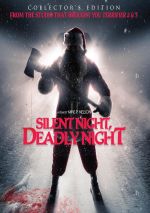
While it exists as a small subgenre, we do get a fairly steady parade of horror-based Christmas films. For another of these, we go to 2025's Silent Night, Deadly Night.
As an eight-year-old, Billy Chapman (Logan Sawyer) saw a man dressed as Santa Claus brutally slaughter his parents. Unsurprisingly, this messes up the youngster for the long-term.
As an adult, Billy (Rohan Campbell) leads a nomadic life and deals with a voice in his head that tells him to kill. When Christmas approaches, he dons a Santa costume and starts his own campaign of bloody violence.
Unmentioned in my introduction: this 2025 film offers the third rendition of this story. 1984's Silent Night, Deadly Night came first and prompted four sequels that appeared between 1987 and 1991.
A first remake of the 1984 movie arrived in 2012, though it came with the shorter title Silent Night. One shouldn't confuse that with 2021's Silent Night or 2023's Silent Night, two other unrelated films that also provided dark stories set at Christmas.
If I ever saw the 1984 Deadly, I forgot about it years ago. At least that means I can assess the 2025 remake on its own merits.
Does it stand out as a quality addition to the genre? Not really, as the 2025 Deadly provides a spotty and less than effective affair.
When we last saw writer/director Mike P. Nelson, he led the 2021 reboot of 2003’s Wrong Turn. Nelson’s Turn seemed too long and essentially devoid of tension or terror.
Perhaps that’s why Nelson’s Deadly goes heavy on overwrought atmosphere. Like too many horror flicks, Deadly tries too hard to seem creepy and gross right out of the box.
This leaves us with tiresome genre tropes and overly insistent music. Deadly wants so desperately to abuse the viewer from the get-go that it lacks anywhere to go.
Perhaps to compensate, Nelson makes his Deadly something of a stylistic mess. Rather than deliver the expected basic slasher flick, the 2025 version bobs and weaves through a mix of other domains.
At times, Deadly embraces black comedy. It also briefly turns into a warped “unstoppable badass” tale for one scene mid-film.
That last segment feels like it comes out of nowhere, as nothing about the prior 45 minutes hints that Billy functions as the John Wick of the serial killer set.
The rest of the flick flirts with other genres as well, especially toward the end when it decides to lean toward Black Phone territory. None of this makes a lick of sense and it means Deadly feels like an awkward melange.
We even get a supernatural bent that implies Billy may exist as something more than the basic troubled young man we expect. In theory this seems like an appealing choice but it can feel too clever-clever for its own good.
I do appreciate that Nelson’s Deadly tries to give the source a twist. However, the end product feels so disjointed that it never connects.