Reviewed by Colin Jacobson (April 19, 2026)
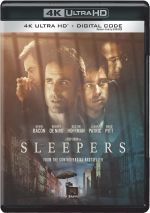
With noted director Barry Levinson behind the camera and a super-famous cast in front, how in the world did 1996’s Sleepers earn a mediocre $53 million in the US and only earn one Oscar nomination – for Best Score, to boot?
Good question. While I can understand why a story about vengeance and abused kids might not have lit up the box office, it seemed primed for award glory that never came.
Well, Sleepers wouldn’t be the first high-profile movie to receive little Oscar love, and it won’t be the last. I know the film didn’t leave much of an impression on me 30 years ago, but I was curious to give it another look.
Set in New York’s Hell’s Kitchen in the late 1960s, four adolescent pals stage a prank that goes tragically wrong. The kids end up in the juvenile justice system and they land in the Wilkinson Home for Boys for six to 18 months apiece, where they find themselves subject to abuse, much of it at the hands of sadistic guard Sean Nokes (Kevin Bacon).
In 1981, the now-adult boys continue to struggle with the legacy of their youthful indiscretion. As they attempt to cope with these issues, they decide to get revenge on Nokes, a decision that leads to new consequences.
If you read my reviews of other Levinson movies, you’ll know I’m not much of a fan of the man’s work. By no means do I think he’s a bad filmmaker, as I’ve liked some of his films, with Bugsy and The Natural as standouts.
Unfortunately, Levinson’s filmography comes burdened with mawkish, heavy-handed duds like Rain Man, Avalon, Toys and Man of the Year. Levinson’s weak films outnumber the good ones and leave me with little optimism when I watch any of his works.
Where does Sleepers fall in the Levinson continuum? Not at the top, but far from the bottom.
At the very least, Levinson – perhaps energized by his work on the then-recent series Homicide - usually reins in his sentimental tendencies. Though you’ll find grittier, more brutal films than Sleepers, Levinson does manage to give it a harshness that suits the tale.
This isn’t a happy, cheerful story, so it needs a certain ugliness. Levinson manages to leave enough rough edges to give it power.
To a large degree, Sleepers feels like “Levinson does Scorsese”. The movie bears a lot of Scorsese’s stylistic touches, though it lacks the impressive flourishes you’d find in something like GoodFellas. Still, it has the same kind of feel you’d get from Scorsese.
Or Scorsese Lite, in this case. While Sleepers has a Scorsese feel, it lacks the impact one would expect from that director’s work.
To be sure, it tells an interesting tale. It also tells it in a reasonably interesting and compelling way, but it never delivers much depth.
This becomes more apparent during the film’s second half, as we spend time with the adult versions of the characters. Sleepers works fine when we’re back in the 1960s, as it develops the kids in a decent manner and shows us their ordeal in an appropriate fashion.
The film doesn’t give us explicit content but it makes it clear how much pain the kids suffered. I think the first half of the flick could’ve been edited a bit – some of the Wilkinson scenes get redundant – but it still does well for itself.
And the “adult half” is also pretty good, but the film shies away from the deeper issues involved. To a degree, it almost feels like a caper flick.
Now an attorney, Michael (Brad Pitt) concocts a plan to set his friends free and punish those who abused them as kids – that’s about it. Sure, the film hints at the tougher topics but it doesn’t dig into them in a satisfying manner.
That’s also true for the movie’s deeper philosophical subjects. As adults, John (Ron Eldard) and Tommy (Billy Crudup) are clearly pretty unsavory characters.
We can argue that Nokes deserved punishment, and we can argue that they were the products of their experiences at Wilkinson. One can certainly make a case for the former, but the latter comes on shakier ground, especially since Shakes (Jason Patric) and Michael went in the opposite direction.
Nonetheless, those issues can be debated – but they’re not. The film simply assumes that all the guards get exactly what they deserve, and it does little to examine John and Tommy as people. It leaves these issues largely unaddressed and avoids bigger implications.
In particular, Sleepers skirts the major theme of global right and wrong. Michael and company operate from rather dicey moral grounds.
It goes down the “do two wrongs make a right?” category, as Michael and the others openly subvert justice to correct the sins that occurred during their youth. They recruit many others to lie and perform other crimes solely to keep John and Tommy out of jail for this crime.
Clearly there’s a bigger issue here, but the film avoids it. Are we supposed to feel happy if John and Tommy avoid jail?
Even if Nokes “deserved it”, the film tells us John and Tommy killed many others and are clearly stone cold criminals. Is it justice that they don’t pay for any of these deeds?
And what good does their freedom do for the cause? We’re led to understand that Michael will throw the trial to right bigger wrongs and get back at all the Wilkinson guards who abused them.
However, the trial has little to do with that agenda. If Michael simply wants justice to be done against those who hurt him and the others as kids, why do Tommy and John need to go free?
They don’t, and that’s a big problem, one that the movie avoids. It views their freedom as a good thing, and I guess we’re supposed to feel happy if they don’t serve time.
I don’t. While one can argue that had good cause for this specific crime, the movie’s loose sense of ethics doesn’t suit the material and makes us feel like they shouldn’t pay at all, especially given all those other misdeeds they’ve done.
Sleepers does present an interesting flick, so don’t take my criticisms to indicate that I don’t find value in it. The story is intriguing and told in a positive manner.
I simply think it ends up lacking due to its simplicity. Without more examination of the extremely loose ethics/morals on display, it’s a one-dimensional experience.