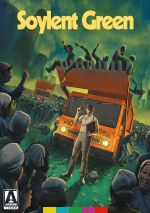
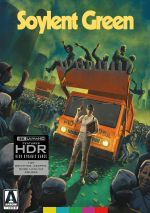
Soylent Green appears in an aspect ratio of approximately 2.40:1 on this Blu-ray Disc. Green offered an appealing presentation.
For the most part, I felt sharpness seemed positive. A little softness crept in at times, but the majority of the film appeared pretty accurate and well-defined.
The movie lacked issues with jaggies or moiré effects, and I saw no edge haloes. Grain looked natural and I witnessed no print flaws.
With a moderately stylized palette, the film’s colors appeared well-rendered. Actually, much of the flick stayed with natural hues, though some green or orange overlays popped up at times. The disc reproduced the tones as intended.
Black levels appeared dense and tight, and low-light shots came across with positive clarity. The occasional softness left this as a “B” but the image nonetheless held up pretty well over the last 53 years.
The LPCM monaural soundtrack of Soylent Green seemed fairly average for its age. Speech lacked much depth or vivacity, but the lines remained easily intelligible and free from edginess. Some awkward looping occasionally marred the presentation, though.
Effects failed to deliver much life, but they also didn’t seem problematic in many ways. The elements were clean and acceptably accurate, and they showed only mild issues related to distortion. The riot sequence came across as a bit rough, but it didn’t become terribly shrill.
Music appeared somewhat infrequently and seemed average when we did hear it. The score and source music sounded decently distinct but they lacked much range and favored the treble side of the equation.
Not much about the audio for Soylent Green presented problems. Not much about it stood out as memorable either.
How did this 2026 Arrow Blu-Ray compare with the 2011 Blu-ray? Both appeared to offer virtually identical audio.
Visuals offered obvious improvements, as the Arrow Blu-ray looked better defined, cleaner and more natural. Even with some mild issues, the 2026 BD became a clear step up in picture quality.
The Arrow BD includes old and new extras, and these begin with two separate audio commentaries. Also found on the prior release, the first features director Richard Fleischer and actor Leigh Taylor-Young as the pair sit together for this running, screen-specific track.
An erratic piece, it offers some good information. However, it doesn’t ever become anything special.
On the positive side, more than a few nice notes about the flick appear. For example, we get information about changes between the original book and the film, Heston’s behavior on the set, and working with Edward G. Robinson at the end of his career.
That last topic generates some touching anecdotes and remarks. Unfortunately, the pair go silent much of the time, and the commentary drags periodically. Though not a great chat, the track presents enough good material to merit a listen.
New to the Arrow set, we find a second commentary from film historians Michael Brooke and Johnny Mains. Both sit together for a running, screen-specific look at the source and its adaptation, environmental views of the era and their impact on the film, cast and crew, themes, story/characters, and some production notes.
Overall this becomes a moderately informative track. While it gives us a reasonable collection of insights, I can’t claim it ever seems better than average.
Next we find some video programs. Created at the time of the film’s original release, A Look At the World of Soylent Green runs 10 minutes, three seconds and quickly covers the flick.
It opens with a look at a few prior cinematic attempts to envision the future. It then gives us some basic details about Green.
This mostly just recaps story points, and it gets some wrong, such as when it refers to the corrupt Thorn character as “scrupulously honest”. However, it merits a look if just for the behind the scenes shots that pop up occasionally.
Another period program, MGM’s Tribute to Edward G. Robinson’s 101st Film lasts four minutes, 51 seconds as it shows a party for the actor. We saw a little of this in the prior featurette as it covers a ceremony that celebrated the actor’s achievement.
Heston reads some affectionate telegrams from notables like Frank Sinatra to Robinson, and then the actor himself delivers a short address. George Burns even shows up along the way.
The piece doesn’t seem terribly interesting. Nonetheless, it’s a nice addition for historical purposes.
Not found on the prior release, we get two archival pieces in the same vein: Charlton Heston at the BFI (1:11:50) and Richard Fleischer at the BFI (1:16:25). Note that the Heston clip only includes audio of the event that runs over the movie but the Fleischer segment involves video as well.
Fleischer talks about working with Orson Welles on Compulsion, why he didn't follow his father Max into animation and his path into movies/early years, the Hollywood Blacklist period, and subsequent films, with a little about Soylent Green toward the end. Fleischer tells a bunch of great stories and makes this a delightful chat.
Heston also digs into a variety of career elements, with his own take on Welles as well as his other films. We get some info about Soylent and a lot more in this likable and engaging discussion.
Along with the movie’s trailer, we find three Image Galleries: “Posters & Artwork”, “Black & White Promo Stills” and “Color Promo Stills”. These offer a decent compilation of elements.
More than 50 years after its original release, Soylent Green remains known more as a punchline than as a movie. The flick itself relies a little too heavily on its famous ending for power and doesn’t seem great on its own, though it has some very good moments. The Blu-ray presents generally positive picture and audio, and it tosses in a nice array of supplements. This delivers a quality Blu-ray for a moderately intriguing movie.