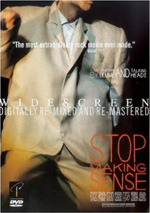
Stop Making Sense appears in an aspect ratio of approximately 1.85:1 on this single-sided, double-layered DVD; the image has been enhanced for 16X9 televisions. Don’t expect visual nirvana from this inconsistent presentation.
The biggest issue stemmed from source flaws. Especially early, I noticed quite a few specks and marks. Occasional instances of blotches, hairs and lines also materialized. The movie looked a bit cleaner as it progressed, but various print defects still came along for the ride the whole way. These meant the movie was dirtier than I’d prefer.
Sharpness was a concern some of the time. Close-ups and relatively near shots seemed acceptably well-defined most of the time, though scenes that focused on David Byrne could be iffy; for reasons unknown, even tight shots of Byrne sometimes looked off. Images that widened the stage tended to appear rather soft and dull; full band shots came across worst of all, but many others that weren't as far away also looked somewhat hazy. It's not as big a distraction as the print flaws, though, and I expect the movie’s always looked this way.
Sense was a largely monochromatic film; although some colored backdrops were used, the majority of it offered variations on white. Most of the performers' clothes also tended to be black, white or gray in nature; even Bernie Worrell’s purple shirt was muted. As such, there weren't a whole lot of colors to evaluate, but what we observed seemed fine. When colored lights or backdrops appeared, they showed no signs of bleeding or noise, and the presentation looked reasonably tight.
Since blacks dominated, I'd like to say that the black levels were outstanding, but while they seemed good, they're no better than that. The dark tones looked nicely deep and were perfectly adequate, but I couldn't help but wish they were just a bit more intense. Shadow detail seemed similarly good but not terrific; I was able to make out everything I needed to see, but the lack of solid intensity in the blacks made them seem a bit mushier than I'd like.
From softness to blacks to shadows, many of the problems I witnessed appeared to result from the limitations of the source; after all, I doubt there was much of a budget for this project, so the film stock didn't seem to be the best. However, that didn’t excuse the source flaws. Overall, the movie remained watchable, and at its best, it could be moderately attractive. It just wasn’t appealing enough for anything above a “C”, unfortunately.
On the other hand, I felt much happier with the film’s Dolby Digital 5.1 audio. The disc featured two separate DD 5.1 tracks: a "Feature Film" production and a "Studio Mix". I flipped between the two and honestly couldn’t specify one that I preferred. The higher quality mix tended to depend on the song in question. Overall, the “SM” usually offered a bit more punch and lower bass, but that wasn’t always the case. For instance, “Making Flippy Floppy” seemed somewhat anemic when I compared it to the “FF” version. On the other hand, “Psycho Killer” showed more body in its “SM” edition.
Although the “SM” was quite good most of the time, I usually favored the “FF” mix. Yes, the “SM” was louder and boasted more prominent bass, but I thought the “FF” version was better balanced. The extreme high and low-end material could dominate the “SM” a little too much, so the more tempered “FF” seemed like a smoother representation of the music. Don’t get me wrong: if the disc only included the “SM”, I’d be happy with it. I just preferred the “FF” mix.
Because I liked it more, I’ll focus my comments on the “Feature Film” audio. The soundfield was nicely localized in the front, with all instruments and vocals spreading effectively across the forward channels. This localization was somewhat inconsistent in that sounds didn't always appear where they should; sometimes a performer will be on the left but the instrument will come from the right. However, this was a minor quibble because it occurred infrequently, and it prevented the mix from becoming a confusing hodge-podge of alternating sounds.
Early on, it looked like the track would try to always present the audio in relation to where it should appear on screen; during the third song - "Thank You For Sending Me An Angel" - the visuals started with a focus on drummer Chris Frantz and rotated around him. While this happened, we heard his drums, Byrne and the other instruments move as well to reflect their placement in relation to Frantz. This was a neat effect but it would have gotten old very quickly; the frequent shifts in perspective would have become annoying. I preferred the occasional misplaced instrument as long as the whole cohered nicely, which it did.
The surrounds provided an engulfing experience that never became too busy. Some specific instrumentation and vocals appeared from the rears, but for the most part they simply provided crowd noise and an ambient reinforcement of the main track. Not much specific action occurred back there, but I was always keenly aware that the surrounds were boosting the music, and they added a nice dimension to the mix.
The quality of the audio seemed positive on a consistent basis. Clarity seemed excellent, and the instruments and vocals always appeared wonderfully natural and vibrant. As I mentioned earlier, bass was a little light on a few songs, but low-end maintained a good presence the vast majority of the time. I felt very pleased with this excellent auditory presentation.
A few extras round out the package. Of most interest is the audio commentary from director Jonathan Demme and band members David Byrne, Tina Weymouth, Chris Frantz and Jerry Harrison. Despite the fervent hopes of fans, the Heads didn't all sit down together and reminisce about the good old days; each member of the band - and Demme as well - was recorded individually and the results were edited together for this piece.
Overall, the commentary provides a pretty nice compendium of information about the songs, the movie and the show. Not surprisingly, Demme and Byrne dominate the proceedings, but not to an extreme; we hear a fair amount from each of the other three as well. The commentary offers a nice overview of the movie, the music and the original concert, and it proves to be a valuable addition.
The disc includes two bonus songs excised from the theatrical version of the film: "Cities" (3:43) and "Big Business/I Zimbra" (7:39). The image is fullframe and is a step down from the quality of the actual flick. I didn't think it looked tremendous worse, but there's clearly a degradation of picture there. It seems blander, muddier and softer, though I still thought it was fully watchable. The music continues to sound great, with some fine 5.1 audio available for these tunes as well. The addition of these songs is a nice treat, especially since they sound so good.
The oddest - but possibly most interesting - supplement is a four-minute, 35-second Self Interview from David Byrne. Through the wonders of video technology, Byrne asks himself a variety of banal questions, to which he provides a number of banal answers (which often consist of "I'll tell you later"). Interviewer Byrne appears in a variety of costumes - including a woman and a black man - and interviewee Dave seems amusingly awkward and nervous. It's odd and it's a trip - I've watched it three times and I still find it bizarrely amusing.
One other unusual extra is a series of storyboards and notes from Byrne. He planned out the show rather carefully, it appears, and used these sketches and jottings to create the concert. We see the storyboard at the top of the frame with corresponding images from the film on the button; a click of a button on your remote replaces the film still with Byrne's notes. It's not an extra that can appear on many concert releases - although many big-budget shows are clearly well-planned and choreographed, they remain in the distinct minority - and it's a very cool thing to see here.
The Big Suit section offers text details on that most famous of Byrne costumes. These fill two screens. It's a good little primer that tells us more about Byrne's thought process. The theatrical trailer is the one that went out for the movie's fifteenth anniversary in 1999. From the looks of it, though, I think it's the same one used for the film's original release, just with a "fifteenth anniversary" notice tacked onto the start.
The Montage section works much like the trailer; it's a conglomeration of different parts of the movie smashed together into this three-minute clip. It's moderately interesting, though not great.
Some additional DVD promos appear in the "Hyperactive" area. This gives us ads for "Dancehall Queen", "Ghost in the Shell" and "Baaba Maal Live at the Royal Festival Hall". Oddly, we also get an anti-drug public service message from Public Enemy's Chuck D. Why is this here? Darned if I know!
Finally, the set’s booklet features some brief notes that document the creation of the disc. For example, we learn what the remixers intended with the two different 5.1 tracks, and we also hear some basics about the recording of the audio commentary.
Under normal circumstances, I wouldn't have been able to mention the DVD's booklet; I initially rented SMS from Netflix, and they don't forward such materials with their discs. However, I so enjoyed SMS that a few days after I watched the rental DVD, I went out and bought a copy of my own.
If that isn't a strong recommendation, I don't know what is. Stop Making Sense provides a very entertaining and well-structured look at a Talking Heads concert, and the film has rightfully earned its status as a classic of the genre. The DVD features a decent though somewhat flawed picture but offers a terrific Dolby Digital sound mix and some good supplements as well. I may never become much of a Talking Heads fan, but I really liked SMS; it would make a terrific addition to anyone's collection.
To rate this film, visit the [Blu-Ray] review of TALKING HEADS: STOP MAKING SENSE