Reviewed by Colin Jacobson (July 2, 2026)
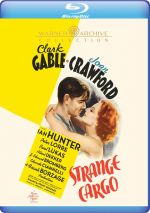
First united in 1931’s Dance, Fools, Dance, Joan Crawford and Clark Gable made eight films together. For the last one of these, we go to 1940’s Strange Cargo.
André (Gable) finds himself stuck in a brutal South American penal colony called Devil’s Island. When he gets released from solitary confinement, he sees café employee Julie (Joan Crawford) and becomes attracted to her.
Along with other prisoners, André eventually escapes from Devil’s Island, and his path toward freedom manages to involve Julie along the way. They encounter various forms of danger and an unusual guide named Cambreau (Ian Hunter) who might not be what he seems.
In addition to the final pairing of its two lead, Cargo reunited Crawford with Frank Borzage, the director of 1938’s The Shining Hour. While I didn’t love that movie, it worked better than I anticipated so this piqued my curiosity to see how Crawford and Borzage would fare this time, especially with Gable in tow.
My verdict? Meh. While Cargo largely keeps us with it, the movie runs too long for its simple story and it doesn’t click on a persistent basis.
Off-screen, Crawford and Gable engaged in romantic entanglements, though Gable was happily married to Carole Lombard when they shot Cargo, a fact that may’ve bothered Crawford. Whatever ups and downs they went through in these interpersonal domains, their on-screen chemistry remained intact here.
When Crawford and Gable interact, they ignite sparks. Their roles don’t require a lot from them but they bring energy to their shared scenes.
I do find it perplexing that the movie depicts Julie as French, and so French that André immediately recognizes her nationality when she speaks. However, Crawford makes zero attempts at a French accent.
Indeed, Crawford sounds more like a New York gangster’s moll than a native of Marseille. I waited for the movie to explain why Julie never vaguely sounded French but that information never came.
Even with this weird anomaly, I liked the Crawford/Gable pairing. However, their chemistry can’t really overcome my feeling that Julie seems essentially superfluous in this story.
Cargo exists as a basic prison escape story, one in which the convicts face extreme odds against survival due to the inhospitable environment they must traverse. The addition of a love interest for one of the prisoners doesn’t make a ton of sense and it fails to become an interesting aspect of the narrative.
Without Julie, Cargo becomes more interesting, and the mysterious Cambreau adds a layer of intrigue. However, too much of Cargo meanders, mainly because it feels like a 90-minute story stretched out to 114 minutes.
At no point does Cargo become a bad film. It just tends to digress too much and take too long to get where it needs to go.