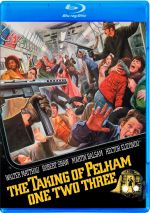
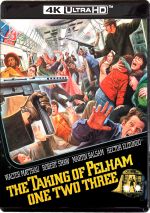
The Taking of Pelham One Two Three appears in an aspect ratio of 2.35:1 on this Blu-ray Disc. The film came with a mostly solid presentation.
Overall sharpness worked fine. Some softness popped up at times but the majority of the movie seemed accurate.
The image lacked jaggies or moiré effects, and edge haloes remained absent. Grain felt natural and the flick lacked print flaws.
As expected for a gritty tale like this, the palette leaned toward a low-key mix of light amber and teal. I couldn’t help but wonder if the colors got a mild “modern-day update” to reflect current preferences but I thought the tones remained restrained enough to seem acceptable.
Blacks looked deep and dense, while low-light shots became smooth and concise. The scan mainly fared well.
In the category of “why bother?”, the movie’s DTS-HD MA 5.1 soundtrack lacked much to make it expand past its monaural origins. Honestly, I felt hard-pressed to locate anything that obviously broadened the soundscape.
Maybe the score spread a bit to the front sides, but if so, these moments remained limited. Effects never demonstrated obvious movement or localization, and I noticed no material from the back channels.
At least audio quality held up fine over the last five-plus decades, as speech seemed concise and without edginess. Music brought fairly appealing range, albeit with limitations typical of movie sound from 1974.
Effects also failed to boast real breadth but they seemed reasonably accurate and without prominent distortion. While the 5.1 remix remained pointless, at least the track sounded fine.
The disc also came with the film’s original DTS-HD MA monaural mix. It boasted sonics similar to what I heard from the 5.1 version.
Given the profound lack of ambition that came with the 5.1 presentation, I couldn’t identify any real reason to opt for the latter. The mono track stayed true to the audio’s origins and became my preference.
As we move to extras, we find two separate audio commentaries, the first of which comes from film historians Steve Mitchell and Nathaniel Thompson. Both sit together for a running, screen-specific look at the source novel’s adaptation and story/characters, cast and performances, sets and locations, details about NYC of the era and the subway, photography, and connected domains.
Though Thompson chimes in on occasion, Mitchell firmly takes the lead here. I won’t complain, as he delivers tons of information about the film.
Mitchell digs into the NYC of the 1970s as well as production elements with gusto, and Thompson tosses out a few nuggets, though this really does remain Mitchell’s baby. The end result proves lively and informative.
For the second commentary, we hear from actor/filmmaker Pat Healy and film programmer/historian Jim Healy. The brothers chat together for their running, screen-specific discussion of the original book and its transition to the screen, story/characters, cast and crew, genre domains, some production notes and their thoughts on the film.
At the start, the Healy brothers describe this as a “fan commentary”. That prompted me to fear it’d offer little more than unrelenting praise.
Happily, the Healy boys make this much more of a traditional film historian chat. Some of this repeats what we got in the prior track, but the Healys add more than enough new material to ensure we get an enjoyable chat here.
A few featurettes follow, and The Making of Pelham One Two Three goes for six minutes, eight seconds. A vintage piece from 1974, it focuses on NYC transit cop Carmine Buresta.
The officer narrates footage from the production and relates his experiences during the shoot. While promotional in nature, this unusual focus makes it worthwhile.
12 Minutes with Mr. Grey fills 12 minutes, two seconds. Actor Hector Elizondo becomes the focus here.
Elizondo discusses how he got his role in Pelham as well as shooting in New York, his character and performance, and other memories of the shoot. The actor offers an enjoyable chat.
Next comes Cutting on Action. This one fills nine minutes, nine seconds and comes with information from editor Gerald B. Greenberg.
As expected, “Action” looks at working with director Joseph Sargent as well as his efforts on the film. Greenberg covers some of the related challenges well.
The Sound of the City lasts nine minutes, seven seconds. Composer David Shire appears here.
Shire talks about his score for Pelham. “Sound” turns into another worthwhile reel.
Via Trailers from Hell, we get a two-minute, 40-second clip with screenwriter Josh Olson. He comments as he watches the trailer for Entity. Olson offers a few minor thoughts, but the segment’s too short to mean much.
The disc gives us trailers for Pelham as well as Charley Varrick, The Laughing Policeman, Force 10 From Navarone, White Lightning, The Train, Breakheart Pass and Runaway Train. We also find a Pelham TV spot and two Radio Spots.
Finally, we find an Image and Poster Gallery with 38 elements that mix ads and shots from the set. It turns into a decent compilation.
A bright thriller, The Taking of Pelham One Two Three holds up after more than 50 years. With a tight plot, a good cast and a tone that reflects the NYC of its era in the best way, it becomes a winner. The Blu-ray comes with pretty good picture as well as decent audio and a selection of supplements. Pelham exists as a gem of its genre.