Reviewed by Colin Jacobson (July 8, 2026)
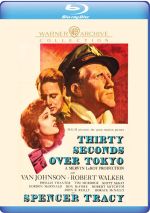
In the aftermath of the December 1941 attacks on Pearl Harbor, Americans eagerly desired some form of revenge on Japan ASAP. This led to an air assault in April 1942 given feature film form via 1944’s Thirty Seconds Over Tokyo.
As the US finds itself embroiled in World War II, Air Force Lieutenant Colonel James Doolittle (Spencer Tracy) gets the assignment to conduct an attack on the enemy. He amasses a team to hit at the heart of Japan.
Headed by Captain Ted Lawson (Van Johnson), the airmen train for the challenges related to a bombing raid on the Japanese mainland. This mission comes with inevitable peril and unforeseen challenges.
Given the year in which it came out, obviously Seconds offered the first cinematic take on what became called the “Doolittle Raids”. To my surprise, however, it appears to be the only movie specifically about these events.
2001’s Pearl Harbor and 2019’s Midway both included quick sequences about the Doolittle Raids. However, they didn’t focus on these actions.
1944’s The Purple Heart looked at the aftermath of the Raids, as it covered Japanese show trials for Americans they captured. The movie depicted the poor manner in which the Japanese treated POWs and apparently provoked opposition from the US government, as authorities worried it would prompt reprisals from the Japanese.
No American military figures seem likely to have objected to Seconds. While not pure wartime propaganda, it definitely attempts bolster spirits as a reminder of US successes.
Which makes sense. Released late in 1944, the film found the US nearly three years into a brutal multiple-front conflict so Americans needed a boost to stay engaged and supportive.
It seemed to succeed. Seconds did well at the box office and garnered praise from critics.
The question now becomes how well Seconds holds up 82 years later. I would say it still brings reasonable entertainment if one can view it through the perspective of the USA circa 1944.
Don’t view that as a sign Seconds only offers appeal as a historical footnote. It still comes as a fairly involving tale even without that side of things.
Still, Seconds does feel like a film that exists mainly to rouse war-weary Americans. It depicts the struggles of US forces and gives the audience heroes to admire.
Given that it adapts a 1943 book from the actual Captain Ted Lawson, it comes as no surprise that this role becomes the focal point of Seconds. Despite his billing and prominence in ads, Tracy plays a fairly small part.
The concentration on Lawson brings the movie’s “human interest” moments via his relationship with new wife Ellen (Phyllis Thaxter). As depicted here, the newlyweds expect a baby, a factor that adds to the personal drama.
As far as I can tell, the movie invented this pregnancy. Honestly, much of Ellen’s involvement feels superfluous without or without a potentially fictitious pregnancy, as her scenes seem like fodder solely to pander to women in the audience.
This leaves Ellen as little more than a chipper cheerleader most of the time. Seconds largely comes across as a “man’s movie”, so Ellen can appear unnecessary.
Otherwise Seconds works better, even if the characters remain pretty thin. Again, because the movie shot/got released during WWII – and the fact many real-life characters remained alive in 1944 – this doesn’t seem like a surprise, but it still means the roles lack much depth.
As mentioned, Ted sticks as our focal point, and that allows him more dimensionality. This becomes especially true thanks to the amount of time the story spends on his status after the titular assault.
Nonetheless, Ted doesn’t become especially well-developed. He exists as a character to remind civilians of heroics.
One aspect of Seconds does surprise me, though: the treatment of Asians, and especially the Japanese. So much WWII-era depicted the Japanese as pure evil and even sub-human.
While the film doesn’t spend time with actual Japanese characters, the other roles discuss them and display some sentiment that they don’t actually hate their opponents. Also, Colonel Doolittle allows airmen to back out of the raid if they feel uncomfortable with the civilian deaths that will inevitably result, a shift from the period’s general “kill ‘em all” sensibility.
Outside of these surprisingly progressive elements, Seconds becomes an enjoyable but thin view of its topics. Though I think it offers an interesting snapshot of its era, it often doesn’t hold up in other ways.