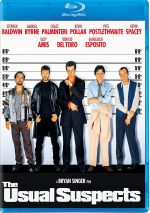
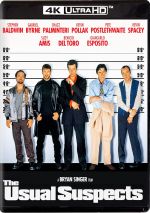
The Usual Suspects appears in an aspect ratio of approximately 2.35:1 on this Blu-ray Disc. The image largely looked very good.
Sharpness seemed strong. A little stylistic softness occurred, but the movie usually boasted solid delineation.
Neither jagged edges nor shimmering materialized, and I saw no edge haloes. Grain seemed appropriate and I witnessed no print flaws.
Suspects went with a clear lean toward amber/orange and teal at times, though not on a consistent basis, as many shots became more natural. Within these choices the colors felt well-rendered.
Black levels came across as deep and rich, while shadow detail looked clean and logically opaque. As a whole, The Usual Suspects provided an appealing visual experience.
As for the DTS-HD MA 5.1 audio, Suspects offered a very chatty film and the soundfield remained oriented toward the forward spectrum. In that realm, music showed very good stereo spread and presence, while effects also demonstrated solid breadth and movement at times.
During a lot of the film, those elements largely remained in the center. At times the mix came more to life and offered clean panning and a nicely blended track.
Surround usage tended to remain within the dimension of general reinforcement. The music worked especially well in that regard, as the rear speakers neatly enhanced the score. Effects also worked nicely in some scenes, especially those that involved gunfire or explosions.
Speech seemed warm and natural through the movie, and I discerned no edginess or problems related to intelligibility. Effects appeared clean and accurate, and they boasted good bass response when appropriate; elements like foghorns or explosions offered solid oomph.
Music worked best of all, as the score seemed clear and bright, and it also featured nice depth and dynamic range. Overall, the mix for The Usual Suspects lacked the sonic ambition to merit an “A”-level grade, but it still earned a solid “B+”.
How did the picture and audio of this Kino Blu-ray compare to those of the 2011 MGM release? Audio felt similar and probably identical?
Visuals offered clear improvements, as the Kino version became better defined and more vivid. However, it also apparently altered the original palette to push toward amber/orange and teal at times.
I didn’t feel wild about these changes but found them sporadic enough to not become a deal-breaker. The Kino disc looked so much better in all other ways that it’s worth the trade-off.
This Kino release mixes old and new extras, and we find two separate audio commentaries, the first of which comes from director Bryan Singer and writer Christopher McQuarrie. Both men were recorded together for this running, screen-specific track.
Apparently these guys have been friends for quite some time, a fact that comes through in the natural and easy manner they have with each other. It's a wonderfully loose and lively track as these guys crack on their film and each other while they provide a great deal of information about the production. This commentary is almost as entertaining as the film itself, which is no mean feat.
By the way, the overlapping comments at the end of the track have confused many people and made them wonder if they got a defective disc. Nope - it’s supposed to be that way. The production echoes the movie’s conclusion. It’s a funny and clever touch that ends this solid piece appropriately.
In addition, we get a new commentary from editor/composer John Ottman, who also provides a running, screen-specific track. Frankly, I expected little from this piece; the Singer/McQuarrie commentary is so good that I thought there wasn’t much left to say unless we heard from the actors.
I was wrong, for Ottman offers a solid track on his own. He’s almost as chatty solo as the other pair were together; Ottman provides a great deal of information during his discussion.
Ottman touches on the challenges inherent in both sides of his particular coin. He tells us more about the editing area, but he includes a wealth of notes about his scoring too.
The track suffers from a few moderate empty spots, but Ottman talks so fast the rest of the time that I can forgive these. It’s another entertaining and winning commentary that definitely merits a listen.
From there we go to featurettes. Although presented separately, the first two actually work as halves of the same documentary. Pursuing the Suspects (24:58) offers Part One, while Doin’ Time with the Suspects (26:47) gives us Part Two.
Across these, we hear from Singer, Ottman, and actors Gabriel Byrne, Chazz Palminteri, Kevin Spacey, Stephen Baldwin, Kevin Pollak, and Benicio del Toro. (McQuarrie briefly appears at the start of “Pursuing” in an archival clip that predates the production, but we get no other info from him.)
Taken separately or together, these are very interesting programs. “Pursuing” focuses on the development of the film, the casting, and the atmosphere on the set, while “Time” concentrates more on various anecdotes from the shoot.
The mood becomes surprisingly frank and blunt. Sure, there’s some of the usual praise, but the participants seemed honest and up front with their thoughts, and a vast number of interesting facts emerge.
The actors’ side of things feels particularly valuable, especially since we already hear from Singer and Ottman elsewhere. They still chime in with some good new material - plus a smidgen of redundant info - but the actors add the lion’s share of the useful details.
The footage from the set is minor, but some of it is quite fun, like outtakes of del Toro mangling his lines. All in all, these programs offer a fine overview of the film and also give us some great insight.
In a similar vein comes Keyser Soze - Lie or Legend? This 18-minute, 37-second program incorporates the same eight interview subjects from the prior programs.
Of course, the focus falls upon the mysterious Mr. Soze, and we learn a lot of little tidbits about that legend. Most of it is good, but the best aspects relate to Spacey’s acting notes.
The producers of the featurettes probably should have simply used this material within the other two programs, as there’s no real reason for it to stand alone. Nonetheless, “Soze” is another entertaining piece.
Much less compelling is the Original Featurette from 1995. This six-minute, 40-second program is nothing more than a glorified trailer.
It includes some sound bites from Singer, Palminteri, Baldwin, Spacey, Byrne, Pollak, del Toro, and an unnamed person I think was a producer. These snippets offer little more than vague character and story notes, while most of the piece just gives us clips from the movie. Skip it.
A little more interesting is Heisting Cannes with the Usual Suspects. This four-minute, 14-second featurette offers a few modern interview bits from Singer, Pollak and Spacey.
However, it mostly consists of fun footage from their trip to the famed film festival. There’s nothing amazing here, but it’s an entertaining piece.
Hosted by John Ottman, we get five Deleted Scenes. Including Ottman’s statements, these fill a total of nine minutes, 24 seconds, five minutes, 16 seconds of which comes from Ottman.
As such, it becomes apparent the scenes themselves are brief, and they don’t offer much to stand out from the crowd. They’re minor and largely forgettable. Still, as a big fan of the film, I’ve very happy to see them, and Ottman’s comments add good information about them.
Next we find a Gag Reel. This seven-minute, 11-second piece starts with a 44-second intro from Bryan Singer. It’s mostly the standard collection of flubbed lines, but some other interesting bits emerge along the way.
We also find two elements included as Easter eggs on the DVD. The more significant comes from a An Interview with John Ottman.
Here we find a 17-minute, 44-second discussion conducted by Film Score Monthly’s Jeff Bond. Ottman talks mainly about his career in general, without too much emphasis on Suspects. It’s an interesting chat that I enjoyed.
Even more fun is the three-minute, one-second compilation of Interview Outtakes from Palminteri, Baldwin, Pollak, del Toro and Singer. I won’t spill the beans about what the various participants say, but it’s amusing stuff.
New to the Kino release, we find The Devil in the Details. Cinematographer Newton Thomas Sigel appears for this 16-minute, 33-second chat.
Unsurprisingly, Sigel discusses his work on the film and other experiences during the shoot as well as his thoughts about how the market for movies changed since 1995. Sigel brings a solid overview.
We get US and international trailers for Suspects, and the former includes an interesting one-minute, 20-second introduction from Ottman. We also find eight TV spots as well as ads for Out of Sight, The Underneath, The Score, The Ice Harvest, Eastern Promises and In Bruges.
More than 30 years after it arrived on movie screens, The Usual Suspects remains a terrific film. Mysteries/thrillers don’t get much better than this, as the flick fires on all cylinders. The Blu-ray comes with some questionable color timing but otherwise looks very good, and it brings solid audio and a lot of supplements. Even with the iffy color choices, this becomes a quality release.