Reviewed by Colin Jacobson (January 7, 2026)
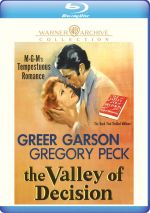
Stories of star-crossed lovers go back centuries, if not millennia. For another in that genre, we head to 1945’s The Valley of Decision.
Set in mid-19th century Pittsburgh, Mary Rafferty (Greer Garson) comes from a family of Irish immigrants. The men work at a steel mill, an occupation that leaves Mary’s father Patrick (Lionel Barrymore) disabled after an accident.
The Scott family owns the facility and Patrick believes poor working conditions caused his condition. This leads to bitterness when Mary goes to work for the Scotts as a maid, and matters grow even more problematic when Mary falls for Paul Scott (Gregory Peck).
As I noted at the start, the basic concept of “lovers from two sides of the tracks” doesn’t exactly seem novel. The question becomes whether or not Valley can do anything interesting with the well-worn premise.
At least to these eyes, the answer comes back a fairly firm no. Despite a talented cast, Valley fails to find much life to bring to its concept.
Part of the issue comes from the sluggish pace of the story. Mary and Paul don’t officially declare affection for each other until about 45 minutes into the movie, and matters don’t really pick up from there.
Valley contrives reasons to keep Mary and Paul apart, and these just feel like pointless padding. I guess they intend to add to the “star-crossed lovers” side of things, but they don’t increase the romantic tension.
Instead, the slow rate at which the situation between Mary and Paul evolves just grows tedious, and that assumes the viewer actually cares. Valley develops the two leads in such a bland way that it becomes tough to invest in the relationship.
Despite the underwritten nature of the role, Peck manages charisma as Paul. Even though Mary dominates the story, Garson fails to do much with Mary.
Saddled with an erratic Irish accent and a tendency to overplay emotions, Garson turns into a moderate issue. It also doesn’t help that her age makes her miscast.
40 during the shoot, Garson was far too old for the part. Logically, Mary should probably be a good 15 years younger.
This issue becomes even more prominent because the movie wants us to buy 40-year-old Garson with 28-year-old Peck. At no point does the film allude to an age difference so I suspect the filmmakers intend for us to believe Mary really is 25 or so.
That becomes the proverbial bridge too far, as Garson couldn’t pass for 30, much less 20-something. Maybe if I liked her performance more I wouldn’t find this to come as such a distraction, but this combination makes her a weak link.
Even with a more logical choice for Mary – such as Jessica Tandy, cast as Paul’s more “socially appropriate” love interest Louise and 25 during the shoot – various other problems would remain. The story just remains inert for too long and when it contrives to indulge in greater drama during the third act, it feels phony and over the top.
Despite the cliché nature of the basic plot, I still think Valley could’ve succeeded with a few changes. As enacted, though, the end product seems slow and dull.