Reviewed by Colin Jacobson (May 6, 2026)
As the Marvel Cinematic Universe (MCU) expanded into its post-Endgame existence, it began to integrate Disney+ TV series into the film tapestry as well. For the first of these shows to blend with the movies, we go to 2021’s WandaVision.
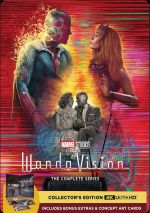
This one takes Wanda “Scarlet Witch” Maximoff and “living android” Vision and presents them as a married couple in confusing circumstances. This 2-disc 4K UHD set includes all nine of the series’ episodes, presented in the order they ran. Plot synopses come from the show’s official website.
Filmed Before a Live Studio Audience: “Wanda (Elizabeth Olsen) and Vision (Paul Bettany) struggle to conceal their powers during dinner with Vision's boss (Fred Melamed) and his wife (Debra Jo Rupp).”
To call WandaVision a high concept series would seem like a severe understatement. The show takes Avengers Scarlet Witch and Vision and plops them in the world of a 1950s sitcom.
“Filmed” plops us in this scenario without explanation. We simply follow the characters as they deal with a typically goofy and cliché TV comedy contrivance and get zero exposition about what the heck is going on here.
Which works for this opening episode. “Filmed” gives us hints that something’s weird and amiss, but most of it plays like a standard 1950s TV show. Expect an intriguing launch to the series.
Don’t Touch That Dial: “In an effort to fit in, Wanda and Vision perform a magic act in their community talent show.”
Rather than remain stuck in one sitcom genre, “Dial” makes it clear that WandaVision will move across its TV inspirations. Whereas “Filmed” came in the I Love Lucy mode, “Dial” leans more toward Bewitched.
All of this occurs while the series tosses out tidbits related to the weird situation into which Wanda and Vision find themselves. That side of things progresses slowly but steadily and helps turn this into another clever show.
Now In Color: “After Wanda's pregnancy takes an unexpected turn, new friend Geraldine (Teyonah Parris) steps in to assist. Meanwhile, Vision gets closer to some of his Westview neighbors.”
Take the episode’s title literally, as the series leaves behind the black and white of the first two programs and embraces a late 1960s/early 1970s Brady Bunch/Partridge Family vibe. Of course, “Color” doesn’t duplicate those shows, but it tips its hat in their stylistic choices.
“Dial” ended with Wanda’s abrupt pregnancy and that becomes the focal point of “Color”. Wanda goes through all three trimesters in exceedingly rapid fashion, a factor that again hints at something being strange in this universe.
Like the prior two episodes, “Color” largely conforms to sitcom conventions. Much of the show revolves around goofiness connected to Wanda’s pregnancy, with only a little exposition related to the leads’ perplexing status.
I assume we’ll get more details in the latter regard soon, and I hope so, as the sitcom theme can only carry us so far. However, that concept continues to work pretty well here, as “Color” parodies the late 60s/early 70s TV tropes nicely. Throw in a teaser at the end that pushes toward future reveals and the episode keeps us in gear.
We Interrupt This Program: “Tasked with a special assignment regarding sentient weapons, Monica Rambeau goes missing.”
We initially met Monica as neighbor “Geraldine”. The reveal of “Geraldine” as Monica goes back to a character introduced as a child in 2019’s Captain Marvel. That film took place in the mid-90s, so her adult status here fits this timeline.
Monica’s presence allows “Interrupt” to finally start to give us some real answers above how Wanda and Vision found themselves stuck in sitcoms. This also means we get a glimpse of “present day” after the Avengers defeated Thanos and the “blip” got reversed.
Given the nature of the first three episodes, a return to more traditional MCU material feels a little like a shock to the system. However, it does come as a relief that we finally move ahead with the overall narrative.
While “Interrupt” leans heavily on exposition, it does so in a smooth and compelling manner. It also leaves open more than enough questions to ensure we remain curious to see where the series progresses from here.
On A Very Special Episode…: “On a very special episode of WandaVision, Wanda and Vision deal with their changing and expanding family — in more ways than one!”
The sitcom side of the series goes into the 1980s, but “present day” infiltrates more than ever. This deepens the plot and brings a dramatic episode that pushes us ahead well.
All-New Halloween Spooktacular!: “Halloween has arrived in Westview! While Wanda takes Billy (Julian Hilliard) and Tommy (Jett Klyne) trick-or-treating, Vision ventures out to the far side of town on a hunch.”
This episode’s style echoes 2000s shows like Malcolm in the Middle, which means the series skipped the 90s – sort of. “Special” took 80s sitcoms as its main inspiration but it demonstrated hints of the 90s as well, so it straddled those two eras.
In any case, “Halloween” nails the tone of the sitcoms being spoofed arguably better than any other episode so far this year. We also get the improbable return of a superhero played by an actor whose prior connection to his character makes this a brilliant move.
While we get plenty of TV comedy elements, these go darker as the season progresses, especially because they alternate with “real world” moments more often as well. “Halloween” deepens the season narrative well.
By the way, we see a movie theater marquee that advertises one film from 1998 and another from 2004. Normally I’d view that as a goof by the series’ producers but I suspect they did so intentionally to depict Wanda’s memories and not objective reality.
Breaking the Fourth Wall: “Wanda decides to take some much needed ‘me time’ while Vision encounters detours along the way back home.”
As time marches on, “Wall” takes obvious inspiration from Modern Family as well as other “docu-sitcoms”. The episode integrates these elements nicely as it also pursues the darker tone seen in the last episode.
With each successive show, Wanda’s mental state becomes more precarious. “Wall” depicts that in a positive manner, and it also delivers a fun revelation related to stereotypical “nosy neighbor” Agatha (Kathryn Hahn).
Footnote: a rare mid-credits bonus scene appears attached to “Wall”.
Previously On: “Wanda embarks on a troubling journey revisiting her past for insight into her present and future.”
The title refers to the fact that the episode essentially offers an “origin story” for Wanda as well as the circumstances of the series. It delves back into her childhood as well as other aspects of her life to give us insights about what brought her to the fantasy depicted in the series.
This means WandaVision finally abandons the sitcom scenarios of the first seven programs, and that makes sense. Those components became less pervasive with each successive show, as “real life” intruded more and more on the series once “Interrupt” gave us info about the truth behind Wanda’s fiction.
All of this leads to a more dramatic episode than usual. We delve into some dark moments and get a narrative push that seems like a good lead-in to the series’ conclusion.
Footnote: another mid-credits scene pops up here.
The Series Finale: “Wanda battles Agatha and Vision fights his SWORD counterpart as Hayward (Josh Stamberg) launches an attack on Westview.”
WandaVision comes to a close with a bang. Most of the series lacked a lot of action, but “Finale” compensates with major battles. These actually feel a little weird after the disposition of the prior eight episodes, but it works fine nonetheless.
Even with those fights, “Finale” creates a bittersweet ending to the show – though Wanda’s tale doesn’t really end here. We got a continuation of the series’ events in 2022’s big-screen affair Doctor Strange in the Multiverse of Madness.
Despite the fact “Finale” doesn’t fully conclude the narrative, it leaves us with a feeling of completion, and a satisfying one at that. WandaVision provides a daring and clever series that succeeds across all nine of its episodes.
Footnote: “Finale” comes with a mid-credits scene that hints at Monica’s future adventures as well as a post-credits tag that pushes toward the events explored in Multiverse of Madness.